What Makes a House Italianate
Identifying Victorian architecture has gotten complicated with all the overlapping styles and regional variations flying around. As someone who spent three years chasing 19th-century homes across the Midwest, I learned everything there is to know about getting this wrong. I’d stand in front of a tall, narrow-windowed structure — brackets under the eaves, elaborate cornice, the whole package — and confidently call it Italianate. Turns out it was Second Empire. Or some bracketed vernacular hybrid nobody bothered to name properly. Today, I will share it all with you.
But what is Italianate architecture? In essence, it’s a 19th-century American style derived from Northern Italy’s rural farmhouses, filtered through Andrew Jackson Downing’s pattern books starting around 1840. But it’s much more than that. Between 1850 and 1885, Italianate became the dominant residential style across the country — urban row houses in Cincinnati, farmsteads in Indiana, merchant mansions in upstate New York. The confusion comes from how much DNA it shares with Second Empire, Bracketed Vernacular, and certain Gothic Revival homes. Learn the three or four actual diagnostic features and most of that confusion evaporates.
The Roofline and Eave Details That Give It Away
Probably should have opened with this section, honestly. The single most reliable Italianate signature is a low-pitched roof with massively overhanging eaves. Not steep. Not a mansard. Low and wide — almost aggressively horizontal compared to what surrounds it.
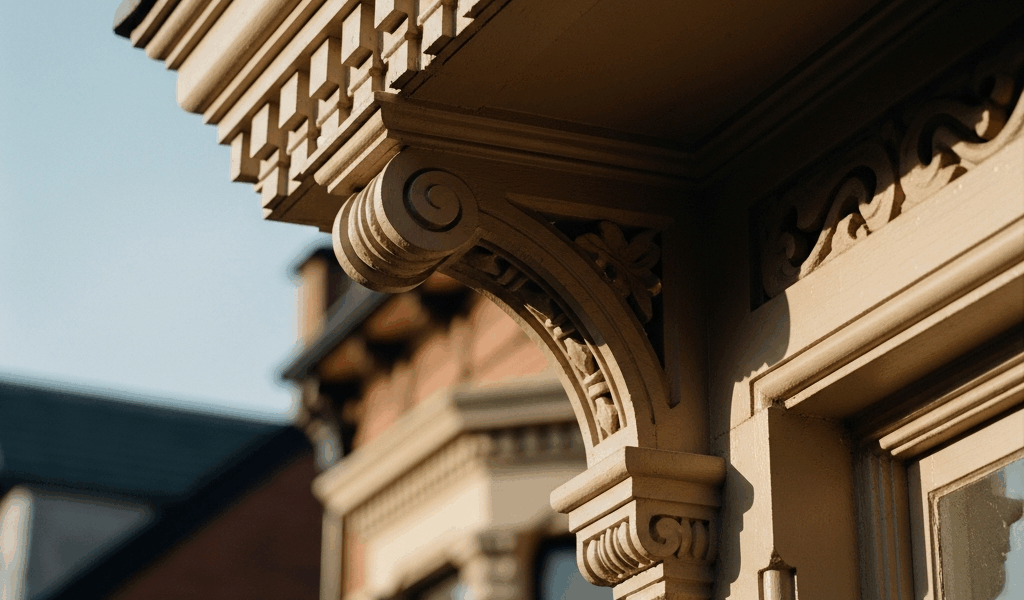
But what supports those eaves? Decorative brackets. That’s the real tell. Paired or grouped wooden brackets — sometimes called corbels — scrolled, elongated, usually painted a contrasting color against the house body. Picture paired brackets that almost look like they’re reaching around the corner of the building. On brick Italianate homes, these might be stone or terra cotta. On clapboard versions, expect dark brown or black brackets against cream or tan siding. The contrast is intentional. It’s theatrical in a way that feels almost excessive until you understand the style is basically the 1860s version of showing off.
Walking past an 1870s brick row house in Cincinnati, I counted seventeen separate bracket groupings on the front facade alone. Each cluster had three or four individual brackets, stacked or paired. The paint had worn down to raw wood in places — which is completely common in older examples and doesn’t disqualify the identification.
Cupolas appear on many Italianate homes. A square tower with small arched windows? Classic Italianate, yes. But cupolas showed up as additions and afterthoughts on plenty of non-Italianate houses too. Use them as supporting evidence, not proof.
Here’s where the Second Empire confusion collapses quickly. Second Empire homes wear mansard roofs — that distinctive double-pitched situation where the lower slope goes almost vertical. Italianate eaves are horizontal and overhanging. One difference, easy to see from the street, eliminates roughly 80 percent of misidentifications. If the lower roof edge looks like it’s trying to become a wall, you’re looking at Second Empire.
Windows Are the Biggest Tell
Tall, narrow windows dominate Italianate facades. Not just tall — dramatically tall, often twice as high as wide. Many feature rounded arches or angular hoods above the opening. This is where hood molding enters the picture. It confused me for years, genuinely, until I finally understood what I was actually looking at.
Hood molding is the decorative cap directly above a window — projects outward from the wall, creates a small overhang, looks like a tiny individual roof sitting over each window. On Italianate homes, these hoods get elaborate fast. Scrollwork. Dentil molding. Contrasting paint. They shed water away from the frame in theory, but mostly they exist to make the facade feel more ornate. Which it does. Walk past a well-preserved 1870s Italianate and the windows almost look like they’re wearing hats.
Don’t confuse these with Gothic Revival pointed arches, which come to a sharp, intentional peak. Italianate arches are rounded or squared off beneath decorative hoods. Gothic Revival reads angular and almost aggressive. Italianate feels softer — more theatrical, less austere. That’s what makes Italianate endearing to us architecture enthusiasts, honestly. It’s trying very hard and not embarrassed about it at all.
Bay windows appear frequently, especially on urban row house versions. Paired windows — two grouped together — signal Italianate. Single windows often sit in deep reveals, recessed several inches back from the wall surface. That depth catches shadow and creates visual drama. This was entirely on purpose.
Exterior Materials and Facade Details
Rural Italianate homes lean heavily on horizontal clapboard siding. Urban versions — particularly across the Northeast and Midwest — favor brick with limestone or sandstone quoins at the corners. Quoins are the decorative corner blocks that frame the building’s edge. On a brick Italianate, these might be rusticated (textured, blocky) or smooth, always more visually substantial than a plain corner.
The decorative cornice running below the roofline is architecture, not decoration for its own sake. In commercial Italianate buildings, cornices are often cast iron or pressed metal. Residential versions use elaborate wooden structures featuring dentil patterns, layered molding, and painted detail. While you won’t need architectural training to spot these, you will need a handful of reference photos the first few times you go looking — at least if you want to distinguish a genuine Italianate cornice from a later Victorian add-on.
Porches vary considerably. Some Italianate homes wear full wraparound porches with substantial bracketed columns — the porch woodwork follows the same design logic as the rest of the house. Others have shallow stoops or recessed entries framed by simplified pilasters. I’m apparently drawn to the porch-heavy versions, and the bracketed wraparound works for me aesthetically while the minimal stoop version never quite feels as satisfying. Don’t make my mistake of treating porch presence as a diagnostic feature. It isn’t.
Commercial Italianate buildings from the 1870s share every diagnostic feature with residential examples — bracketed eaves, hood-molded windows, rusticated brick detailing — just deployed across a three- or four-story commercial block footprint. Walk a small Midwestern river town’s main street and you’ll often see six of these in a row.
How to Confirm You Are Looking at an Italianate Home
So, without further ado, let’s dive in to the actual confirmation process. Low-pitched roof with wide overhanging eaves — check the eaves for paired or grouped brackets. Tall, narrow windows with hood molding above each opening. Vertical emphasis across the whole facade, with rhythmic window placement that feels almost musical in its repetition.
Three of those four features present? Almost certainly Italianate. Mansard-shaped roof instead? Second Empire. Brackets minimal and ornament stripped away while the basic roofline and window proportions remain? That’s probably Bracketed Vernacular — a regional American simplification that keeps the skeleton of Italianate without the decorative intensity. It might be the best option for identification when details are ambiguous, as Italianate requires all its signatures working together. That is because no single feature is exclusive to the style; the combination is what confirms it.
Geography and dates help close the case. Italianate dominates the Midwest, Mid-Atlantic, and New England from roughly 1850 to 1885. River towns and early railroad communities have particularly high concentrations — these were prosperous places during exactly the right decades. A home built in 1875 in Ohio, Indiana, or upstate New York showing these features? Italianate is almost certainly correct.
The honest part: some houses tick most of these boxes and still feel ambiguous. Historic styles blur at the edges. Regional builders improvised. But the bracketed eaves, tall arched windows with hood molding, and low horizontal roofline form a combination that’s genuinely unmistakable once you’ve seen it cleanly a few times. This new understanding tends to take off several walks later and eventually evolves into the instinctive recognition that architecture enthusiasts develop and rely on today. Learn these three features first. Everything else is refinement.




Stay in the loop
Get the latest classic architecture today updates delivered to your inbox.