What Makes Tudor Revival Different From Other Historic Styles
Identifying historic home styles has gotten complicated with all the overlapping terminology and half-remembered architecture classes flying around. As someone who spent years touring pre-war neighborhoods with a battered copy of A Field Guide to American Houses and eventually started buying and renovating them, I learned everything there is to know about spotting Tudor Revival from the curb. Today, I will share it all with you.
When I first started trying to identify Tudor Revival features, I genuinely thought I was looking at medieval English houses somehow transplanted to American suburbs. Embarrassing in hindsight. Tudor Revival is a revival style — born in the early 1900s, not the 1500s — that borrows visual language from English medieval architecture and filters it through American builder budgets and labor costs of the 1910s through 1940s.
That distinction matters more than most people realize. A real Tudor house has half-timbering because the frame structurally requires those members. A Tudor Revival home built in 1928 Milwaukee uses half-timbering as pure decoration, applied over concrete block or wood frame purely for effect. Probably should have opened with this section, honestly — it changes how you evaluate authenticity and condition when you’re standing in front of one.
Tudor Revival gets tangled up with Craftsman and Colonial Revival constantly. They overlapped in the same decades. They chased the same middle-to-upper-class buyers. But once you know the core features, the differences become unmistakable. The roofline alone tells you most of what you need to know.
The Roofline Tells You Almost Everything
Stand across the street and look up. That’s the whole method, really.
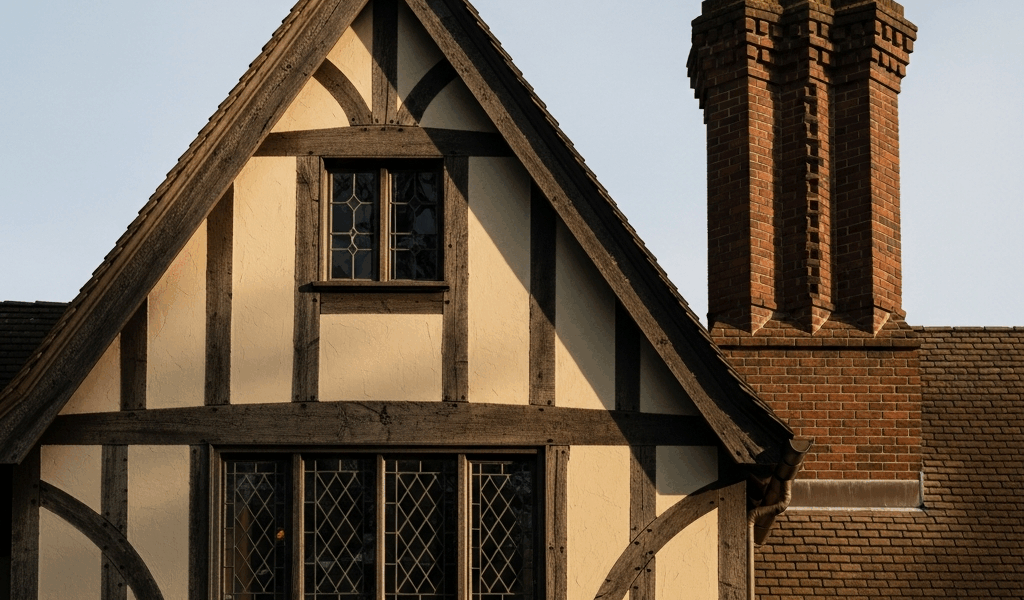
The roofline on a Tudor Revival home is the dominant visual feature — dramatically steep, often pitched at 45 degrees or sharper. Not the gentle slope of a Colonial. Not the moderate pitch of a Craftsman. We’re talking angular, almost urgent angles that grab your eye from half a block away.
On actual medieval English homes, that steep pitch had a job: shed rain and snow fast. On a 1922 suburban house in Columbus or Hartford, it was nostalgia, full stop. Builders kept the feature anyway because buyers wanted that Old World feeling, and builders gave buyers what they wanted.
Watch for multiple cross gables breaking up the roofline. Tudor Revival homes almost never have a simple peaked roof. Instead you get complex intersecting gable sections — often a large front-facing gable over the entry, flanked by lower gables or sections running at different angles. That complexity is the signature. Colonial homes have cleaner, simpler rooflines. Craftsman homes go lower and broader, with wide eaves doing the visual work.
Some higher-end builders added decorative false thatching details — shaping the roof edge or adding texture to mimic actual thatch. Rarer in America than in English precedents, but it shows up on the builds where the budget allowed for it. I toured a 1931 house in a Chicago suburb where the roofer had sculpted the eaves to within an inch of their life. Stunning effect. Probably cost a fortune in 1931.
From the street, a Tudor Revival roofline reads vertical and pointed. It makes the house feel taller than it actually is. That’s intentional. That’s the feature that makes Tudor Revival unmistakable once you’ve seen it once.
Half-Timbering and What It Actually Means
But what is half-timbering? In essence, it’s dark wooden boards — often stained near-black or deep brown — set against light cream, tan, or white stucco. The contrast is deliberate and dramatic. But it’s much more than that.
On a genuine medieval English timber-frame house, those boards are structural. They hold the building up. Spaces between them get filled with wattle and daub, or sometimes brick. On a Tudor Revival home built in 1925? The half-timbering is applied decoration. Builders attached wooden boards or moldings to the exterior of an otherwise conventional structure — concrete block, brick, wood frame — and called it done. Looks exactly right. Carries zero structural load.
Placement follows patterns borrowed from English precedent. Upper stories get the heaviest treatment, creating that visual lightness at the top. Gable ends — those triangular sections above lower rooflines — often feature dense cross-hatching or diagonal patterns. Dormers get framed with half-timbering. First-floor sections occasionally get some, but upper stories always take priority.
Quality varied dramatically by budget. A high-end Tudor Revival home in an affluent neighborhood might feature elaborate diagonal patterns, curved braces, and detailed corner posts. A more modest build might have simple vertical and horizontal boards with minimal decorative work. I once toured a 1928 home in Columbus with such sparse half-timbering I nearly missed it entirely — just a few boards around the upper windows. The builder was economizing, clearly. Don’t make my mistake of dismissing those as non-Tudor just because the half-timbering is subtle.
That’s what makes half-timbering endearing to us Tudor Revival enthusiasts. Even when builders cut corners on it, something about that dark-on-light contrast still reads as unmistakably Tudor. If half-timbering is present, you’re looking at Tudor Revival — or a Colonial Revival trying very hard to be something it isn’t.
Chimneys, Windows, and the Details That Confirm It
Once the roofline and half-timbering have pointed you toward Tudor Revival, the secondary details lock it in.
Chimneys first. Look for tall, ornate stacks — often multiple stacks grouped together at a single location, sometimes featuring decorative brickwork, stone accents, or molded caps. I’m apparently obsessed with chimneys and scrutinizing Tudor Revival stacks works for me while glancing at rooflines alone never quite satisfies. A single elegant chimney centered on a Colonial reads completely differently from the clustered, prominent chimneys of Tudor Revival. They almost function as architectural punctuation marks. Tall. Intentional. Hard to miss once you’re looking.
Windows follow distinct patterns. Multi-pane casement windows — divided into small diamond or rectangular panes with leaded glass effects — are standard on Tudor Revival. These aren’t the big single-pane picture windows of mid-century builds. They’re subdivided, sometimes with actual lead came in higher-end examples, sometimes with muntins applied purely for effect. Oriel and bay windows projecting from the facade show up frequently too, adding three-dimensional interest to the street-facing elevation.
Arched doorways with decorative stonework surrounds appear at entries. Sometimes the arch is subtle — just a slight curve above the door. Sometimes it’s dramatic — a full rounded stone surround with carved detailing running $800 to $2,000 even in 1930s money. The entry usually reads formal, intentional, like the house is asking you to notice it.
Tudor Revival vs. Craftsman — How to Tell Them Apart
So, without further ado, let’s dive into the comparison people get wrong most often.
Both styles peaked during overlapping decades. Both appealed to buyers with disposable income. Both rejected Victorian excess in favor of something they considered more honest. That’s where the similarity ends.
Roofline: Tudor Revival reads vertical — steep pitched roofs, multiple complex gables, everything pointing upward. Craftsman reads horizontal — moderate-pitched roofs with deep, wide overhanging eaves pulling the eye outward and down. Look up first. This single feature separates them in under ten seconds from across the street.
Structural honesty: Craftsman emphasizes exposed structural elements. Visible rafter tails under eaves. Decorative exposed beams. Tapered columns on the porch. Everything says “look how we built this.” Tudor Revival hides structure behind applied decoration. The half-timbering isn’t structural. The chimneys are often taller than any practical heating requirement justifies. It’s theater, and it knows it’s theater.
Exterior materials: Craftsman favors natural materials used naturally — exposed wood shingles, river rock, clinker brick in varied earth tones. Tudor Revival weaponizes contrast — dark wood against light stucco, always. The contrast itself is the point.
Stand across the street one more time. If the house feels vertical, angular, and medieval-inspired with applied decorative woodwork, that’s Tudor Revival. If it feels grounded, horizontal, and straightforward about how it was built, that’s Craftsman. This new way of looking at rooflines and structural honesty took hold with me several years into my renovation work and eventually evolved into the identification method enthusiasts know and rely on today.



Stay in the loop
Get the latest classic architecture today updates delivered to your inbox.