Why People Confuse These Two Styles
Art deco vs art nouveau has gotten complicated with all the vague, hand-wavy explanations flying around. I’ve watched homebuyers stand in front of a 1928 apartment building and call it “that flowery Art Nouveau style” when every single detail on that facade was screaming geometric Art Deco. Both styles feel old, ornate, vaguely European. Both peaked somewhere in the early 20th century. That overlap trips people up — and honestly, most articles make it worse by burying the answer inside art history theory instead of just telling you what to actually look at.
Here’s the short version. Art Nouveau ran roughly 1890 to 1910. Art Deco owned the 1920s and 1930s. They barely overlap. More importantly, they aren’t a continuation of each other — they’re practically a rebuttal. Deco came along and deliberately rejected everything Nouveau was doing with its soft, organic shapes. Keep that tension in mind and the whole thing starts to snap into focus. So, without further ado, let’s dive in.
The Shapes Tell You Everything
This is where I’d start every single time. Before you read a tile or a piece of ironwork, step back. Look at the overall geometry of the building first.
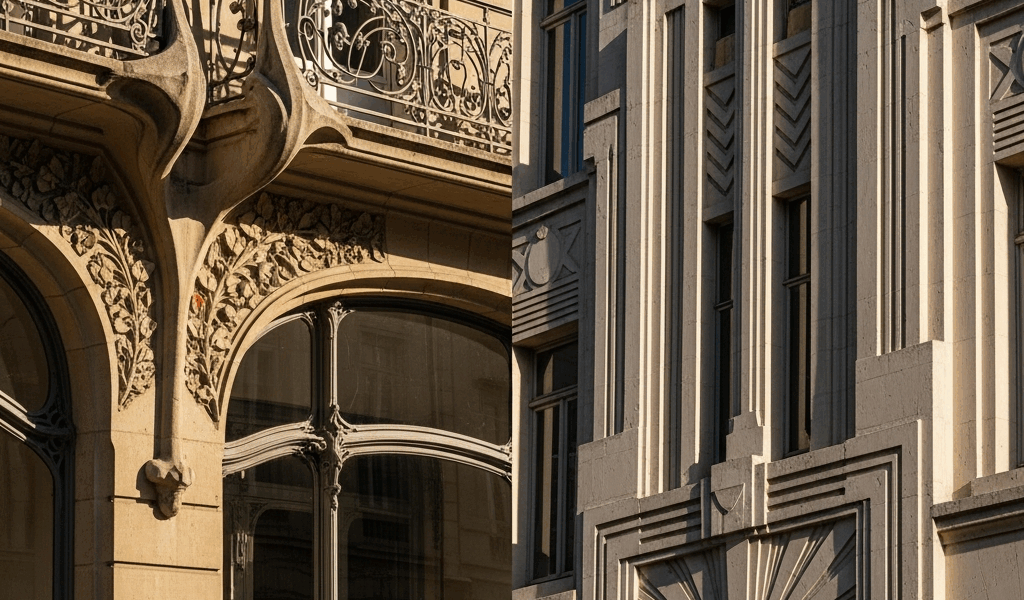
Art Nouveau buildings curve. The lines feel pulled — almost like someone drew them freehand while thinking about water or tangled vines. Facades undulate. Window surrounds follow irregular, asymmetric paths. The whole composition feels like it grew rather than got constructed. Look at the entry of the Hotel Tassel in Brussels or Hector Guimard’s Paris Métro entrances from 1900. Those whiplash curves are unmistakable once you’ve seen them even once.
Art Deco cuts. Zigzags, chevrons, stepped crowns, bold vertical fins. Everything deliberate. Everything precise. The Chrysler Building in New York is the textbook example — those stainless steel eagle heads and the sunburst crown are pure Deco geometry. Speaking of sunbursts: if you see a sunburst or fan pattern radiating from a fixed center point, you are almost certainly looking at Art Deco. And flowing floral ironwork — the kind that looks like a blacksmith got inspired by a lily pad — is almost always Nouveau. That’s what makes each style endearing to us architecture nerds once we finally learn to read them.
Symmetry is another fast tell. Deco buildings tend to have a strong central axis. Nouveau buildings break symmetry intentionally, letting organic forms lead wherever they want to go.
Facades, Windows, and Entrances
Probably should have opened with this section, honestly. This is what buyers and renters actually see when they’re standing on the sidewalk about to tour a building.
Art Nouveau Facades
Nouveau facades often use ceramic tile or mosaic work in muted, nature-pulled colors — sage green, dusty blue, warm ochre, deep teal. Window shapes get irregular. You’ll find arched frames that aren’t quite semicircles, elongated openings with curved tops, door surrounds that look hand-carved rather than manufactured. The ironwork on balconies and gates mimics plant stems, with terminal curls that feel genuinely botanical. Run your eye along the roofline and you might find sculpted female faces framed by flowing hair. That’s a signature Nouveau motif called a “femme-fleur” — and it shows up on facades from Vienna all the way to Chicago’s old warehouse district on West Randolph.
Art Deco Facades
Deco facades have a vertical emphasis that’s hard to miss. Pilasters, fins, or banding elements drag your eye straight up. Window groupings stack or band horizontally in repeating sequences, but the overall composition still pulls vertical. Entry surrounds are bold and geometric — polished black granite, gold-toned metalwork, chrome detailing framing a strong central door. Colors on Deco buildings skew high-contrast: black, gold, ivory, chrome. If a building has a two-tone polished stone entry with angular relief panels flanking the door, that is Deco. No question.
One specific detail worth hunting: spandrel panels — the flat panels between window rows. In Deco buildings these often carry geometric or stylized relief work. In Nouveau buildings they’re more likely to carry organic mosaic or carved floral forms. Small detail, big difference.
Ornamentation and Surface Detail
This is where you get close. Stand at the door. Look at what’s actually carved, cast, or applied to the surface.
I got stumped by a building once because the entry had both geometric banding AND floral tile work. Turned out it was a 1924 transitional building — rare, but it happens. Don’t make my mistake of assuming everything fits cleanly into one box. Use this as a checklist, not a rulebook.
Art Nouveau ornament — look for:
- Vines, lily pads, irises, wisteria — rendered naturalistically, not stylized into geometry
- Female figures with long loose hair flowing into plant forms
- Insect wings — dragonflies and beetles were basically a Nouveau obsession
- Sinuous whiplash curves in ironwork, especially railings and gates
- Mosaic or enamel tile in earth tones with irregular, hand-crafted-looking edges
- Carved stone that looks soft, almost liquid — like it was formed rather than cut
Art Deco ornament — look for:
- Stepped or tiered relief panels — shapes that stack like a ziggurat
- Stylized animals: leaping deer, eagles, greyhounds rendered in flat angular profile
- Egyptian motifs: lotus columns, scarab forms, sphinx profiles — Tutankhamun’s tomb opened in November 1922 and Deco architects ran with it almost immediately
- Aztec and Mayan-influenced stepped patterns, especially on cornices
- Abstract human figures — laborers, athletes — with simplified geometric musculature
- Sunburst, fan, and chevron patterns in metalwork and stone
The feel is different too. Nouveau ornament looks handmade. You can practically imagine one specific craftsperson executing each piece. Deco ornament looks like it came from a precision mold — consistent, repeatable, manufactured. That’s not an insult. It was intentional. Deco embraced industrial production. Nouveau was partly a reaction against it. Completely opposite philosophies, which is why they look so different once you know what you’re seeing.
How to Tell Them Apart at a Glance
Here’s how I run the quick mental checklist when I’m standing in front of a building I want to identify.
Ask yourself three questions:
- Does it curve or does it cut? Flowing organic lines mean Nouveau. Sharp angles, stepped forms, geometric precision mean Deco.
- Does the decoration look like nature or like a machine? If the ornament could have been growing in a garden, Nouveau. If it looks stamped from a die, Deco.
- Is it symmetrical? A strong central axis with balanced flanking elements is a Deco signature. Asymmetric compositions that follow organic logic lean Nouveau.
The gut-check rules:
If your first instinct is that the building looks alive — like it’s growing or flowing — that’s Art Nouveau. If your first instinct is that it looks powerful and sleek, like money and machinery got together and hired an architect, that’s Art Deco.
Where you’ll find each style in the US:
Art Nouveau is harder to find in American cities. It peaked before most US urban construction booms really hit. Look for it in older neighborhoods in Chicago, New Orleans, and San Francisco — especially on cast-iron storefronts, cemetery ironwork, and pre-1910 commercial buildings. Some residential row houses in the Northeast show Nouveau influence in their tile entries and balcony ironwork. You have to look harder, but it’s there.
Art Deco is everywhere once you know what to look for. Downtown cores of New York, Miami’s South Beach, Los Angeles, Detroit, and Tulsa are loaded with it. Miami’s Ocean Drive is probably the most concentrated single stretch of Deco architecture in the entire country. Tulsa’s downtown is genuinely underrated — I’m apparently obsessed with it and visit every couple of years, and it works for me while other “Deco destinations” never quite deliver the same density. The city boomed on oil money in the late 1920s and built heavily in Deco during that window. Movie theaters, courthouses, apartment lobbies, and commercial towers built between roughly 1925 and 1940 are your best hunting grounds nationwide.



Stay in the loop
Get the latest classic architecture today updates delivered to your inbox.