Why Spanish Colonial Revival Gets Misidentified So Often
Spanish Colonial Revival has gotten complicated with all the mislabeling flying around. I’ve walked through open houses in San Diego and Coral Gables where agents confidently called the home Mediterranean — meanwhile the original deed, sometimes stamped as far back as 1923, lists it plain as day as Spanish Colonial Revival. It happens at nearly every open house I visit.
Probably should have opened with this section, honestly. The style exploded after the 1915 Panama-California Exposition in Balboa Park, and suddenly California and Florida were drowning in barrel tile, arches, and hand-troweled stucco. That was 1915. Architects and wealthy homeowners fell hard for it. But here’s where things get murky: Spanish Colonial Revival shares visual DNA with Mission Revival and Mediterranean styles. All three use clay tile, stucco, arches. The overlap is real — but the differences matter enormously once you know what you’re looking for.
Design magazines, real estate listings, even some architectural references blob all three styles together. A buyer searching online finds articles treating them as interchangeable. They’re not. Spanish Colonial Revival is rooted in 16th and 17th century colonial Mexican architecture, then reinterpreted through an early-1900s Californian lens. Mission Revival pulls from mission-era simplicity — functional, sparse, intentional. Mediterranean borrows from Italy and coastal Spain without the colonial Mexican specifics. Once you internalize the visual markers that separate them, misidentification becomes nearly impossible. So, without further ado, let’s dive in.
The Exterior Features That Give It Away
Low-Pitched Red Clay Tile Roofs
This is non-negotiable. Spanish Colonial Revival homes sit under shallow-pitched roofs — usually a 4-in-12 to 6-in-12 pitch — covered in barrel or S-style clay tiles in deep red or rust tones. Not steep. That shallow angle came straight from colonial Mexico, where climate and available materials drove every design decision. Mission Revival also uses clay tile, sure. But Spanish Colonial Revival tiles run larger and often arrange in decorative patterns rather than simple uniform rows. That distinction alone is worth burning into your memory.
Thick Stucco Walls and Thermal Mass
Run your hand across the exterior wall. Spanish Colonial Revival demands walls 12 to 18 inches thick — often stucco over adobe brick or concrete block. That thickness wasn’t aesthetic vanity. It regulated interior temperature in brutal heat, keeping rooms livable without mechanical cooling. The stucco finish is hand-troweled, never smooth and uniform the way you see on Mediterranean homes. You’ll find texture, color variation, occasionally exposed adobe brick at corners or where water has done its work over the decades. That roughness isn’t deterioration. It’s authenticity.
Arched Openings — Rounded, Not Pointed
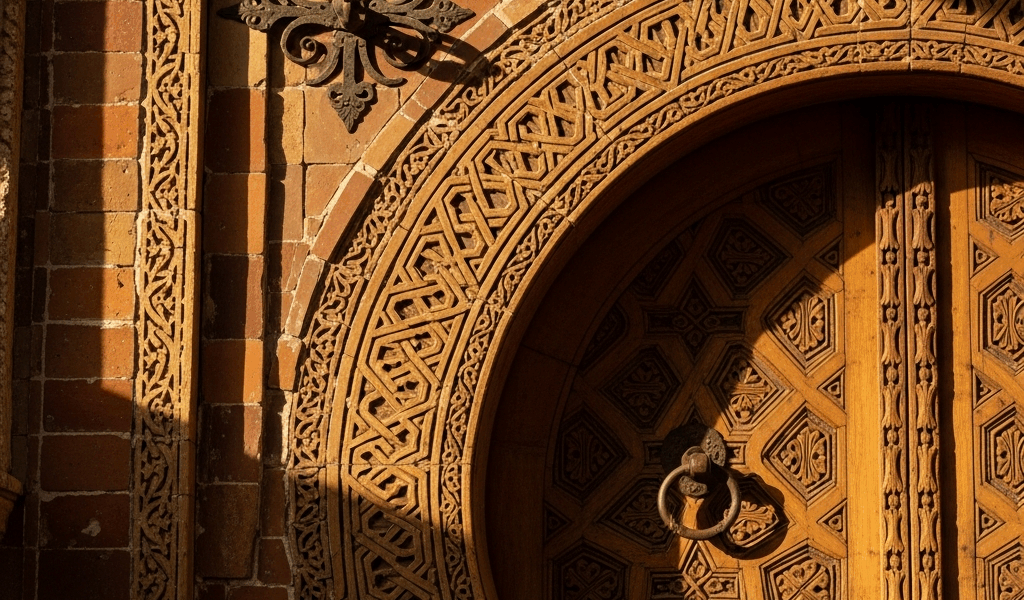
Windows and doors sit under semi-circular arches. Not Gothic. Not horseshoe-shaped. Plain rounded arches, supported on thick columns or pilasters. This is where Spanish Colonial Revival and Mission Revival genuinely overlap — and where most people get lost. The difference: Spanish Colonial Revival arches grow ornate at the entry, with carved stone or plaster decoration surrounding them. Mission Revival keeps arches bare and entirely functional. That carved detail at the entry arch is your first reliable split between the two.
Asymmetrical Facades
Step back from the street and look at the whole composition. Spanish Colonial Revival rejects symmetry outright. Windows vary in size and placement. The entry door might sit noticeably off-center. Towers, small turrets, or projecting wings break up the wall plane in ways that feel almost accidental. That deliberate imbalance traces back to colonial-era buildings that grew organically over generations — added onto, expanded, never planned as a single unified composition. Mediterranean-style homes, by contrast, tend toward balanced, formal facades. That’s what makes asymmetry endearing to Spanish Colonial Revival enthusiasts — it tells a story of accumulated time.
Decorative Details That Seal the Identification
Ornamental Ironwork
Spanish Colonial Revival homes are iron-heavy. Window grilles, balcony railings, gate hinges — wrought iron, often hand-forged, with intricate scrollwork. These aren’t geometric bars. Look for acanthus leaves, tight spirals, botanical motifs climbing the metalwork. High-end homes built in Pasadena and Phoenix during the 1920s featured ironwork commissioned at prices that would shock you even adjusted for inflation. I’m apparently someone who notices ironwork first at every property, and Spanish Colonial Revival never disappoints while Mediterranean ironwork never quite hits the same. Don’t make my mistake of skipping past the grillework — it’s one of the fastest tells on the whole exterior.
Carved Stone and Plasterwork Around Entries
The entry door is where Spanish Colonial Revival truly flexes. You’ll find Churrigueresque-influenced carving — ornate plaster and stonework inspired by the Baroque style that dominated colonial Mexico through the 1700s. Geometric patterns, floral reliefs, sometimes coats of arms or scallop shells radiating around the doorway. Mission Revival entries stay stark by comparison, essentially unadorned archways with nothing to say. That carved entry detail is the single most reliable visual marker separating the two styles. If you only learn one thing from this entire article, learn that.
Decorative Tile Accents
Glazed ceramic tile bands run around window openings, along rooflines, down chimney stacks. Hand-painted, typically in cobalt blue, ochre yellow, and forest green. On some homes built between 1918 and 1935, you’ll find original Talavera tile imported directly from Puebla, Mexico — identifiable by its slightly irregular glaze and warm off-white base. The patterns reference colonial-era designs: geometric, floral, occasionally religious symbols worked into the border. Mission Revival rarely includes this kind of decorative tile. When you see it, you’re almost certainly looking at Spanish Colonial Revival.
Interior Clues You Might Overlook
Exposed Wooden Beams and Ceiling Details
Inside, look up immediately. Spanish Colonial Revival ceilings feature exposed wooden beams — vigas — often hand-hewn and left with visible tool marks or bark at the edges. In higher-end homes, beams carry carved geometric patterns running their full length. The space between beams fills with wood planks or decorative plaster, building a coffered effect that feels genuinely heavy and old. This is not a drywall approximation of a style. It’s deliberate structural mass, authentic to the colonial architecture it references.
Terracotta and Saltillo Floor Tile
Ground-level floors run on clay tile — terracotta tones, typically 12-by-12-inch pavers or larger. Saltillo tile imported from Saltillo, Coahuila, Mexico features a softer, more porous surface that develops a natural patina over decades of use. It wears beautifully. The tile sits on concrete or stone substrate — never directly on wood subfloor, which can’t handle the weight or moisture properly. These materials stay cool underfoot even in 95-degree heat. Another climate-driven decision that doubles as aesthetic perfection.
Arched Interior Doorways and Passages
Interior doorways mirror the exterior arched openings — plaster-finished, sometimes with decorative tile trim or carved stone surrounds at the jambs. These interior arches create a cohesive visual rhythm moving through the home, room to room. When the arching is consistent throughout the interior, that’s a strong signal of original design intent rather than later renovation borrowing exterior style cues without following through inside.
Wrought Iron Fixtures and Hardware
Door hardware, light fixtures, staircase railings — all wrought iron, hand-forged or sand-cast. Chandelier bases, sconce brackets, gate latches carry the same scrollwork and botanical detailing as the exterior ironwork. That consistency across every surface of the home is a hallmark of genuine Spanish Colonial Revival. When the ironwork inside matches the ironwork outside, you’re in an original. When it doesn’t, someone renovated — and probably cut corners.
Spanish Colonial Revival vs Mission Revival Side by Side
Roofline: Spanish Colonial Revival uses ornately laid clay tiles, sometimes in decorative patterns, with a shallow 4-in-12 to 6-in-12 pitch. Mission Revival keeps tiles uniform and simple, no pattern variation.
Entry Treatment: Spanish Colonial Revival surrounds the doorway in heavy carved stone or plasterwork — Churrigueresque detail, botanical relief, sometimes heraldic symbols. Mission Revival entries are stark, unadorned archways. Nothing extra.
Window Grilles: Spanish Colonial Revival installs ornate wrought iron with scrollwork and botanical motifs. Mission Revival either skips grilles entirely or uses simple geometric bars — nothing ornate.
Overall Composition: Spanish Colonial Revival embraces asymmetry, visual complexity, projecting towers, varied window sizing. Mission Revival presents clean lines and functional simplicity — everything in its place, nothing added for decoration alone.
Interior Finishes: Spanish Colonial Revival layers decorative tile, carved plaster, ornate ironwork, and patterned vigas across every surface. Mission interiors stay minimal — focused on honest materiality rather than ornament.
If you’re standing in front of a house and need to decide quickly: look at the entry surround and the window grilles. Ornate carved stone around the door plus decorative wrought iron scrollwork on the windows? Spanish Colonial Revival — full stop. Plain arch with simple bars or no grilles at all? Mission Revival. That single observation corrects nine out of ten misidentifications. I’ve tested it on dozens of properties across San Diego, Scottsdale, and Tampa. It holds every time.



Stay in the loop
Get the latest classic architecture today updates delivered to your inbox.