Why Mediterranean Revival Gets Misread So Often
Mediterranean Revival has gotten complicated with all the misinformation flying around — especially when you put it next to Spanish Colonial Revival. As someone who has walked through dozens of these homes across Southern California and Florida, I learned everything there is to know about telling them apart. Today, I will share it all with you.
The mix-up isn’t trivial. We’re talking about $1.2 million properties, restoration budgets, and appraisal comparables that swing wildly depending on which style label ends up in the public record. Appraisers get it wrong. Real estate agents get it wrong. Historians occasionally get it wrong too. Probably should have opened with this section, honestly — it’s the foundation for everything that follows.
But what is Mediterranean Revival? In essence, it’s an architectural movement that peaked between 1915 and 1940, borrowing from Italian, Greek, and Moorish traditions rather than purely Spanish colonial sources. But it’s much more than that. Both styles use stucco, tile roofs, and arches. Both thrive in warm climates. That’s exactly why the confusion persists. The proportions, the details, the ornamentation — they diverge sharply once you know where to look. That’s what makes Mediterranean Revival endearing to us architecture obsessives. The differences are subtle enough to reward attention.
Roof and Roofline Details Most People Walk Past
The roofline is the loudest signature these homes carry. Look up. Really look.
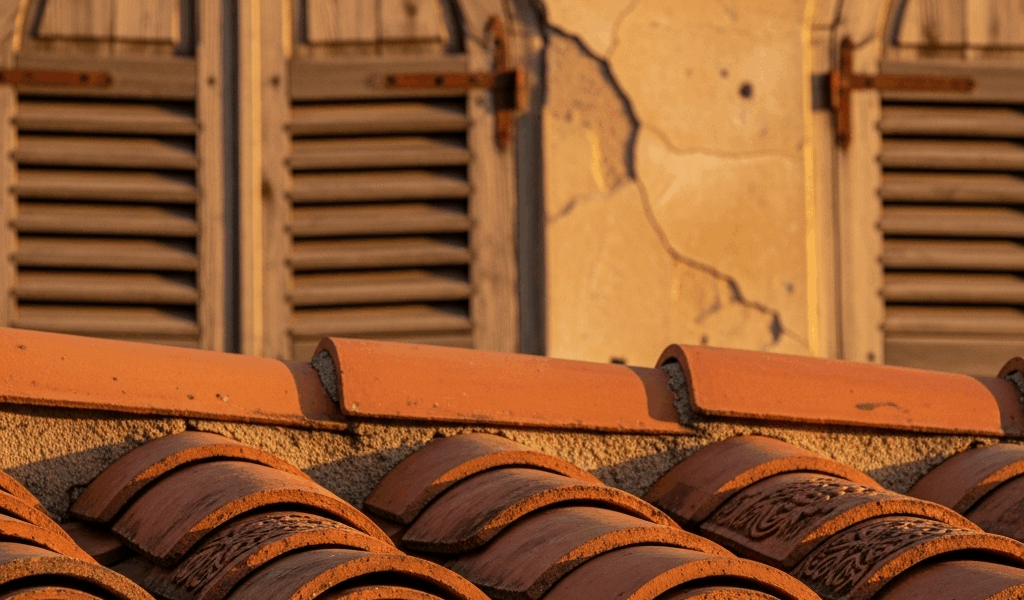
You want a low-pitched clay barrel tile roof — typically a 4-in-12 slope or shallower. Not flat. Not steep. Barrel tiles are the curved, overlapping kind that look almost like terracotta pipes laid side by side in rows. They’re not flat Spanish tiles, though buyers mix those up constantly. That curvature creates a distinctive shadow pattern you can spot in 1920s photographs from thirty feet away.
The eaves are shallow. Two feet of overhang, sometimes less — and that’s intentional. Don’t make my mistake: I once flagged shallow eaves on a 1928 Pasadena property as deferred maintenance. The inspector agreed. We were both wrong. Shallow eaves let southern light flood the walls while still cutting some of the heat. Deep overhangs belong on Craftsman bungalows. Not here.
Bigger homes combine hip roofs with gabled sections. The main body carries a gentle hip while a front-facing tower or secondary wing gets a slightly steeper gable. Asymmetrical. Deliberate. Architects used these roofline variations to echo authentic Mediterranean precedents — places where buildings had literally accumulated additions over centuries and nobody cared about perfect symmetry.
When you’re evaluating a listing online, photograph the roof from across the street. Tile color ranging from rust to cream? Good sign. Eaves present but restrained? That’s the style. If someone has swapped original barrel tiles for composition shingles — and they do, because shingles are cheaper — you’ve got a bigger restoration conversation ahead. Budget accordingly.
Arches, Loggias, and Exterior Openings Done Right
Round arches are the fingerprint. You’ll find them framing windows, doors, arcades, covered walkways. Not all of them. Not in perfect symmetry. That last part trips people up constantly.
A loggia is the feature that announces Mediterranean Revival louder than almost anything else. It’s a covered exterior space — an open-air room, essentially, with a roof supported by columns or arches, opening directly off the main house. Think of it as a designed threshold between inside and outside. Buyers sometimes walk a loggia and think: wasted square footage, something unfinished, a porch someone forgot to enclose. That’s completely backward. A loggia was a luxury marker in the 1920s and 1930s. It signaled that whoever designed this house actually understood California living — or Florida living, depending on where you are.
The arches themselves vary. Some are full round arches. Others are segmented or slightly flattened — still arches, just quieter. One arch might frame a single tall window. Another might span an entire covered walkway with smaller arches nested inside it. This variety isn’t inconsistency. It’s intentional composition, and it’s one of the things that separates a genuine period home from a 1980s pastiche trying to approximate the look.
Asymmetrical arch placement is the real tell. A 1925 facade might carry three arched openings that aren’t evenly spaced — because they’re responding to interior room functions, not exterior geometry. Walk the property. Notice whether the arches feel purposeful or purely decorative. Purposeful is period-correct. Decorative usually means someone added them later.
Stucco Finish and Wall Texture as a Style Signal
The exterior walls are smooth or lightly textured stucco. Run your hand across one if you get the opportunity. It should feel almost clay-like — not rough, not heavily aggregate. Spanish Colonial exteriors lean toward rougher finishes. Mediterranean Revival chose refinement. That distinction is tactile, not just visual.
I’m apparently someone who reads too much into stucco patina, and honestly, that has served me well while ignoring it never has. I walked through a 1927 home in Pasadena with pale cream stucco that looked worn, almost faded. My first instinct was maintenance problem. It was original. Eighty-year-old stucco weathers — it develops honest patina. Recoating everything in fresh bright stucco is actually a restoration mistake, though plenty of well-meaning homeowners make it every year. Don’t make my mistake.
Color palettes matter here. Look for whites, creams, soft ochres, pale terracotta, warm grays. The Mediterranean Revival palette drew from Italian vernacular and North African traditions where pigments faded under actual Mediterranean sun and became muted, sophisticated, almost dusty. If the stucco on a listing looks too vivid — think bright coral or sharp white — that’s likely a modern recoat masking what was underneath.
Cracks in old stucco happen. Hairline cracks that follow wall movement are normal. Surface crazing and minor vertical cracks? Standard wear. Horizontal cracks running along foundation lines are a different conversation — that’s settlement, and it warrants a structural engineer, not a restoration contractor.
Interior Features That Confirm the Style
Step inside. The interior details should whisper confirmation.
While you won’t need a historian on speed dial, you will need a handful of reference points. Wrought iron railings on stairs and balconies — scrollwork that’s decorative without being fussy. Arched interior doorways framing sightlines between rooms. Decorative tilework, specifically Catalina tiles or hand-painted geometric patterns, appearing in kitchens, bathrooms, and around fireplace surrounds. Exposed wood beam ceilings, sometimes with corbels. Fireplace openings with arched surrounds.
Not every Mediterranean Revival home carries all of these. Think of them as confirmation points, not requirements. A modest 1930 bungalow might show only arched doorways and a run of decorative tile in the kitchen. A larger estate will layer all of them throughout. Three or four of these features present together? You’ve probably got the style correctly identified. One feature in isolation? Keep looking.
The takeaway is straightforward. Photograph the roof. Trace the arches. Feel the stucco. Check the interior details in sequence. Mediterranean Revival doesn’t announce itself loudly — it accumulates conviction through specific, deliberate choices made by people who actually knew what they were building. So, without further ado, start with the roofline and work your way in. The home will tell you what it is.




Stay in the loop
Get the latest classic architecture today updates delivered to your inbox.