What French Eclectic Architecture Actually Is
French Eclectic home identification has gotten complicated with all the mismatched terminology flying around. As someone who spent years touring pre-war neighborhoods in Ohio and Indiana, I learned everything there is to know about spotting this style from the street. Today, I will share it all with you.
But what is French Eclectic? In essence, it’s an American architectural style that emerged between 1915 and 1945, borrowing heavily from French provincial farmhouses and Norman estates — then filtering those ideas through local materials and American taste. But it’s much more than that. It wasn’t a copy job. It was a conversation across the Atlantic, conducted entirely in brick, stucco, and steep rooflines.
You’ll hear Norman Revival and French Norman used interchangeably at open houses and in listing descriptions. That’s technically fine — they’re regional variants of the same DNA. French Eclectic is the formal umbrella term, and knowing that distinction matters when you’re standing in front of a house trying to figure out what you’re actually looking at.
The Roof Is the Biggest Giveaway
Frustrated by dozens of confusing roof profiles during back-to-back home tours, I eventually developed one simple visual rule: look up first. Always.
The roofline is the single most diagnostic element of this whole style. What you’re hunting for is a steep hipped or cross-gabled roof — 45 degrees minimum, often steeper — paired with a round or conical turret. That turret is everything. Not a cupola. Not a belvedere. A proper turret rising from the roofline or upper wall, usually capped with its own pointed cone.
This combination almost never appears on Tudor Revival homes. Tudors do run steep, yes, but their gables are angular and asymmetrical. No round tower. Mediterranean Revival won’t have steep roofs at all — those slope gently or run flat, designed for sun, not snow. A conical turret would look genuinely absurd bolted onto a Mediterranean facade. Stand across the street. Squint at the roofline. Steep pitch married to a rounded tower — that’s your French Eclectic. Nearly every time.
Walls, Windows, and Exterior Materials
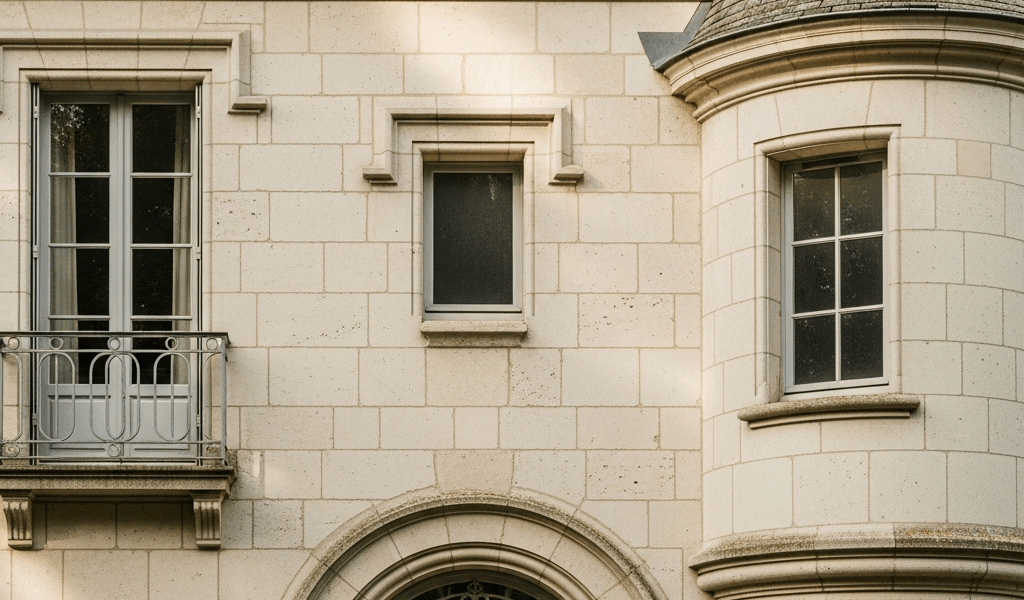
The material palette tells the second part of the story. French Eclectic facades regularly mix three or four different exterior finishes — brick, stone, stucco, rendered cement — sometimes all on the same front elevation. This isn’t a renovation mistake or a budget patchwork. The randomness is intentional. That’s what makes French Eclectic endearing to us architecture nerds.
Mediterranean homes lean almost entirely on stucco, maybe with thin stone trim at the entryway. Tudor Revival commits hard to dark brick or timber-and-plaster, with the timber acting as a visual frame that dominates everything. French Eclectic just throws them all together without apology and somehow makes it work.
Windows matter too. Look for casement windows with divided lights — those small-paned glass grids that break up each sash. Some will have gentle arched tops, not the bold full arches you’d see on a Mediterranean home, but subtle curves hinting at European influence. Tudor windows occasionally share this casement format, but Tudor versions tend toward heavy vertical timber mullions. French Eclectic windows feel lighter. More Continental. More like something you’d open to hear rain hitting a cobblestone courtyard.
Half-timbering shows up on French Eclectic facades, and this is exactly where people get confused — I’ve seen real estate agents get it wrong on printed flyers. The half-timbering here is decorative and secondary. It’s not structural and dominant the way it reads on an authentic Tudor. Think of it as an accent rather than the main event. A French Eclectic home might have decorative timber boarding around a gable end or near the turret base, with the rest of the facade running open stucco or brick. A true Tudor drowns you in timber. French Eclectic barely dips its toe in.
Three Styles People Confuse It With and Why
French Eclectic vs. Tudor Revival
The confusion makes sense. Both go steep on the roofline, both use half-timbering, and neither has any interest in minimalism. Here’s a fast field test. Does the home have a round turret tower? Yes — French Eclectic. No — probably Tudor. Does the half-timbering cover most of the facade or just small accent sections? Full coverage signals Tudor. Decorative patches signal French Eclectic. Is the exterior primarily one material, or are two or three textures competing for attention? Single dominant material points Tudor. The eclectic material mix points the other direction entirely.
French Eclectic vs. Mediterranean Revival
Mediterranean homes are honestly easier to rule out once you know the checklist. Low-pitched or flat roofs — designed for warm climates, not Ohio winters. Almost entirely stucco facades. Bold, rounded arches at entryways and windows. Everything reads warm and sun-soaked. French Eclectic reads like a house that’s braced for a hard February. Steep roofs, mixed materials, subtle arches, conical turrets. If you feel like the house wants a garden party, Mediterranean. If you feel like it wants a fireplace and a wool blanket, French Eclectic.
French Eclectic vs. Norman Revival
Probably should have opened with this section, honestly. Norman Revival is technically a subset of French Eclectic — specifically inspired by Normandy estates and farmhouses rather than broader French provincial sources. French Eclectic is the umbrella. Norman Revival sits underneath it. In practice, they’re nearly identical. Same turrets, same mixed materials, same steep rooflines. If someone hands you a listing sheet that says Norman Revival, you can call it French Eclectic and be completely correct. The distinction matters mostly to architectural historians and the occasional very particular seller.
Quick Checklist to Confirm the Style
So, without further ado, let’s dive in — use this field-guide approach when you’re standing on the sidewalk and need to make a call fast:
- Roofline is steep (45+ degrees) and hipped or cross-gabled
- A prominent round or conical turret rises from the roof or upper wall
- Exterior combines at least two different materials — brick with stucco, stone with rendered walls, or all three at once
- Casement windows with divided lights appear throughout the facade
- Some windows carry gentle arches at the top — subtle curves, not Mediterranean drama
- Half-timbering is present but decorative, not structural — limited to gable ends or around the turret base
- Overall impression reads “formal and European” rather than “warm Mediterranean” or “rural farmhouse”
- Construction date likely falls between 1915 and 1945, though revival examples continued appearing later
Five or more boxes checked — French Eclectic is your answer. Don’t make my mistake of second-guessing yourself when the turret is right there staring back at you.
Geographically, these homes cluster hard in the Midwest — Columbus, Detroit, Chicago suburbs, Baltimore, parts of the upper South. I’m apparently a Midwest architecture person and Ohio works for me while Los Angeles listings never deliver this style the same way. If you’re house hunting in Dallas or Southern California, you’ll rarely encounter them. If you’re touring pre-war neighborhoods in Michigan or Illinois, they’ll be on every third block. That frequency matters — it should calibrate how seriously you take style identification depending on exactly where your market sits.
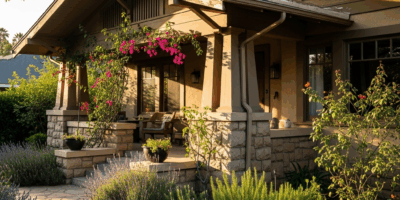
Compare related styles: Contrast French Eclectic massing with the symmetry of Neoclassical and Colonial Revival homes and the porch-centered informality of a Craftsman bungalow.



Stay in the loop
Get the latest classic architecture today updates delivered to your inbox.