What Makes Prairie Style Architecture Different
Prairie style architecture has gotten complicated with all the misidentification noise flying around — especially online, where agent listings casually slap “Craftsman” or “Mid-Century Modern” onto anything with a low roofline. As someone who has spent five years helping homeowners and real estate agents sort through exactly this confusion, I learned everything there is to know about prairie style home features and why they keep getting mislabeled. Today, I will share it all with you.
But what is Prairie Style, really? In essence, it’s Frank Lloyd Wright’s early 1900s philosophy that buildings should grow organically from their landscapes rather than fight them. But it’s much more than that. Unlike Victorian homes stacking towers and ornament toward the sky, or Craftsman bungalows settling into cozy proportions, Prairie Style homes stretch horizontally. They hug the ground. Every line, every brick course, every window band pulls your eye sideways — never up.
The style took hold in the Midwest. Chicago, Oak Park, Wisconsin, Minnesota — flat terrain and open prairie that demanded architecture belonging to that flatness. Most people today only encounter Prairie homes in photographs or unfamiliar neighborhoods. That distance breeds real confusion. A low-pitched roof gets labeled “Mid-Century Modern.” Horizontal banding reads as “Craftsman detail.” The misidentification compounds fast when you’re buying, selling, or planning a renovation. Don’t make my mistake of assuming a quick glance is enough.
The Roofline Is Usually Your First Clue
Start at the top. The roofline will tell you more than anything else standing in front of a house trying to figure out what you’re looking at.
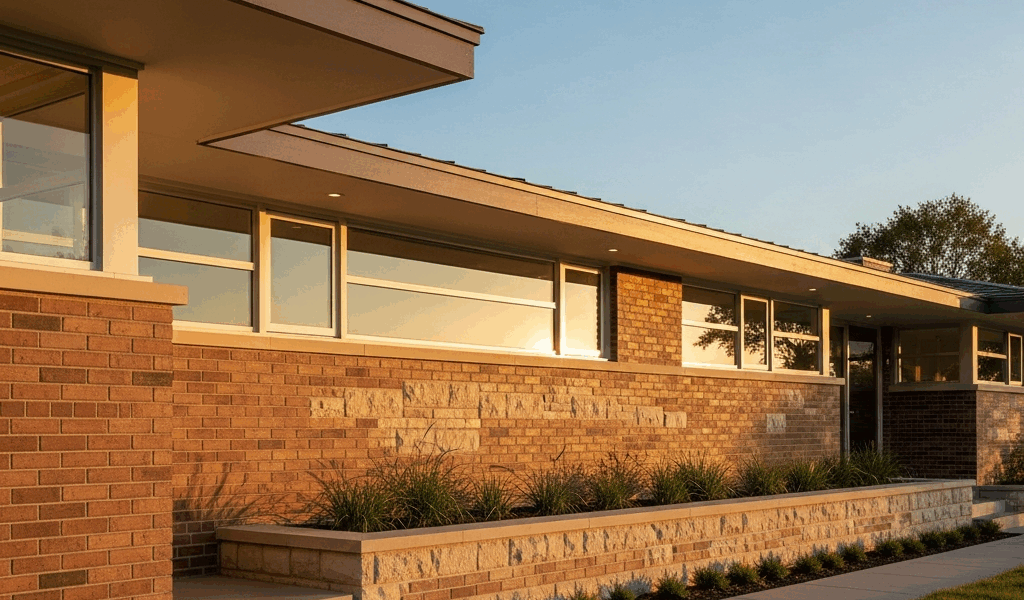
Prairie homes feature low-pitched, almost flat roofs with dramatic overhangs. Not subtle ones — I’m talking 18 to 36 inches of overhang beyond the wall face, sometimes more. Those eaves aren’t just protecting the foundation. They’re an architectural statement. They shade long bands of casement windows below and create shadow lines that hammer home the horizontal. You notice them immediately, or you should.
Craftsman homes confuse people constantly on this point. They do have overhanging eaves, sure. But the pitch is steeper and the overhangs are modest — typically 8 to 12 inches, visible slope from the street. Prairie roofs look almost like they’re floating above the walls. That’s the difference. Floating versus pitching.
Mid-Century Modern homes sometimes mimic this flatness, and that’s where real confusion sets in. But Mid-Century roofs carry a cleaner, more minimal edge profile. Prairie eaves have exposed rafter tails or brackets visible underneath — you can actually see the construction. That exposed woodwork traces back to Wright’s honest-materials philosophy. Look up into a Prairie overhang and you should see something: wood structure, shadow, depth. If it’s just a clean soffit, you’re probably not looking at Prairie.
Hipped roofs — sloped on all four sides — with broad overhangs and low pitch are strong Prairie indicators. Gabled roofs belong to other styles. Gambrel roofs belong to farmhouses. Prairie roofs are hipped or nearly flat. That’s the short version.
Horizontal Lines That Run Through Everything
Probably should have opened with this section, honestly, because the horizontal emphasis is the actual DNA of Prairie Style. Once you’ve clocked the roof, look at the walls.
Everything runs sideways. Window bands stretch across the facade in long continuous lines — casement windows opening outward in pairs or groups, not punched holes like Victorian windows. Ribbons of glass. The muntins dividing those panes run horizontally, reinforcing the lateral pull of the eye across the facade.
Brick coursing follows the same logic. On a Prairie home, mortar lines align with window bands intentionally. The brickwork echoes the horizontal emphasis on purpose. On a Craftsman home, brick gets laid normally without this orchestrated relationship to the windows. It’s just a wall. On Prairie homes, the wall is a composition — that distinction matters enormously when you’re standing in front of one trying to read it.
Exterior trim runs horizontal too. Wood sills, bands between stories, cornice lines — all of it. Almost no vertical trim breaks the eye’s journey across the facade. Radically different from Victorian and Gothic Revival styles, which use pilasters, corner boards, and decorative vertical trim specifically to emphasize height.
Step inside a genuine Prairie home and the logic continues. Open floor plans with continuous sightlines. Built-in bookcases running horizontally along walls. Trim at the ceiling line rather than ornamental baseboards climbing upward. Even the furniture built for these spaces — mission oak pieces, low-slung tables — respected the horizontal logic of the architecture. I’m apparently someone who notices furniture proportions immediately, and in a Prairie home that low-slung scale works while anything tall and vertical never quite fits.
Features Buyers Confuse With Craftsman or Mid-Century
Here’s where I watch confusion happen most often — real estate postings, renovation consultations, and buyers walking through homes with agents who mean well but misidentify things consistently.
Open Floor Plans
Both Prairie and Craftsman homes helped pioneer open living concepts, eliminating walls between parlor and dining room. That part’s accurate. But Prairie homes pushed further — the openness flows horizontally through the entire footprint, with sightlines extending across the whole floor. Craftsman interiors feel more enclosed by comparison. You move through rooms. In Prairie homes, rooms bleed together into one horizontal plane. That’s the lived difference.
Natural Materials
Craftsman homes obsess over wood — visible joinery, woodwork as decoration, wood wherever it can go. Prairie homes use natural materials too: wood, brick, stone, plaster. But the materials are honest without being ornamental. A wood sill isn’t carved or detailed. It’s a clean plane expressing itself through proportion and placement rather than applied decoration. Mid-Century Modern stripped this back further into industrial minimalism. Prairie sits between them — honest and refined, neither rustic nor cold.
Low Profiles
Prairie homes sit low. So do Mid-Century Modern ranch homes. The difference is why. Prairie homes are low by design — to echo the landscape, to belong to the flat terrain. The low pitch is structural and integral to the philosophy. Mid-Century ranches are low because of post-war efficiency and construction cost. A Prairie home feels connected to the earth. A Mid-Century ranch feels compact and practical. Same visual result, completely different reasoning behind it.
Absence of Ornament
All three styles reject Victorian excess — that’s what makes simple clean walls endearing to us as a shared modern sensibility. But Prairie’s simplicity serves horizontal emphasis. Craftsman’s simplicity celebrates the material itself. Mid-Century’s simplicity is aesthetic and functional economy. When you see clean walls and minimal trim, ask why they’re simple. Look at what’s doing the visual work instead of what’s missing.
How to Confirm You Are Looking at Prairie Style
So, without further ado, let’s dive in — use this checklist when evaluating a home or standing on the sidewalk trying to figure out what you’re actually looking at.
- Check the roof pitch from the street. Nearly flat with dramatic overhangs of 18 inches or more? Prairie indicator. That overhang depth matters.
- Look at the windows. Long horizontal bands with horizontal muntins dividing the panes? Strong Prairie signal — not Craftsman, not Victorian.
- Observe the brick or exterior coursing. Does it align horizontally with window placement? That intentional relationship is Prairie design thinking made visible.
- Estimate the overhang depth from shadow lines if you can’t measure directly. Prairie homes don’t whisper about their eaves — the shadows are obvious even on overcast days.
- Step inside and check sightlines. Open floor plan where you can see horizontally across the entire footprint? Prairie homes reward that view specifically.
- Look for exposed rafter tails or wood brackets under the eaves. That honest construction detail underneath the overhang is a strong confirming sign.
- Note the location. Prairie homes cluster in the Midwest — Oak Park, Illinois has a dense concentration, the Frank Lloyd Wright Trail covers several Wisconsin sites, and historic neighborhoods in Milwaukee, Madison, and Minneapolis still anchor authentic examples. Geography isn’t proof, but it’s useful context.
Prairie Style homes remain concentrated in the Midwest, though Wright and his contemporaries built examples throughout the country. These visual tests work faster than reading architectural history — the roofline, the windows, the horizontal lines running through everything. Once you see it, you genuinely can’t unsee it. That’s what makes Prairie Style endearing to us as a distinct and stubbornly recognizable architectural tradition.




Stay in the loop
Get the latest classic architecture today updates delivered to your inbox.