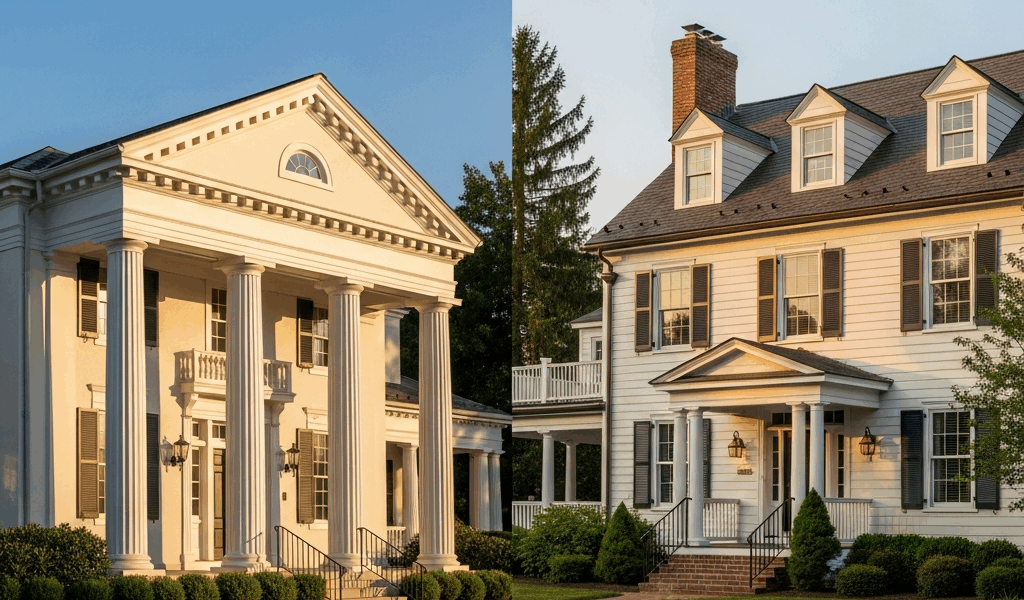
Why These Two Styles Get Mixed Up So Often
Neoclassical vs Colonial Revival has gotten complicated with all the vague listing descriptions and overconfident home inspectors flying around. I know this firsthand. Toured a property in Alexandria, Virginia back in 2019 — a white-columned facade on a tree-lined street — where the listing called it “neoclassical” and the home inspector kept referring to it as “classic Colonial Revival.” Both couldn’t be right. That afternoon sent me down a research rabbit hole I honestly haven’t fully climbed out of.
The confusion makes sense when you stand there looking at it. Both styles pull from ancient Greco-Roman architecture. Both lean hard into symmetry. Columns, formal entryways, that stately curb presence that reads as “important building” from fifty feet away. They share DNA because they share source material — 18th and 19th century American architects worked from the same pattern books, the same Grand Tour sketches, the same reverence for Palladio. That’s what makes classical American architecture so endearing to us history nerds, and so maddening to identify.
But they split sharply in purpose, scale, and detail. Once you know what to look for, the differences are obvious. So, without further ado, let’s dive in.
How to Spot a Neoclassical Home
Neoclassical architecture in America peaked roughly between 1895 and 1950. Think of the 1893 World’s Columbian Exposition in Chicago — that “White City” aesthetic of monumental grandeur, elaborate ornament, columns that mean serious business. Neoclassical style is architecture making a civic-scale statement, even when it’s technically someone’s house.
Four identification cues you can use from the sidewalk:
- Full-height columns, usually Ionic or Corinthian. These run the full two or three stories of the facade — not decorative suggestions. Structural-looking, substantial, topped with elaborate carved capitals. Corinthian columns carry that leafy acanthus detail up top. Ionic columns have the scroll-like volutes. Either way, they command the whole facade.
- Low-pitched or nearly flat rooflines. Neoclassical buildings resist the steep gable. The roofline tends to hide behind a prominent cornice or parapet — from the street, the building reads more horizontal than vertical.
- Elaborate entablature and cornice work. Look at the decorative band just below the roofline. On a neoclassical building, this area — the entablature — is densely detailed. Dentil molding, egg-and-dart patterns, modillions. The craftsmanship is deliberate and frankly a little show-offy.
- Grand, monumental scale. Neoclassical residential buildings are large — not just big, but proportioned to impress. Wide facades, tall windows, deep porticos. If the house looks like it could plausibly pass for a bank, you’re probably looking at neoclassical.
How to Spot a Colonial Revival Home
Probably should have opened with this section, honestly. Colonial Revival is far more common as a residential style than neoclassical — if you’re buying a house in a historic neighborhood, the odds heavily favor Colonial Revival before you’ve even stepped out of the car.
The style emerged as a nostalgia movement after the 1876 Philadelphia Centennial Exposition stirred up national interest in early American history. It draws from 18th-century New England and mid-Atlantic vernacular forms — the kinds of houses actual colonists built, not ancient Romans. Domestic at its core. Approachable. Human-scaled in a way neoclassical simply isn’t.
Four identification cues for Colonial Revival:
- Steeper pitched roof, often with dormers. This is the most reliable visual signal — full stop. Colonial Revival homes have roofs that read as roofs. Visible, prominent, frequently punctuated by dormers. The Gambrel roof — that barn-like double pitch — shows up specifically on Dutch Colonial Revival variants.
- Simpler columns or pilasters, usually Doric or plain. Where neoclassical columns are elaborate and full-height, Colonial Revival columns are modest. Often pilasters — flat, decorative column forms applied to the facade — or simple round columns supporting a smaller entry porch rather than a full portico.
- Multi-pane double-hung windows. Six-over-six or nine-over-nine panes are a hallmark. These divided-light windows reference genuine colonial-era glazing, when large single panes were expensive and rare. Symmetrically arranged, but narrower and less monumental than neoclassical equivalents.
- Paneled front door with fanlight or sidelights. Formal but restrained — a semicircular fanlight above the door, flanked by narrow sidelight windows. It’s as close to a Colonial Revival signature detail as you’ll find.
The Fastest Way to Tell Them Apart at a Glance
Here’s the side-by-side breakdown. Keep this as a reference the next time a listing description leaves you guessing.
- Scale — Neoclassical: Monumental, grand, imposing. Colonial Revival: Domestic, human-scaled, residential.
- Column style — Neoclassical: Full-height Ionic or Corinthian with ornate capitals, spanning two or more stories. Colonial Revival: Shorter Doric columns or flat pilasters, usually framing only the entry porch.
- Roof pitch — Neoclassical: Low-pitched, flat, or hidden behind parapet. Colonial Revival: Steeper pitched gable or gambrel, often with dormers.
- Window type — Neoclassical: Large, tall, often paired windows with elaborate surrounds. Colonial Revival: Multi-pane double-hung — six-over-six or nine-over-nine — narrower proportions.
- Ornamental detail — Neoclassical: Dense — dentil molding, carved entablatures, elaborate cornice work. Colonial Revival: Restrained — clean moldings, simple trim, decorative restraint treated as an actual aesthetic value.
- Typical building use — Neoclassical: Banks, courthouses, libraries, large estate homes, institutional buildings. Colonial Revival: Single-family residential, suburban homes, smaller civic buildings in historic districts.
The single fastest field test: look at the roof. A flat or near-flat roofline hiding behind an elaborate cornice points toward neoclassical. A visible, steeply pitched roof with dormers points toward Colonial Revival. Get that one right and you’ll be correct roughly 80 percent of the time — before you’ve examined a single column capital or window pane.
Does the Style Label Matter When Buying or Renovating
Don’t make my mistake. In 2019, stumped by an inconsistent listing description, I pulled a permit for exterior trim work using the wrong style category. The historic district review board in that jurisdiction used specific architectural terminology in their approval guidelines — and “neoclassical” versus “Colonial Revival” triggered entirely different sets of acceptable materials and profiles. The correction cost three weeks and a $340 revised application fee. I’m apparently detail-oriented about most things, and somehow missed this one entirely.
Style labels carry real weight in several contexts. Historic district permit applications reference specific categories that determine which replacement materials, window profiles, and door hardware are considered appropriate. Appraisers who accurately identify architectural style support more defensible comps — two houses on the same street may look nearly identical but appeal to different buyer segments depending on correct identification. Renovation contractors specializing in period-accurate restoration quote differently based on style. The wrong assumption leads to scope creep fast — at least if your contractor is doing their job properly.
“Neoclassical estate” signals something different to a buyer than “Colonial Revival center-hall.” Neither description is wrong if accurate. But using them interchangeably is sloppy, and buyers who know the difference will notice immediately.
The practical takeaway: use the identification cues here before committing to any description in writing — listing, permit application, or renovation scope of work. Columns plus flat roof plus monumental scale equals neoclassical. Columns plus steep roof plus dormers plus divided-light windows equals Colonial Revival. Once it clicks, it stays clicked.
Compare related styles: See how these formal traditions differ from the exposed structure and handcrafted detail of a Craftsman bungalow, or compare them with the asymmetry and regional details of French Eclectic homes.



Stay in the loop
Get the latest classic architecture today updates delivered to your inbox.