Why People Keep Getting These Two Mixed Up
Spanish Colonial Revival vs Mediterranean Revival has gotten complicated with all the misinformation flying around — especially in real estate listings where agents slap labels on houses like they’re guessing. Both styles lean on white or cream stucco. Both use red clay barrel tile roofs. Both feature arched openings that make people slow down on a Sunday drive. The surface similarity is genuinely real. I’ve stood in front of houses where the listing said one thing and every architectural detail screamed another. By the end of this article, you’ll have a working mental checklist — specific enough to make the call from the curb, before you ever step inside.
What Spanish Colonial Revival Actually Looks Like
But what is Spanish Colonial Revival? In essence, it’s a distinctly American romantic interpretation of colonial Spanish architecture from Mexico and California. But it’s much more than that — it’s a concentrated set of ornamental decisions that peaked hard between roughly 1915 and 1940. California, Florida, Arizona, Texas. Santa Barbara is practically a living textbook. So is Coral Gables, Florida, where the city actually mandated the style in early development codes.
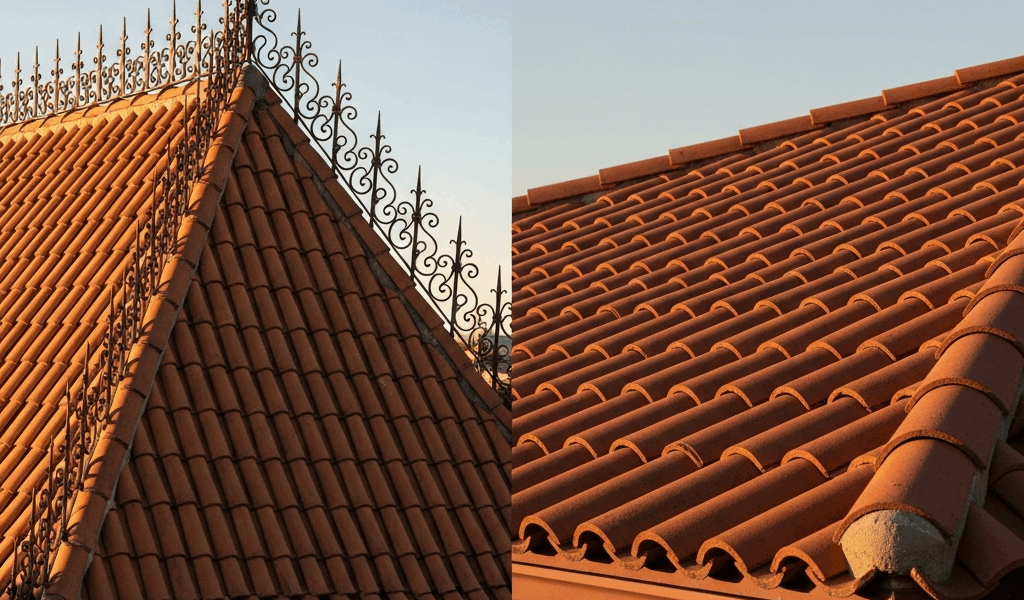
The roof pitch runs low to moderate, almost always finished with hand-laid terracotta barrel tiles. But the roof isn’t the primary tell. Look at the entry. Spanish Colonial Revival is obsessed with the front door surround — dense, almost sculptural carved stonework borrowed from 17th and 18th century Spanish Baroque. Churrigueresque ornament. Think vines, shells, layered figures framing a heavy carved walnut or alder door stained nearly black.
Facades are asymmetrical. There might be a small tower element, a shaped parapet rising above the roofline, or a projecting wing that breaks the front wall’s plane entirely. Wrought iron appears constantly — window grilles, small balconettes, light fixtures — but in tight, restrained patterns. Windows are often small and deeply set into thick walls. That squinting, fortress-like quality is genuinely distinctive to the style.
One thing I got wrong early on: I kept calling any stucco house with a tile roof “Spanish Colonial.” Don’t make my mistake. The ornamental concentration at the entry, the asymmetry, and those parapet or tower elements are what actually define it. Full stop.
What Mediterranean Revival Actually Looks Like
Probably should have opened with this section, honestly — because understanding what Mediterranean Revival is not (Spanish) clarifies Spanish Colonial faster than any description of Spanish Colonial on its own.
But what is Mediterranean Revival? In essence, it’s a broader European synthesis — drawing from Italy, the south of France, Venetian palazzos, classical southern European precedents. But it’s much more than that. It isn’t pulling from Spain specifically, and that distinction sounds purely academic until you’re standing in front of two houses and trying to explain why one feels different from the other.
Addison Mizner’s Palm Beach estates from the 1910s and 1920s are the reference point here. Mizner was pulling from Venetian palazzos, Italian villas, and Spanish precedents simultaneously — which muddied the taxonomy for about a century. That was the 1910s. We’re still untangling it.
Facades are typically symmetrical. That’s probably the fastest single tell. Where Spanish Colonial Revival embraces asymmetry as a deliberate aesthetic feature, Mediterranean Revival organizes its elevation around a central axis. Classical columns or pilasters appear at entries and loggias. The loggia itself — an open colonnaded porch integrated directly into the building’s structure — is a strong indicator. Spanish Colonial Revival uses covered walkways, sure. But a formal loggia with columns and a flat or low-pitched ceiling reads Italian, not Spanish.
Cornices are elaborate and continuous, wrapping the building at the roofline. The roof is typically a low hip rather than the more varied roofline of Spanish Colonial Revival. Entry surrounds are refined — even restrained compared to the Churrigueresque explosion you see on Spanish Colonial examples. Arches appear frequently but tend toward the clean Roman round arch over the slightly horseshoe-shaped Moorish arches that sometimes surface in Spanish Colonial work.
Side-by-Side Feature Comparison
So, without further ado, let’s dive in. Here’s the breakdown that actually sticks — go through this list when you’re standing in front of an unfamiliar house.
- Roof shape — Spanish Colonial Revival: low-to-moderate pitch, often with varied roofline elements, parapets, or a small tower. Mediterranean Revival: low hip roof, more uniform and continuous around the structure.
- Facade symmetry — Spanish Colonial Revival: asymmetrical, with projecting wings, towers, or uneven window placement. Mediterranean Revival: symmetrical, organized around a central entry axis.
- Entry ornamentation — Spanish Colonial Revival: dense Churrigueresque or Moorish carved stonework, heavy carved wood door, elaborate surround. Mediterranean Revival: classical pilasters or columns at entry, refined but not sculptural ornament.
- Arches — Spanish Colonial Revival: round, slightly horseshoe, or Moorish-influenced arches. Mediterranean Revival: clean Roman round arches, consistent proportions.
- Window details — Spanish Colonial Revival: small, deeply set windows with wrought iron grilles. Mediterranean Revival: larger windows, often paired, with classical surrounds or shutters.
- Tower or parapet presence — Spanish Colonial Revival: yes, frequently — shaped parapets, espadañas, or small corner towers are common. Mediterranean Revival: cornices and balustrades, not towers or parapets.
- Loggia — Spanish Colonial Revival: covered arcades or portales, often with Saltillo tile floors. Mediterranean Revival: formal colonnaded loggia, often integrated into the piano nobile level.
- Regional concentration — Spanish Colonial Revival: California, Arizona, Texas, and Florida — especially Coral Gables. Mediterranean Revival: Florida’s east coast, particularly Palm Beach, Miami Beach, and Boca Raton.
- Stylistic source material — Spanish Colonial Revival: colonial Spanish Mexico and California missions. Mediterranean Revival: Italian villas, Venetian architecture, and French Riviera estates.
How to Make the Call When You’re Standing in Front of One
Three steps. That’s genuinely all this takes once you’ve internalized the comparison above.
- Start at the roofline. Is it varied — parapets rising above the tile, a small tower, a shaped gable end? That’s pointing toward Spanish Colonial Revival. Is it a clean, continuous low hip with an elaborate cornice wrapping the whole structure? Mediterranean Revival.
- Move to the entry surround. Dense carved stonework, a dark heavy door, Moorish or Baroque ornament? Spanish Colonial Revival. Columns, pilasters, a refined classical frame with restrained detail? Mediterranean Revival.
- Check facade symmetry. Can you draw a vertical line down the center and have it roughly mirror on both sides? Mediterranean Revival. Does the facade feel deliberately off-balance — projecting elements, a tower pulling weight to one side? Spanish Colonial Revival.
Getting the label right isn’t trivia. I’m apparently someone who learned this the hard way, and sourcing wrong materials for a restoration project is an expensive lesson. Saltillo tile runs roughly $3–$6 per square foot. Hand-carved wood doors from suppliers like Rustica House run $800–$4,000 depending on size and configuration — and that’s before installation. Adding Italianate columns to a Spanish Colonial Revival house because someone misidentified the style has cost real owners real money, making a period property less coherent and, frankly, less valuable on resale. For listings specifically, correctly identifying the style attracts buyers who are actively searching for it. Narrower pool. More motivated. And motivation — that’s what closes deals.



Stay in the loop
Get the latest classic architecture today updates delivered to your inbox.