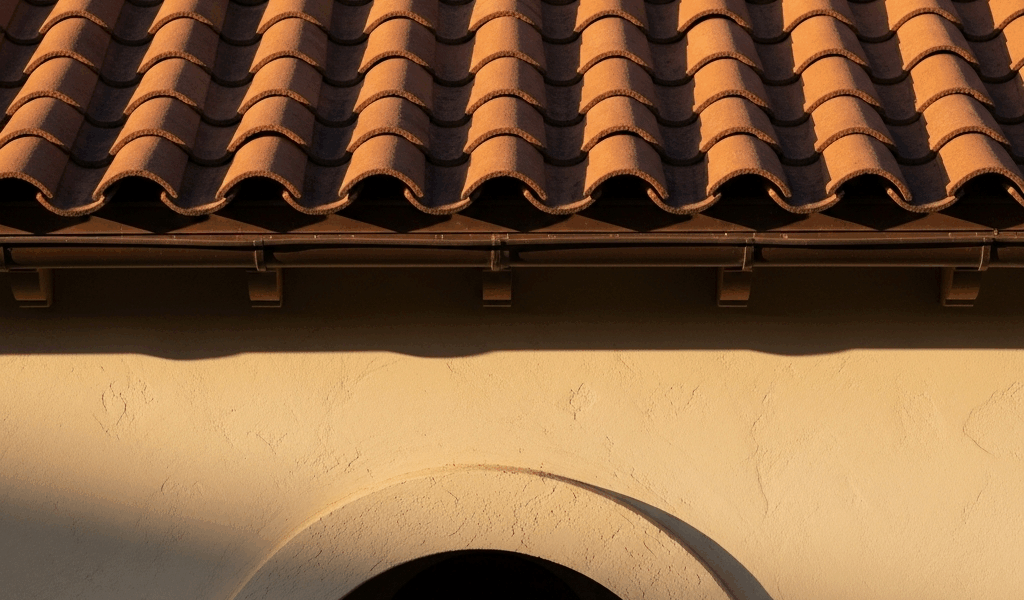
Mediterranean Revival is an American period-revival style that blends architectural ideas from Spain, Italy, France, North Africa, and other places around the Mediterranean. In the United States it became especially prominent in warm-climate development during the 1910s through the 1930s, with a major concentration in 1920s Florida and California.
The fastest way to recognize a Mediterranean Revival house is not one decorative detail. Look for a group of features: stucco walls, clay-tile roofing, arches, an irregular or picturesque composition, outdoor rooms, decorative tile, and ironwork. Historic examples vary, so no single checklist item proves the style by itself.
Mediterranean Revival at a Glance
- Era: primarily the early 20th century, with strong popularity during the 1920s building boom
- Walls: stucco, sometimes combined with stone, terra cotta, or glazed tile
- Roofs: low-pitched gabled or hipped forms, flat sections, parapets, and clay barrel tile
- Openings: round arches at doors, windows, porches, arcades, and loggias
- Details: wrought-iron grilles or balconies, heavy wood doors, decorative vents, carved surrounds, and ceramic tile
- Plan and massing: often irregular, rambling, or assembled to create a picturesque silhouette
- Outdoor space: patios, courtyards, balconies, loggias, and arcaded wings
1. Read the Whole Shape Before the Details
Start from across the street. Many Mediterranean Revival houses have asymmetrical or irregular massing, multiple roof forms, projecting wings, towers, porches, or a mixture of one- and two-story sections. That composition can make the house appear to have grown over time even when it was designed at once.
Do not use symmetry as a universal dividing line between Mediterranean Revival and Spanish Colonial Revival. Historic preservation records document both irregular Mediterranean Revival houses and more formal, box-like Italian Renaissance-influenced examples. The style is eclectic, and regional examples emphasize different sources.
2. Check the Roof and Parapets
Clay barrel tile is one of the strongest visual clues. Roofs may be low-pitched hips or gables, but flat roof areas and parapets also occur. Complex rooflines are common on picturesque residences, while more Italian Renaissance-influenced buildings may have a restrained low hip or flat roof.
Original roof tile is not merely a color layer. Its profile, installation pattern, edge details, flashing, and relationship to the eaves all affect the building’s character. A later asphalt roof does not automatically erase the underlying style, but it can remove a major character-defining feature.
3. Look for Stucco, Arches, and Deep Openings
Stucco is the typical wall finish. The surface may be smooth or textured, and historic color is not limited to bright white. Warm whites, creams, ochres, and other muted tones appear across regional examples.
Round arches commonly mark entrances, windows, porches, porte-cocheres, and arcades. Windows may be deeply set in the wall and can include multi-light casements or double-hung sash. One applied arch on a recent house is weak evidence; repeated arches integrated with the wall thickness and plan are much more persuasive.
4. Find the Indoor–Outdoor Rooms
Loggias, patios, courtyards, balconies, and arcaded wings are characteristic because the style was widely adapted to warm climates. A loggia is a roofed, open-sided gallery or room connected to the building; it is more integrated than a freestanding garden structure.
These spaces can be essential to the original composition. An enclosed porch or loggia may still be visible through its columns, arches, floor level, roof form, or a different wall infill. Historic alterations are part of the building’s story, but buyers should distinguish original fabric from later enclosure.
5. Use Ornament as Supporting Evidence
Look for wrought-iron window grilles, balcony rails, heavy paneled doors, carved stone or cast ornament, decorative vents, glazed tile, terra cotta, columns, pilasters, and wood details. Ornament may be concentrated around an entrance or spread across balconies and openings.
The amount of ornament varies from modest houses to elaborate estates. A small residence can belong to the style without a tower or lavish tilework; a civic or resort building may combine many sources. Treat the details as a vocabulary, not a required shopping list.
6. Check Interior Clues Carefully
Interior evidence can include arched openings, plaster walls, decorative tile at stairs or fireplaces, iron railings, wood-beamed ceilings, and heavy wood doors. These features help only when their materials, construction, and relationship to the house are consistent with its age.
Modern renovations frequently add Mediterranean-looking tile, beams, and ironwork. Check permits, historic photographs, real-estate records, physical joints, and material aging before calling a feature original.
Mediterranean Revival vs Spanish Colonial Revival
The labels overlap in everyday use and even in preservation documents. Mediterranean Revival is often used as an umbrella for an eclectic mixture of Spanish Colonial, Mission, Italianate, Moorish, Byzantine, and other sources. Spanish Colonial Revival places stronger emphasis on precedents from Spain and the Spanish Americas, but real buildings can combine both vocabularies.
That means a rigid one-feature test—symmetrical versus asymmetrical, smooth versus rough stucco, or simple versus ornate—will produce false identifications. Compare the full composition and documented history. Our separate Spanish Colonial Revival vs Mediterranean Revival guide explains the overlap and the most useful distinctions.
Buyer Checklist: Identify Before You Renovate
- Confirm the construction date and whether the property is in a local or National Register historic district.
- Compare the present roof, openings, porches, windows, and stucco with historic photographs or permits.
- Separate original features from later Mediterranean-style additions.
- Ask a qualified inspector about water entry, roof condition, stucco cracking, structure, and prior repairs; style alone cannot diagnose defects.
- Check local preservation rules before replacing tile, windows, doors, stucco, ironwork, or other character-defining material.
- Use a preservation architect or qualified specialist when a proposed repair affects historic fabric.
If you are evaluating market appeal rather than identifying the style, see our discussion of Mediterranean Revival homes and buyer demand. Identification should come first: a listing label is not proof of architectural history or condition.


Stay in the loop
Get the latest classic architecture today updates delivered to your inbox.