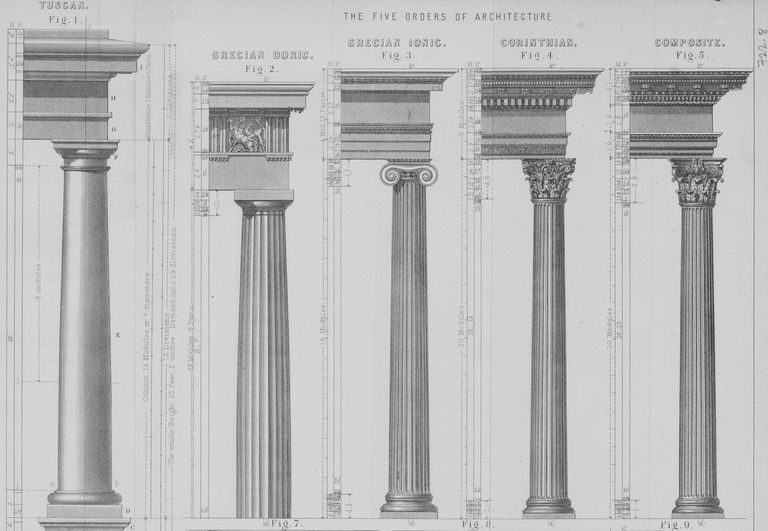
You’ve walked past them thousands of times on banks, courthouses, museums, and the grandest residential facades. Those vertical cylinders supporting the porticos of important buildings come in distinct varieties, and once you learn to read them, you’ll never look at a classical building the same way again. Here’s your 30-second guide to distinguishing Doric, Ionic, and Corinthian columns.
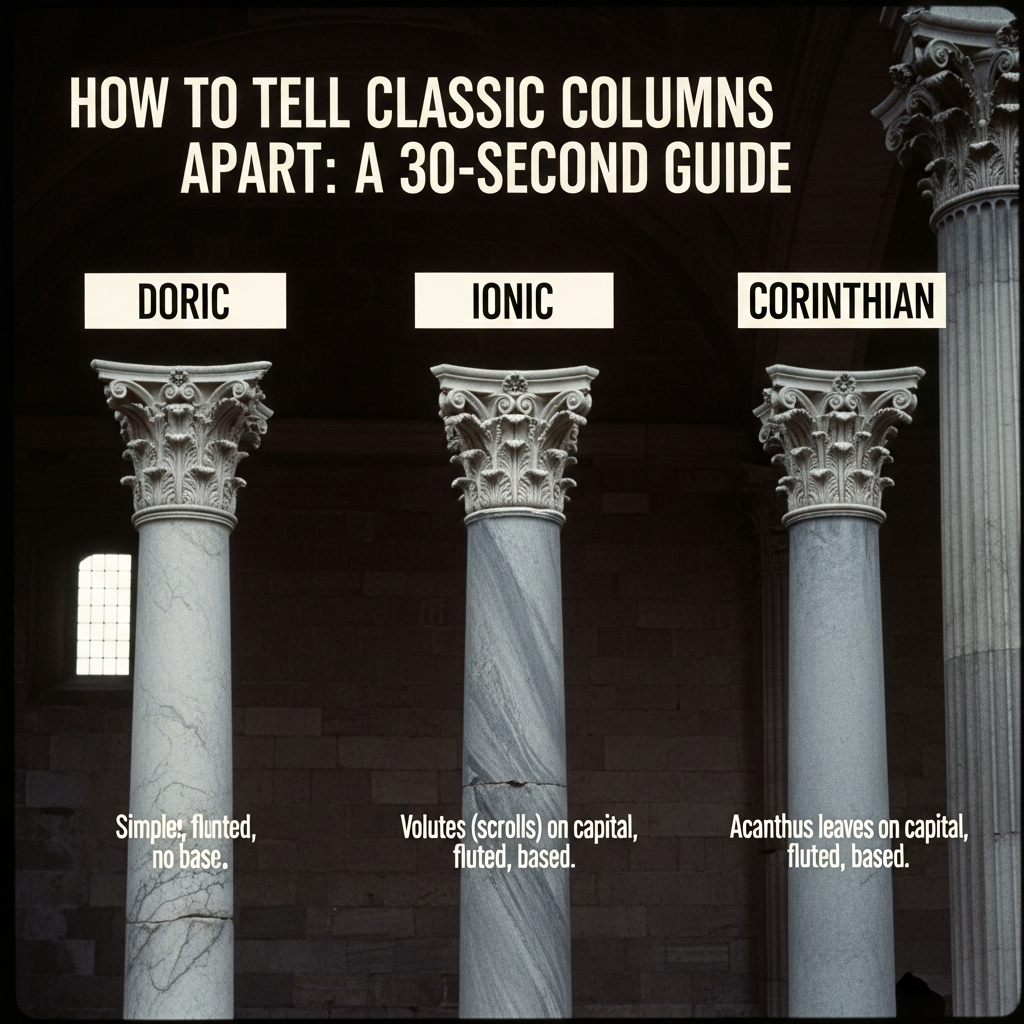
Doric: The Strong, Silent Type
The Doric order is the oldest and simplest of the three Greek column types. Look for these telltale signs:
The capital (top): A plain, circular cushion called an echinus sits beneath a square block called an abacus. No ornament, no scrolls, no leaves. Just pure geometric forms.
The shaft: Usually features 20 shallow vertical grooves called flutes. Importantly, Greek Doric columns have no base they rise directly from the floor or platform.
The proportions: Doric columns are the stockiest of the three, with heights typically 4 to 6 times their diameter. They convey strength and solidity.
Where you’ll see them: The Parthenon is the most famous Doric building. In America, the Lincoln Memorial uses a Roman variant of Doric. Many bank buildings from the early 20th century employed Doric to suggest stability and trustworthiness.
Ionic: The Elegant Scroll
The Ionic order, developed slightly later than Doric, introduces ornamental refinement:
The capital: Two prominent spiral scrolls called volutes extend from each side of the capital. This is your instant identifier. If you see scrolls, you’re looking at Ionic. The scrolls connect across the top, creating what some have described as ram’s horns or nautilus shells.
The shaft: Features 24 flutes, more numerous and deeper than Doric. Ionic columns always have bases, typically consisting of stacked circular moldings.
The proportions: More slender than Doric, with heights 8 to 9 times the diameter. The overall effect is lighter and more graceful.
Where you’ll see them: The Erechtheion on the Acropolis showcases Ionic beautifully. In America, look for Ionic columns on the Jefferson Memorial, many courthouses, and countless residential porticos where elegance matters more than monumental strength.
Corinthian: The Showpiece
The Corinthian order, the most ornate of the three, developed last and became the Roman favorite:
The capital: Elaborately carved with two or three tiers of acanthus leaves, topped by small scrolls. The acanthus, a Mediterranean plant with deeply lobed leaves, provides the decorative motif. A Corinthian capital requires significant carving skill and expense.
The shaft: Similar to Ionic, with 24 flutes and an elaborate base.
The proportions: The most slender, with heights typically 10 times the diameter. The tall, ornate columns create maximum visual impact.
Where you’ll see them: The Supreme Court Building in Washington features magnificent Corinthian columns. The U.S. Capitol’s principal facades employ Corinthian throughout. When a building wants to make the grandest possible statement, Corinthian delivers.
Quick Reference Cheat Sheet
See no scrolls, no leaves, stocky proportions? DORIC.
See scrolls (volutes) at the capital? IONIC.
See ornate acanthus leaves? CORINTHIAN.
Roman Variations
The Romans adopted all three Greek orders and added two of their own: Tuscan (a simplified Doric) and Composite (combining Ionic scrolls with Corinthian leaves). Roman Doric, unlike Greek, typically includes a base. These variations appear throughout American architecture, but the fundamental Doric-Ionic-Corinthian distinction remains the essential vocabulary.
Now, the next time you approach a building with columns, you’ll be able to identify its architectural lineage in seconds. That simple knowledge connects you to 2,500 years of Western architectural tradition, from ancient Athens to your local courthouse steps.



Stay in the loop
Get the latest classic architecture today updates delivered to your inbox.