The Symmetry Rule That Defines Georgian Homes
Georgian architecture details are everywhere in American neighborhoods, but most homeowners walk right past them. I spent two years renovating a 1752 colonial in Massachusetts before I actually understood what made it Georgian—and honestly, it all came down to one principle: bilateral symmetry.
The moment you learn to spot it, Georgian homes become unmistakable. Imagine a vertical line down the exact center of your house’s front facade. Everything on the left mirrors everything on the right. Windows align. Chimneys balance. Even the front door sits dead center, not offset like you’d see in Victorian or Federal-era homes.
This wasn’t decoration. It was philosophy. Georgian architects—working roughly between 1700 and 1780—believed symmetry represented order, reason, and rational design. Classical proportions mattered. A five-window front facade would have the door in the middle, two windows on each side. A nine-window front (which I see constantly in the Mid-Atlantic) has the door centered with four windows flanking each side.
Probably should have opened with this, honestly. Understanding symmetry is the skeleton key to every other Georgian detail. Once you see it, you can’t unsee it. And when you’re planning renovations, symmetry becomes critical—at least if you care about historical accuracy. I’ve watched homeowners remove symmetrical paired chimneys from rooflines or replace one matching window with a different style, not realizing they’d destroyed the fundamental architectural language of their home.
Why does this matter for restoration? Because any alteration—a new window, a repositioned door, an added garage wing—gets judged against this symmetry principle. Your Georgian home is symmetrical, and you’re planning exterior work? Maintaining that balance isn’t optional. It’s the baseline expectation.
Sash Windows and Why They Matter More Than You Think
Walk down any street in Philadelphia, Savannah, or Charleston and count how many people can actually identify a Georgian sash window. Most can’t. They see old windows and assume they’re all the same vintage.
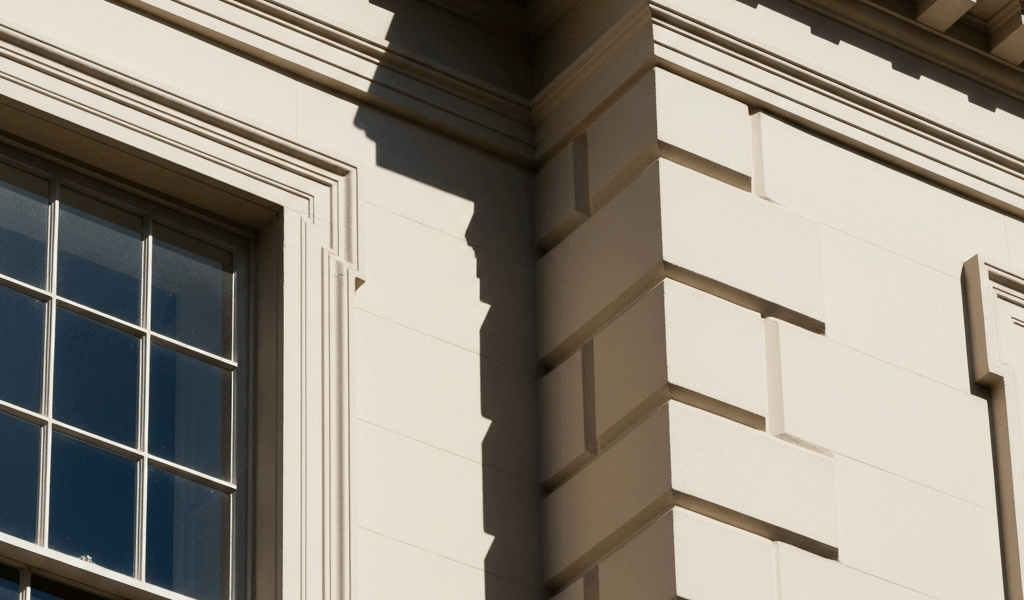
Georgian sash windows have specific pane configurations, and these tell you everything. The most common pattern is 6-over-6, meaning six panes of glass in the upper sash and six in the lower sash. You’ll also see 8-over-8 (more prestigious, more expensive originally), 9-over-9, or 12-over-12. These weren’t random choices. More panes meant more labor, more money, more status.
The muntins—those thin wooden dividers between panes—are another giveaway. Original Georgian muntins are genuinely thin, often just 5/8 inch or so. Later reproductions, especially Victorian-era copies made in the 1880s-1920s, use noticeably thicker muntins. The proportions look wrong to your eye before your brain can articulate why.
Here’s where I made a mistake that cost me: I replaced eight original Georgian sash windows in my renovation without understanding the difference between restoration and reproduction. The modern replacements I chose looked close enough. They had the right pane count. But they used modern double-glazed units, thicker frames, and contemporary hardware. The window tax era, which actually taxed windows in Britain, had created an incentive to minimize visible glass. Real Georgian windows acknowledge glass as material value. The reproductions I installed missed that entirely.
The glass itself was textured and uneven in original windows. Modern reproduction glass is flat and perfectly clear. Keeping original sash windows? That irregularity is worth preserving. Replacing them? Single-glazed reproductions with exterior storm windows—yes, really—perform better and look historically correct than modern insulated units.
Energy performance trade-offs exist. Real Georgian windows leak cold air like you wouldn’t believe. Storm windows help, but they’re not invisible. The decision to restore versus replace comes down to your comfort threshold and budget. At least understand what you’re choosing between.
Dentil Molding and Other Cornice Details You Walk Past
Dentil molding is the small, evenly-spaced rectangular blocks you see running horizontally under the eaves and around doorways. If you’ve ever looked up at a Georgian building’s roofline, you’ve seen them. Most people don’t process what they’re looking at.
The name comes from the Latin word for tooth—”dens.” That’s exactly what they resemble: a row of tiny teeth. They weren’t functional. They were status. A well-executed dentil course required custom milling and careful installation. Only people with resources did it right.
Modillions are larger, more ornamental brackets that support cornices. You see these especially on fine Georgian homes—essentially decorative corbels, usually arranged in a regular sequence. Modillions + dentil molding together? That signals a home with serious money behind it.
Belt courses are horizontal bands of molding that visually divide the facade into stories. A Georgian home might have a belt course separating the first floor from the second, creating a layered visual hierarchy. This horizontal banding actually makes buildings look wider and more stable—another classical principle at work.
The hierarchy matters when you’re assessing a home. Ground-floor elements feature heavier molding, deeper shadows, more ornament. Upper-floor treatment is lighter, more delicate. Entrances get concentrated ornamentation. The roof edge steps up the embellishment because it’s the crescendo of the facade. Missing or simplified dentil work, or inconsistent modillion spacing, suggests a less prosperous original owner—or a later renovation that downgraded the detailing.
Door Surrounds and Pediments That Signal Georgian Style
The front door in a Georgian home isn’t just a door. It’s an announcement.
Fanlights are the semicircular or elliptical windows above the door. Real Georgian fanlights have radiating muntins—thin wooden bars that fan outward from the center like spokes. You’ll see simple straight-line divisions, spiral patterns, or intricate geometric designs depending on the home’s original wealth and location.
The fanlight sits within a frame called a transom, and this sits on top of sidelights—tall, narrow windows flanking the door itself. Together, the door surround becomes the focal point of the entire facade. This is where the builder’s resources concentrated.
Many homeowners encounter Victorian modifications here. Victorian-era owners sometimes added heavier frames, widened door openings, replaced elegant fanlights with stained glass (beautiful but wrong), or added porches that obscure the original door surround entirely. Identifying what’s original versus what’s a later addition requires looking at proportions and materials.
Broken pediments sit above doors as well. These are triangular or curved ornamental elements that appear “broken” in the center—they don’t come to a point but instead have a gap or a decorative urn in the middle. This architectural flourish signals educated taste. The homeowner knew classical architecture. Pediments without breaks are simpler and less expensive.
Columned entries are common on higher-end Georgian homes. Simple pilasters (flat columns) frame the door. More substantial homes have full round columns. These columns sit on bases and reach toward capitals that match one of the classical orders—Doric, Ionic, or Corinthian being most common.
Common Mistakes Homeowners Make When Restoring Georgian Details
Identifying Georgian details is only half the battle. Restoration presents genuine challenges that I’ve seen mishandled repeatedly.
Over-painting is common. Original Georgian woodwork—sashes, door frames, cornices, dentil molding—was often painted. But not painted thick. Modern paint, applied in multiple layers over decades, can obscure fine details completely. Stripping paint to wood is labor-intensive and expensive, but it’s the only way to see what you’re actually working with. I’ve watched homeowners paint over dentil molding so heavily that individual teeth disappear.
Material substitution happens when people replace wood muntins with vinyl or aluminum. Modern replacements are easier to maintain, genuinely. But they look wrong in photographs and they feel wrong standing in front of the house. The visual weight changes. The way light reflects changes. Save the original sashes if they’re salvageable.
Inappropriate window replacements account for more Georgian home damage than almost any other single factor. Someone replaces an original 6-over-6 sash with a modern single-pane picture window or a casement window, and the fundamental visual language of the home shifts. The symmetry disrupts. The proportions feel off.
Mismatched hardware destroys details you might not consciously notice but absolutely feel. Original Georgian hinges, locks, and latches are period-specific. Replace them with modern reproductions or hardware from the wrong era, and it reads immediately to anyone with architectural knowledge. Everyone else just feels wrong-ness, even if they can’t articulate it.
Understanding Georgian architecture details isn’t purely academic. It’s practical. When you recognize dentil molding, sash window configurations, and symmetry principles, you can make informed choices about restoration. You’ll avoid mistakes that cost money and damage architectural integrity. And you’ll actually see your home—really see it—instead of just living in it.


Stay in the loop
Get the latest classic architecture today updates delivered to your inbox.