What Is Beaux Arts Architecture and Where You’ll Find It
Walking through older neighborhoods, I’ve noticed something repeatedly—homeowners miss the real Beaux Arts details. Everyone spots a Victorian mansion or recognizes Greek Revival columns from a block away. Beaux Arts, though? It sits in this awkward middle ground. Formal and ornate without the immediately recognizable drama.
The style emerged from the École des Beaux-Arts in Paris and dominated American residential design roughly between 1880 and 1920. You know that refined townhouse downtown that somehow looks more “official” than its neighbors? Probably Beaux Arts. Distinguished by symmetry, classical proportions, and restrained but sophisticated ornamentation, it borrowed heavily from Greek and Roman architecture but refined those elements through a distinctly academic lens.
Here’s where confusion starts. People lump Beaux Arts in with Federal or Greek Revival because they genuinely are similar—all use columns, pediments, and balanced facades. The difference? Restraint and purpose. Greek Revival swings toward the monumental. Federal style emphasizes delicate, linear details. Beaux Arts splits the difference—confident and decorated without screaming for attention.
You’ll find it most often in urban and suburban homes built during the early 1900s, particularly in neighborhoods developed as wealthy enclaves. Brownstones in Brooklyn, limestone facades in Chicago’s Gold Coast, brick townhouses in Boston. But it also appears in smaller cities and even rural estates where someone had the budget and taste for architectural sophistication.
Signature Ornamental Details That Define the Style
Probably should have opened with this section, honestly. People miss these elements constantly because they’re subtle enough to blend into a building’s overall presence without announcing themselves.
Rustication and Quoins
Rustication means the lower portion of a facade—typically the basement level or first story—features deeply recessed mortar joints. The stone or brick appears rougher, more textured, as if the foundation itself needs visible strength to support what’s above. You’re looking at blocks that are beveled or chamfered, creating shadow lines that catch light differently than smooth masonry.
Quoins are the corner treatments—and on a Beaux Arts building, they’re emphasized. Sometimes you see alternating stone colors (light and dark bands). Sometimes projecting stone blocks literally stick out from the plane of the wall. Walk around your block and look at the corners of older homes. On Beaux Arts houses, the corners don’t disappear. They’re statements.
Homeowners miss this because they assume all old buildings show age through texture. They don’t realize rustication was intentional, applied during construction — not just weathering.
Mansard Roofs
A mansard is a hip roof with a double slope on all four sides. The lower slope runs nearly vertical; the upper slope nearly flat. This creates extra attic or servant quarters space while maintaining that formal French silhouette. The lower section features dormer windows punctuating its vertical face.
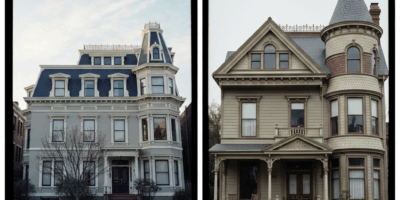
People see these roofs and think “Victorian” automatically. That’s the biggest misidentification I encounter. Mansards appear on both, but on Beaux Arts homes, the dormers are symmetrically placed—usually with peaked tops and often with small pediments or dentil molding around them. Victorian dormers feel more scattered and idiosyncratic. Beaux Arts dormers follow a rigid grid.
Elaborate Cornices
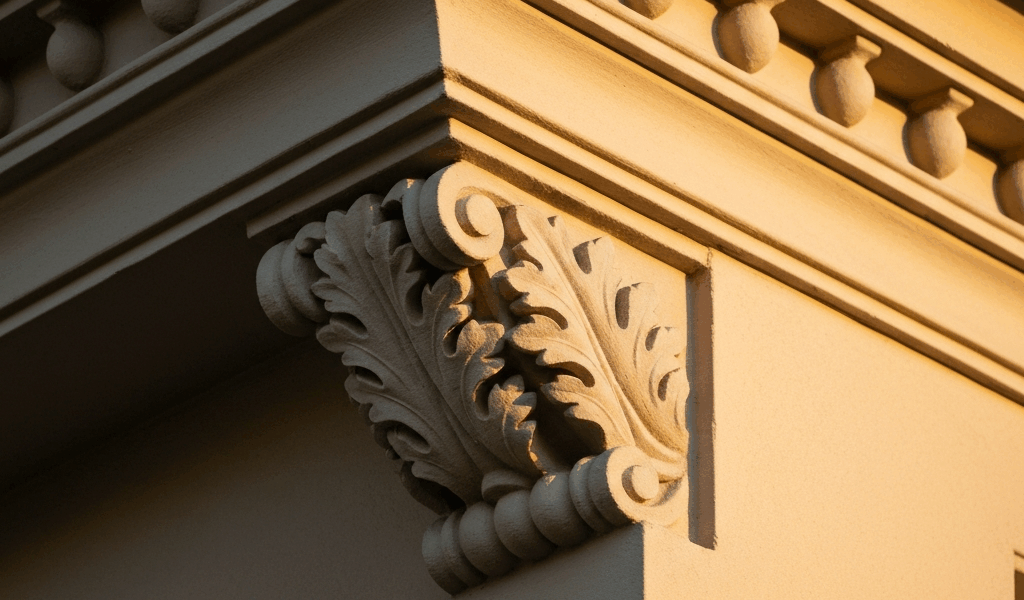
The cornice is that band of decorative molding running along the roofline where the wall meets the roof. On Beaux Arts buildings, cornices project substantially—sometimes 24 to 36 inches—and feature multiple tiers of molding. You’ll see brackets, dentils (those small rectangular blocks that look like teeth), modillions (larger, more ornamental brackets), and often a band of egg-and-dart pattern molding.
This is where plaster, limestone, or cast stone gets applied over brick or wood. The detail is genuinely impressive up close—bring binoculars if you’re standing on the street. Most people never scrutinize the cornice because it’s high up and feels distant.
Keystones and Arched Details
Keystones are the wedge-shaped stones forming the top center of an arch, particularly above windows and doorways. On Beaux Arts facades, these keystones project—they stick forward from the surrounding masonry, often topped with carved ornament (a rosette, an urn, or abstract foliation). Sometimes the entire arch voussoir (the curved arrangement of stones) gets emphasized with alternating stone colors or raised stone bands.
Windows and doorways become monumental through this treatment, even when the overall building scale remains residential and manageable.
Dentil Molding
Dentils are small rectangular blocks arranged in a single row, creating that distinctive sawtooth appearance. They run continuously along cornices, around door frames, and beneath window sills. Beaux Arts architects loved them. The repetition feels architectural and measured—intentional in a way that signals “formal design” immediately.
Many homeowners spot dentil molding but assume it’s generic “old house decoration.” They don’t realize how specifically it points toward Beaux Arts dating and style.
Balustrades and Balconies
A balustrade is a railing made of small, turned balusters (spindles) connected by a rail. On Beaux Arts homes, these appear as actual structural balconies on upper floors — never as merely decorative railings on porches. The proportions are refined. The balusters are typically fluted or have carved details. Sometimes they’re stone rather than wood, which immediately conveys permanence and expense.
How to Tell Beaux Arts From Similar Classical Styles
Greek Revival emphasizes columned porticoes and pediments as the primary focal point. The style wants you to see the temple immediately. Beaux Arts applies classical elements across the entire facade—columns might appear as pilasters (flat columns attached to the wall), and decoration gets distributed rather than concentrated.
Federal style dates earlier (roughly 1780–1820) and feels lighter. The detailing is linear and delicate. You see thin moldings, slender columns, refined proportions. Think townhouses in Charleston or Salem. Beaux Arts arrived fifty years later when construction techniques allowed heavier ornament and architects felt comfortable applying more decoration without the building feeling overwrought.
Neoclassical is a broad umbrella—it technically encompasses both Greek Revival and Beaux Arts. If someone says “Neoclassical,” ask what period and what specific elements they’re noting. The term alone doesn’t narrow it down.
Use this approach: If you see rustication on the ground level, symmetrical dormers on a mansard roof, projecting cornices with elaborate molding, and keystones above the windows—all on a building from 1890–1920—you’re almost certainly looking at Beaux Arts.
What Condition Issues Affect Beaux Arts Details
The ornamental materials on Beaux Arts facades are often terra cotta, limestone, cast stone, or decorative plaster. These deteriorate in specific ways that homeowners frequently misinterpret as structural failure when they’re actually cosmetic concerns.
Spalling is the most common issue. Chunks of stone or plaster break away, exposing the base material. This happens when water gets trapped behind the ornament, freezes, expands, and pushes fragments off. You’ll notice it most on cornices and keystones because those project outward and catch rain directly.
Cracks in ornamental plaster follow freeze-thaw cycles. The plaster separates from its substrate (usually brick), develops hairline fractures, then larger splits. This looks alarming but isn’t always urgent unless water is actively pouring in.
Efflorescence appears as white, chalky staining on stone and terra cotta. It’s mineral deposits from water migration—not mold. Unsightly? Yes. Urgent? Usually not. It often improves with time as the salts crystallize and stabilize.
Call a restoration specialist if spalling is actively expanding, if the ornament is becoming detached and poses a safety risk, or if you’re seeing water damage patterns inside the building that correlate to damaged exterior details. DIY repair works for hairline cracks you can fill with appropriate caulk and for surface cleaning with soft brushes and pH-neutral detergent. Replacing entire sections of terra cotta or stone keystones? That requires expertise.
Material compatibility matters enormously. Using modern Portland cement on a lime-mortar building accelerates damage because the new material is too hard and doesn’t allow the older materials to move slightly with temperature changes.
Why Preserving These Details Matters for Your Home
Beaux Arts homes command respect in real estate markets, particularly in urban neighborhoods where architectural pedigree matters. Original ornamental details signal quality and authenticity in a way that even meticulous replication cannot fully achieve.
Restoration costs money—a limestone cornice repair runs $3,000 to $8,000 depending on square footage and complexity. Replacing keystones can cost $400 to $1,200 per element. But removal costs curb appeal and historical accuracy far more than the preservation expense itself. A home with original Beaux Arts details intact pulls 5–12% higher offers in competitive neighborhoods compared to identical properties where details were stripped away.
Beyond market value, these details represent the architectural intention of the original designer. They’re not accidents or excesses. They embody early-20th-century ideas about how a well-built, carefully designed home should look. Preserving them maintains that conversation with history.
If you own a Beaux Arts property, get a professional facade inspection every 5–7 years. Document existing conditions. Address water intrusion before it cascades into interior damage. When you’re renovating, resist the urge to strip ornament for “cleaner” aesthetics. That detail is part of why your home has character that new construction cannot replicate.

Stay in the loop
Get the latest classic architecture today updates delivered to your inbox.