How to Identify Federal Style Architecture Details
I stumbled into an obsession with Federal architecture completely by accident. Three years ago, walking through Salem, Massachusetts, I found myself photographing the same buildings over and over without understanding why they felt so deliberately balanced, so mathematically pleasing to look at. A local historian finally explained what I was seeing—Federal style, the architectural identity America settled on between 1780 and 1820. Once I learned the visual markers, I couldn’t unsee them anymore. Now I spot Federal homes instantly, and honestly, you can too if you know what to look for.
Federal style identification matters because these buildings constantly get mistaken for Colonial or Greek Revival. But they’re distinctly different — fundamentally different. You’ll find them everywhere too. Boston, Philadelphia, Baltimore, Charleston — if you’re shopping for a historic home, renovating one, or just want to understand American architecture better, learning these details transforms how you read the built environment around you.
What Makes Federal Style Different from Colonial
Colonial architecture came first — roughly 1600 to 1780. It was functional. Practical. Symmetrical enough, but without any real obsession about it. Federal style arrived after the Revolution, when America suddenly had money, confidence, and access to pattern books from England featuring classical Greek and Roman details.
Here’s the critical difference: Colonial homes are symmetric and plain. Federal homes are symmetric and ornamental.
Colonial exteriors feature simple rectangular windows, basic shutters, and minimal decoration. The overall impression says honest house. Federal design took that symmetrical framework and dressed it up entirely. Suddenly there are fanlights over doors, decorative molding under eaves, slender columns that reference ancient temples, and brick or painted wood laid in ways that feel deliberately intentional.
Both styles obsess over balance — that’s the thing about eighteenth-century aesthetics. But Federal style adds classical vocabulary that Colonial ignored completely. A Colonial home from 1770 and a Federal home from 1800 might have identical footprints and floor plans. The Federal version just says something more.
The Fanlight Window Over the Door
Probably should have opened with this section, honestly. If you can identify one Federal feature reliably — just one — make it the fanlight.
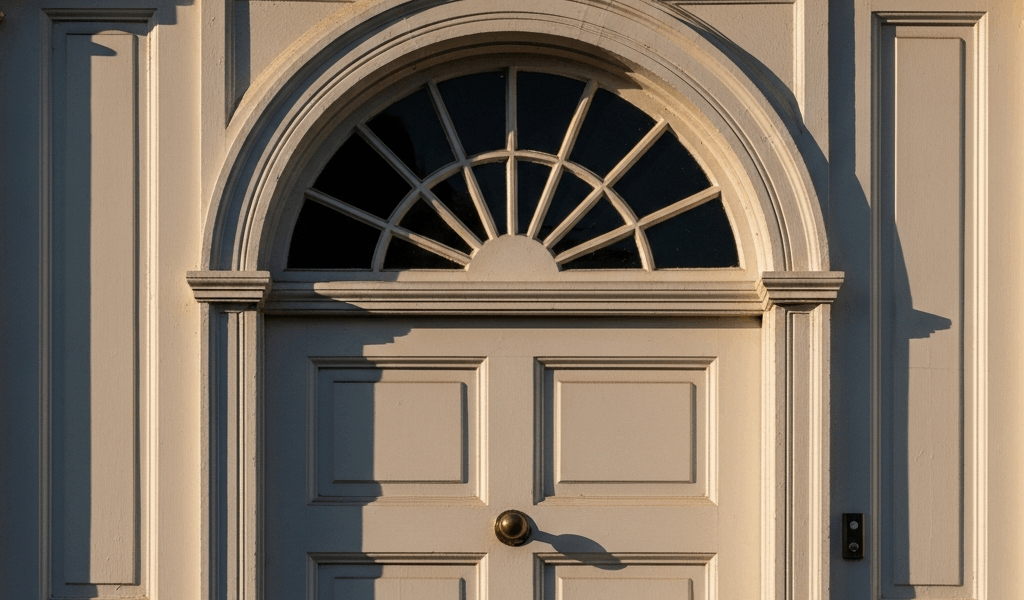
A fanlight is a window sitting directly above an entrance door. It’s semicircular or elliptical in shape. Inside that curved glass are thin bars radiating outward like a fan — hence the name. These bars typically arrange themselves in 8 to 15 segments, though patterns vary considerably between buildings and regions.
Why are fanlights so Federal? Because they’re geometrically perfect, inherently classical, and they flood the entry hallway with natural light. They feel elegant without being ornate or excessive. You see them on countless Federal buildings: the Lyman House in Waltham, Massachusetts (built 1793); townhouses in Federal Hill, Providence, Rhode Island; brick mansions throughout Baltimore’s historic neighborhoods.
The fanlight bars are usually thin wood or, later, thin metal strips. The glass is often original single-pane or has been replaced with historically accurate reproduction panes. Some are simple arcs. Others include decorative borders or metalwork. Some have a keystone — a wedge-shaped stone at the apex that looks like it’s holding the arch together (it usually isn’t, structurally, but it creates that visual effect).
Here’s how to spot a fanlight from the street: look at every residential door you pass. Most have nothing above them but wall. Federal homes have that distinctive curved window catching light differently than the rectangular windows surrounding it. Once you notice one, you’ll see them everywhere — they’re suddenly unavoidable.
A practical note: not every Federal home has a fanlight. Some have rectangular transoms instead — a straight window sitting above the door. That’s still Federal, but slightly less iconic. The fanlight, though, is the smoking gun.
Dentil Molding and Eaves Details
Dentil molding consists of a series of small rectangular blocks carved from wood or stone, running horizontally beneath the eaves. They look like teeth — the word “dentil” comes from the Latin “dens” (tooth). Each block measures typically 1.5 to 3 inches deep and gets separated from its neighbors by small gaps creating visual rhythm.
Federal builders loved dentils — at least if they wanted to signal taste and resources. They’re classical, drawn from Greek and Roman temples. They’re also functional as decoration: they catch shadow, which gives the building’s top edge visual definition and depth. That detail cost money to install.
On a Federal home, scan the area where the roof meets the walls, especially under eaves. You should see these small rectangular blocks marching along rhythmically. On some homes they’re painted to match the wall. On others they’re a different color entirely — cream trim against red brick is common throughout New England. They’re subtle until you know to look for them.
Other architectural styles have molding under eaves too. Victorian buildings often have much more elaborate trim — scrollwork, curves, complex painted patterns everywhere. Greek Revival homes sometimes have dentils, but they’re usually bolder and chunkier, more monumental. Federal dentils are restrained, geometric, classical — they know their place.
If you see delicate rectangular blocks marching evenly beneath the eaves, that’s almost certainly Federal or early Greek Revival. Combine this detail with other markers on this list, and you’ll narrow it down quickly.
Symmetrical Facade and Centered Doors
Federal architects treated symmetry as law. The front door sits dead center. Windows arrange themselves identically on either side. The facade gets bisected by an invisible vertical line, and everything mirrors across it perfectly.
This might sound like common sense — many architectural styles use balance. But Federal symmetry is different because it’s rigid and visible. You’re meant to notice it. There’s no randomness or organic irregularity. If the left side has three windows in a row, the right side has three windows in identical positions and sizes.
Door placement matters especially. Federal doors don’t sit off to one side or somewhere unexpected. They’re centered. And because they’re centered, the windows flanking them arrange themselves symmetrically. This creates visual order that feels almost mathematical — almost computer-generated, though of course it’s not.
Asymmetrical features signal a different style immediately. If you see a house with the front door slightly off-center, windows of varying sizes, or an unbalanced facade, it’s probably not Federal. It might be Farmhouse, Victorian, Craftsman, or Gothic Revival — all of which embrace asymmetry as a design principle.
Look at the roofline too. Federal roofs are generally simple: either a side gable or a hip roof. The ridge runs straight and level. There are no turrets, no multiple peaks, no theatrical angles added for drama. Simple geometric shape. Centered everything. That’s Federal.
Slender Columns and Pilasters
Federal columns are thin — elegant — referencing classical Greek temples without copying them exactly. If you see a Federal home with a front porch, the columns will feel proportionally slender. Often 8 to 10 inches wide and rising 8 to 10 feet tall, creating a height-to-width ratio around 10:1. That’s the sweet spot for Federal proportion.
Compare this to Greek Revival columns, which are bolder — sometimes 12 to 16 inches wide. They look more substantial, more monumental, more intimidating. Federal columns feel more refined by comparison — more approachable. They’re supported by simple capital blocks at the top (called capitals) that often feature modest carved details: small leaves, scrolls, or geometric patterns.
Many Federal homes don’t have full-height columns at all. Instead they have pilasters — engaged columns attached flat to the wall. Pilasters create the illusion of columns without the structural support they imply. They’re pure classical decoration. You’ll see them framing the doorway, creating visual order, suggesting strength and proportion without being load-bearing.
The materials vary considerably. Brick homes have pilasters made from projecting brick — literally different bricks laid to create dimension. Wood-frame homes have applied pilasters (wooden strips attached to the painted surface). Both serve the same visual purpose: to reference classical architecture and create vertical emphasis that draws your eye upward.
Quick ID Checklist for Federal Homes
- Semicircular or elliptical fanlight window directly above the front door, with radiating bars inside
- Dentil molding running horizontally beneath the eaves (small rectangular blocks in a row)
- Perfectly symmetrical facade with the front door centered on the building
- Windows arranged in matching patterns on either side of the centerline
- Slender columns or pilasters with simple capitals, either framing the door or supporting a porch
- Simple roofline — usually a side gable or hip roof with no peaks or turrets
Here’s the honest reality: not every Federal home has all six of these features. Some are missing porches entirely. Others have lost original fanlights to modern renovations and replaced them with standard doors. Some have severely simple pilasters that aren’t immediately obvious from the street. But if a building hits three or more of these markers — especially the fanlight plus symmetry — you’re almost certainly looking at Federal style.
Start with the fanlight. Train your eye to spot that curved window above the door — it’s unmistakable once you know what to look for. Then look for dentils and symmetry. Once you see those patterns repeated, the other details become obvious. You’ll develop the ability to identify Federal homes instantly, and honestly, it changes how you experience old neighborhoods. You start reading buildings like text. And Federal architecture, once you learn its vocabulary, is unmistakable.




Stay in the loop
Get the latest classic architecture today updates delivered to your inbox.