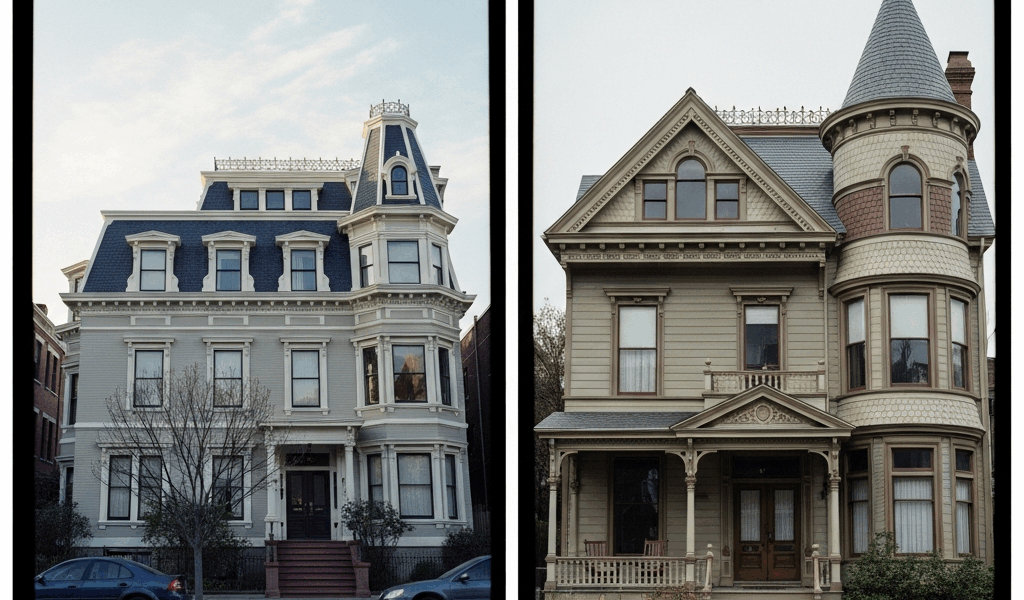
Victorian vs Queen Anne Style Homes Explained
Why People Mix These Two Styles Up
Victorian vs Queen Anne style homes has gotten complicated with all the conflicting information flying around. Walk away from most explanations more confused than before, and honestly, that’s not your fault — the terminology is genuinely messy. Here’s the thing that makes everything click: Queen Anne is a Victorian style. Victorian isn’t a design language. It’s a time period. Homes built roughly between 1837 and 1901, during Queen Victoria’s reign, get that label the same way music from the 1970s gets called classic rock — whether it’s Zeppelin or Fleetwood Mac doesn’t matter.
Queen Anne emerged as one specific style within that era, peaking in American residential architecture somewhere between 1880 and 1910. So when someone says “I love Victorian homes” and gestures at a turreted, wildly ornate house with three competing wall textures, they’re probably looking at a Queen Anne. Not wrong, exactly. Just imprecise in ways that cause real headaches — at the paint store, with a preservation board, or when a real estate listing has to actually mean something.
Probably should have opened with this section, honestly. Once that distinction lands, the rest of the comparison gets a lot more interesting.
What a True Queen Anne House Looks Like
Standing in front of a Queen Anne, the first thing you notice is that nothing lines up the way you’d expect. The facade is asymmetrical — almost aggressively so. No mirror image left to right. One side might push forward with a bay window, the other wraps around into a porch, and somewhere above it all sits a corner turret that looks like it arrived uninvited and never left.
That turret is the single most recognizable Queen Anne feature. Round, typically rising one to two full stories, planted at a corner of the house like an afterthought that became the main event. Not every Queen Anne has one — but when you spot a turret on a residential home, Queen Anne is almost always the right answer.
The porch is another giveaway. Queen Anne porches are loaded with spindle work — rows of turned wooden balusters, sometimes called a spindled frieze — hanging from the porch ceiling like ornamental fringe. Some homeowners have swapped original spindle work for plain lumber over the years. Painful to see. But the structural bones of the porch still tell the story even when the decorative details are gone.
Look at the walls. Queen Anne architects mixed exterior materials on purpose — fishscale shingles on the upper gable, clapboard siding on the first floor, decorative wood panels somewhere in between. Three textures on one house was a feature, not a construction accident. Paint schemes ran to four or five colors, each one chosen to highlight a different layer of trim or texture. The Painted Ladies around San Francisco’s Alamo Square are the most photographed examples, but similar homes exist in older neighborhoods throughout the Midwest, South, and Northeast. I’m apparently drawn to the Midwest ones specifically, and the examples in Cincinnati’s Gaslight District work for me while coastal examples never quite hit the same way.
The roofline is steep and irregular. Multiple gables pointing different directions. Dormers appearing where you don’t expect them. The silhouette of a Queen Anne against the sky looks almost restless — like the house couldn’t quite decide when to stop.
Other Victorian Styles and How They Differ
Queen Anne gets the most attention, but it had company. Three other Victorian styles show up regularly in older American neighborhoods — each with a signature feature that separates it from the rest.
Italianate
But what is Italianate? In essence, it’s a Victorian style borrowing heavily from northern Italian rural architecture. But it’s much more than that. Popular from roughly 1840 to 1885, these homes are defined by tall, narrow windows with decorative hood moldings sitting above them and wide bracketed eaves — those curved wooden supports visible under the roofline overhang. Rooflines on Italianate homes run low-pitched, almost flat-looking compared to the restless peaks of a Queen Anne. The overall shape is more rectangular. More settled.
Second Empire
This one is easy. Two distinct slopes on each side of the roof — a steep lower slope, a flatter upper one — that’s a mansard roof. A mansard roof means Second Empire. Full stop. The style pulled from French architecture and ran fashionable from about 1855 to 1885. Dormer windows typically punch through that lower mansard slope, giving Second Empire homes a heavy-lidded, dramatic look from the street. That was the whole point, really.
Stick Style
Stick Style is less common but worth knowing. Exposed decorative woodwork applied directly to the exterior wall surface — thin boards arranged horizontally, vertically, or diagonally over the siding, mimicking the structural framing underneath. It looks almost skeletal. The ornamentation is flat and graphic rather than three-dimensional like Queen Anne spindle work. Less theatrical, more diagrammatic.
The Fastest Way to Tell Them Apart at a Glance
Think of this as a field guide, not a quiz. You’re on the sidewalk. You have thirty seconds. So, without further ado, let’s dive in.
- Turret at the corner + irregular roofline + spindled porch + mixed wall textures — Queen Anne. High confidence.
- Mansard roof with dormer windows punching through the lower slope — Second Empire. The double-pitch is unmistakable once you’ve seen it once.
- Tall narrow windows + wide bracketed eaves + low-pitched roof — Italianate. The brackets under the eaves are the fastest tell in the whole catalog.
- Exposed decorative board patterns applied flat to the siding — Stick Style. The surface looks almost like a structural diagram printed on the outside of the house.
Confused by a symmetrical facade with decorative trim but none of the above? You might be looking at Folk Victorian — a simpler, builder-grade version of Victorian ornament applied to basic house forms. Common in rural areas and small towns from about 1870 to 1910. Less dramatic, but not uncommon.
Don’t make my mistake. Early on, I assumed any house with a porch and decorative trim qualified as Queen Anne. Walked away from a house tour in Cincinnati convinced I’d seen one — turned out it was Italianate with later porch additions tacked on sometime around 1920. The brackets under the eaves were right there the whole time. I just didn’t know to look for them yet.
Does the Style Name Affect Home Value or Renovation Rules
Short answer — yes. In ways that catch homeowners completely off guard.
Historic district designation is where the style label starts carrying real weight. Many local preservation boards use specific architectural classifications when deciding what exterior changes require a certificate of appropriateness. A Queen Anne in a locally designated historic district may face different guidelines around porch restoration, window replacement, or exterior color than an Italianate three doors down. Misidentifying the style on a renovation application can slow an approval or trigger additional review — sometimes months of it.
Frustrated by an unexpected restriction mid-project, one homeowner I spoke with spent three months going back and forth with her city’s preservation office over a porch railing replacement. The issue wasn’t the material cost — around $2,800 in pressure-treated lumber — but that her original application described the house as “Victorian” without specifying Queen Anne. The board wanted documentation of the original spindle work pattern, specifically the baluster spacing and profile dimensions, before they’d approve a replacement design. That was 2021. The railing still isn’t finished.
On the resale side, accurate style descriptions in listings matter more than most sellers expect. Buyers searching specifically for Queen Anne homes — collectors, preservation-minded buyers, people chasing a particular aesthetic — filter by style terms. Listing a Queen Anne as simply “Victorian” is like listing a Tudor as “old.” Technically defensible. Practically useless.
Knowing what you actually own isn’t just satisfying trivia. That’s what makes this distinction endearing to us architecture enthusiasts — it’s practical information. It affects who wants to buy your home, what you’re allowed to do with it, and how you describe it when the time comes to hand it off to someone else.



Stay in the loop
Get the latest classic architecture today updates delivered to your inbox.