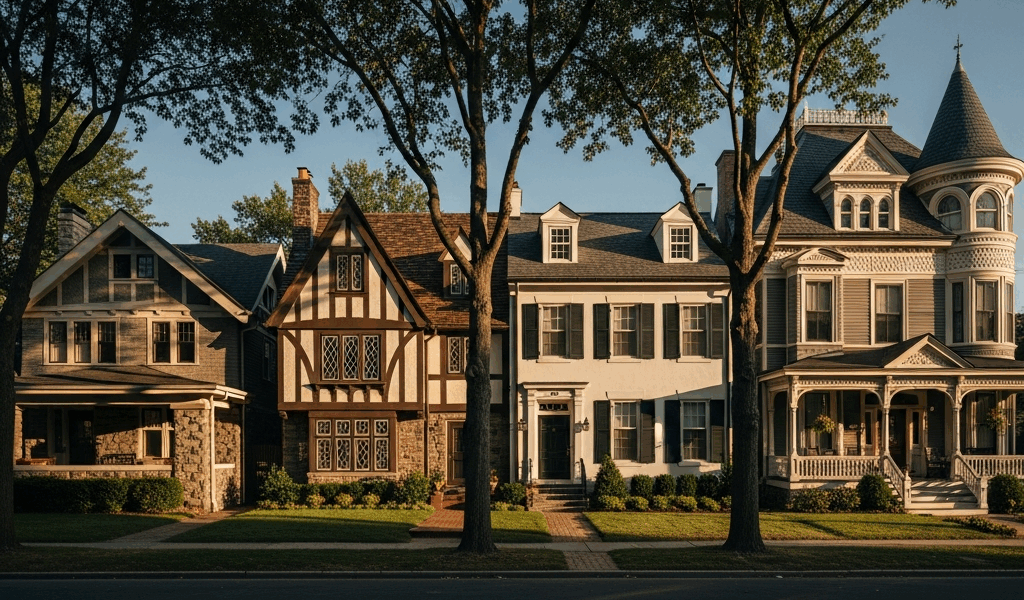
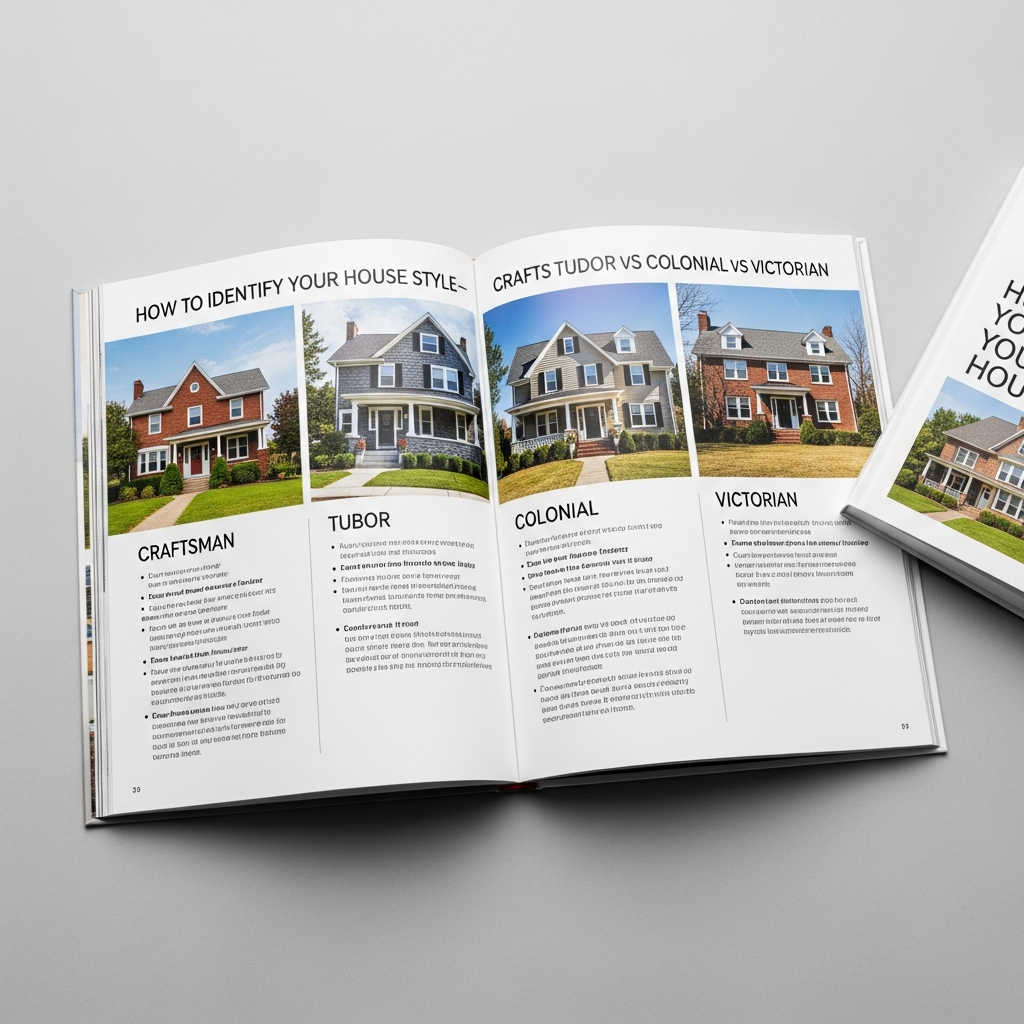
How to Identify Your House Style — Craftsman vs Tudor vs Colonial vs Victorian
Identifying house architectural styles has gotten complicated with all the vague, contradictory advice flying around. As someone who spent eight years surveying neighborhoods across New England and the Mid-Atlantic, I learned everything there is to know about reading a building’s DNA from the sidewalk. Today, I will share it all with you.
Probably should have opened with this, honestly — I used to stand on street corners in Providence squinting at rooflines like an absolute fool. Three years in before a contractor finally pointed at a roof and said, “Why are you looking at the porch?” That was 2017. Everything changed after that.
So, without further ado, let’s dive in.
Start With the Roof
The roof is your first move. Not the porch. Not the windows. The roof.
Pitch matters more than anything else. Once you’ve clocked the angle, entire categories of architectural style simply disappear from consideration. It’s the fastest filter you have — at least if you want to stop wasting time on irrelevant details like I did.
Low Pitch Roofs
A low pitch — angles under 6:12 slope — immediately suggests Craftsman or Ranch. The roof sits relatively flat against the sky. Clean lines. Minimal drama. Minimal overhang.
Craftsman homes, built primarily between 1905 and 1930, embraced this understated roofline deliberately. Ranch homes — the post-war workhorses that started appearing around 1952 — inherited that same preference. Both styles were essentially a rejection of everything theatrical that came before them. That rejection is what makes the low-pitched roof so endearing to us architecture nerds — it’s ideological geometry.
Steep Pitch Roofs
A steep pitch — think 10:12 or steeper, sometimes pushing 12:12 or beyond — points directly toward Tudor, Victorian, or Colonial Revival. These roofs are dramatic. Sharp. Urgent. Your eye travels upward whether you want it to or not.
They also shed snow efficiently, which explains why these styles flourished across the Northeast. Function and theatrics, aligned for once.
Flat or Nearly Flat Roofs
Flat roofs signal Modern or Prairie style. Prairie style might be the best starting assumption here, as identifying correctly requires context. That is because Frank Lloyd Wright’s horizontal obsession — flat roofs, overhanging eaves, continuous window bands — created a visual language that later Modernists borrowed wholesale. You won’t see flat roofs on residential homes built before 1900. That single detail eliminates entire categories instantly.
Check the Porch and Entry
But what is an entry sequence? In essence, it’s the architectural grammar between the street and the front door. But it’s much more than that — it tells you what the builder believed about privacy, community, and status.
The Wide Front Porch With Columns
Craftsman homes display this signature. Wide porch extending outward, supported by tapered columns or thick square timber posts — often 6×6 Douglas fir, if original — with the porch floor elevated a good 18 to 24 inches off grade. These porches feel substantial. Livable. I measured a 1922 Craftsman in Portland, Oregon once that had an 8-foot-deep porch with columns rising 9 feet. You could actually furnish that thing. Someone had. Rocking chairs, a small table, a rug.
That’s Craftsman thinking embedded in dimensional reality. No pretense. Construction logic you can actually see.
The Recessed or Arched Entry
Tudor Revival homes pull the entry inward — set back 3 to 4 feet from the façade plane, sometimes featuring actual arched openings, sometimes just a deep shadowed alcove. Heavy timber framing around the door. Decorative ironwork on the hardware. The entry announces something story-worthy is behind it.
The Symmetrical Center Door
Colonial and Colonial Revival homes almost always center the front door on the façade’s main axis. Windows balancing perfectly on both sides. Equidistant. Deliberate. This wasn’t a design preference — it was ideological. Symmetry meant civility and authority, inherited directly from European Georgian architecture. That’s what makes Colonial formality so endearing to us history-minded walkers — every proportional decision was an argument.
The Wraparound Porch
Victorian homes wrapped their porches around multiple sides — front, side, sometimes partially around back. Ornate railings. Turned balusters. Decorative brackets at every corner. These porches served actual Victorian domestic life — the parlor entrance, the servant entrance, the complex circulation patterns of multigenerational households sharing one address. Architectural democracy applied directly to the façade.
Look at the Windows
Window style and arrangement reveal era and intention more reliably than most people realize. I’ve apparently got a type — I’m the person who photographs window details obsessively — and paying attention to fenestration has never once led me astray while other quick shortcuts frequently have. Don’t make my mistake of ignoring windows early on.
Horizontal Bands of Windows
Prairie style and Modern homes feature windows running in continuous horizontal bands across the façade at a consistent height. Frank Lloyd Wright pioneered this starting around 1901. The idea was extending the interior sight line outward — creating visual continuity rather than discrete rectangular holes punched through a wall. If you see continuous bands, you’re looking at Prairie style (roughly 1900–1920) or later Modernist interpretation (1930s forward).
Double-Hung Windows With Shutters
Colonial homes typically display double-hung windows — two separate sashes sliding vertically past each other — flanked by shutters that are either functional or purely decorative. The windows are usually smaller, more numerous, and maintain strict regular spacing. A well-preserved Colonial from around 1800 might show 6-over-6 glazing — six small panes top sash, six bottom, twelve total panes per window. That configuration dates a home almost instantly.
Diamond-Pane or Casement Windows
Tudor and Tudor Revival homes favor casement windows — hinged like doors, swinging outward — arranged in groups of three or four. Diamond-pane glazing (small rectangular panes arranged diagonally) suggests Tudor influence strongly. This references medieval English construction directly. The small panes also reflect pre-industrial glass manufacturing reality. You simply couldn’t produce large panes cheaply before industrialization made it possible.
Multiple Grouped Windows
Craftsman homes cluster windows — three casements together in one wall section, creating visual rhythm without Prairie-style obsession. The grouping feels intentional but practical. Maximizing light in specific rooms. Honest fenestration, not ideology.
Building Materials Tell the Era
Material choices date homes more reliably than almost anything else — at least if you know what emerged when.
Wood Clapboard
Original wood clapboard siding — overlapping horizontal planks — suggests pre-1940 construction almost without exception. Before aluminum siding arrived around 1948 and vinyl followed in the 1960s, wood was simply what you used. I’m apparently obsessed with original siding and wood clapboard works for me as a dating tool while vinyl replacement siding never tells me anything useful. Aluminum and vinyl obscure the original construction era completely.
Brick With Half-Timber Infill
Frustrated by purely European reference materials, early American Tudor Revival architects developed their own interpretation using exposed decorative timber framing combined with brick infill — a material pairing referencing medieval English construction directly. This new approach took off in American suburbs around 1910 and eventually evolved into the Tudor Revival vocabulary enthusiasts recognize and love today. Developers sold authenticity through material mimicry. It worked.
Stucco Exterior
Stucco — cement plaster finish — suggests Mission style or Mediterranean Revival. These styles flourished in warmer climates: California, Florida, the Southwest, particularly from the 1920s onward. Stucco is durable, low-maintenance, and historically consistent with Spanish colonial architecture. It’s not common on Colonial, Craftsman, or Victorian homes — at least not original stucco.
Stone Exterior
Stone construction suggests Colonial or Tudor Revival, depending on how it’s used. Colonial-era homes in Pennsylvania and New England used locally abundant stone — tight, deliberate masonry, because they were genuinely learning techniques as they built. Tudor Revival masonry from the 1920s reads differently — purposefully varied patterns meant to look authentically aged. I surveyed a neighborhood in Lancaster County once where 1790s limestone Colonials sat directly alongside 1923 Tudor Revival homes using nearly identical stone. The Colonial masonry was quieter. The Tudor Revival masonry was performing.
That was a genuinely strange afternoon.
Putting It Together — A Quick Diagnostic Framework
While you won’t need an architecture degree to use this system, you will need a handful of reliable identification anchors working together. Here’s how they combine in practice.
Scenario one: steeply pitched roof, wide front porch with tapered columns, double-hung windows with shutters, brick exterior. Steep pitch eliminates Ranch and Craftsman immediately. Wide porch with columns suggests Craftsman — but the double-hung windows with shutters and symmetrical composition push this toward Colonial Revival. Probably built between 1880 and 1920.
Scenario two: low-pitched roof, prominent front porch with thick square columns, grouped casement windows, original wood clapboard siding. Low pitch eliminates Victorian and Tudor. Porch column type combined with grouped casement windows points directly at Craftsman. Built between 1905 and 1925, almost certainly.
Scenario three: steeply pitched roof with decorative eave brackets, wraparound porch featuring ornate railings and turned balusters, multiple bay windows, varied window sizes creating visual abundance. Steep pitch plus wraparound porch plus visual complexity — that’s Victorian. Likely 1880 to 1910.
First, you should start with the roof — at least if you want the rest of the process to take under five minutes. Then move to the porch. Then examine the windows. Verify with materials. The house will tell you what it is. These styles weren’t accidental. Architects followed conventions. Conventions created patterns. Patterns become readable once you know the signals.
You know the signals now.


Stay in the loop
Get the latest classic architecture today updates delivered to your inbox.