Tudor Revival Homes — How to Identify the Style and Its Key Features
Tudor Revival architecture has gotten complicated with all the “Tudor-inspired” noise flying around. Every third listing on Zillow slaps the word Tudor onto anything with dark beams and a pointy roof — which makes it genuinely hard to know what you’re actually looking at. As someone who spent years photographing historic homes across the Mid-Atlantic and Midwest, I learned everything there is to know about spotting the real thing versus a 1987 production builder’s interpretation of it. Tudor Revivals are consistently the homes that draw the longest stares from people who’ve never cracked an architecture book in their lives. There’s something about them — the steep rooflines, the clustered chimney stacks, those half-timbered facades — that communicates permanence in a way most houses just don’t. That’s what makes Tudor Revival endearing to us architecture obsessives. If you’ve been bookmarking listings with those distinctive exteriors and wondering what separates the genuine article from a lookalike, this guide is for you.
Tudor Revival — The Quick Identification Checklist
Forget memorizing design theory. When you’re standing on a sidewalk squinting at a house, you need a mental checklist that actually works in thirty seconds. Here’s what I look for, roughly in the order I notice things.
Half-Timbering — The Defining Detail
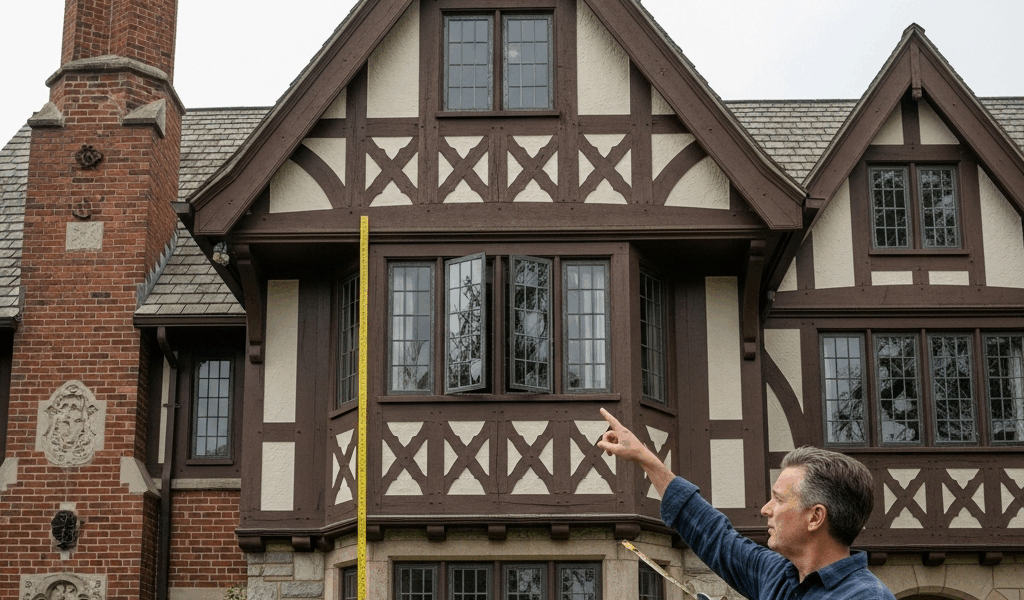
Half-timbering is the most iconic feature — and the one most people respond to emotionally before they even realize what it is. But what is half-timbering? In essence, it’s dark exposed wooden beams set against lighter stucco, plaster, or brick infill. But it’s much more than that. On a Tudor Revival, those beams aren’t purely structural — they’re decorative, mimicking the medieval English technique where the timber frame was genuinely load-bearing. On an authentic Revival from the 1910s or 1930s, you’re typically looking at Douglas fir or oak timbers, stained dark brown or black, with stark contrast against white or cream stucco.
Real half-timbering on quality Revival homes has texture and slight irregularity — boards that aren’t perfectly uniform because they were often hand-hewn or hand-finished. If the timbers look printed on — perfectly flat, no shadow line, suspicious uniformity — you’re probably looking at a modern Tudor-inspired home where the beams are thin applied strips of wood or even foam. Not inherently bad. But worth knowing before you make an offer.
The Roofline — Steep, Irregular, and Often Asymmetrical
The pitch is almost always the first thing visible from down the block. Tudor Revival roofs typically pitch between 12:12 and 16:12 — rising twelve to sixteen inches for every twelve inches of horizontal run. That’s steep. The roof dominates the facade, often consuming more than half the visible elevation of the house. You’ll also see multiple intersecting gabled sections rather than a single clean ridge. The roofline looks busy, layered, sometimes almost haphazard. That complexity is intentional and period-correct.
Cross gables, jerkinhead gables, decorative half-timbering within the gable ends themselves — all normal. One house I documented in Cleveland Heights had five distinct roof planes visible from the street alone. It looked like the architect had a wonderful time designing it.
Chimneys — Tall, Ornate, and Often Grouped
Massive chimneys are table stakes for a true Tudor Revival. Stacks that rise well above the roofline, often with decorative patterned brickwork, corbeled tops, and multiple flues built together into a single architectural statement. The Revival architects kept the scale and drama of those chimneys even after central heating made the fireplace-as-primary-heat-source obsolete — honestly, thank goodness they did.
Look for diagonal or spiral brick patterns on the chimney shafts. Look for multiple caps clustered on a single base. If the chimney looks like something lifted straight from a fairy tale castle, you’re on the right track.
Windows — Leaded Glass, Casements, and Oriel Bays
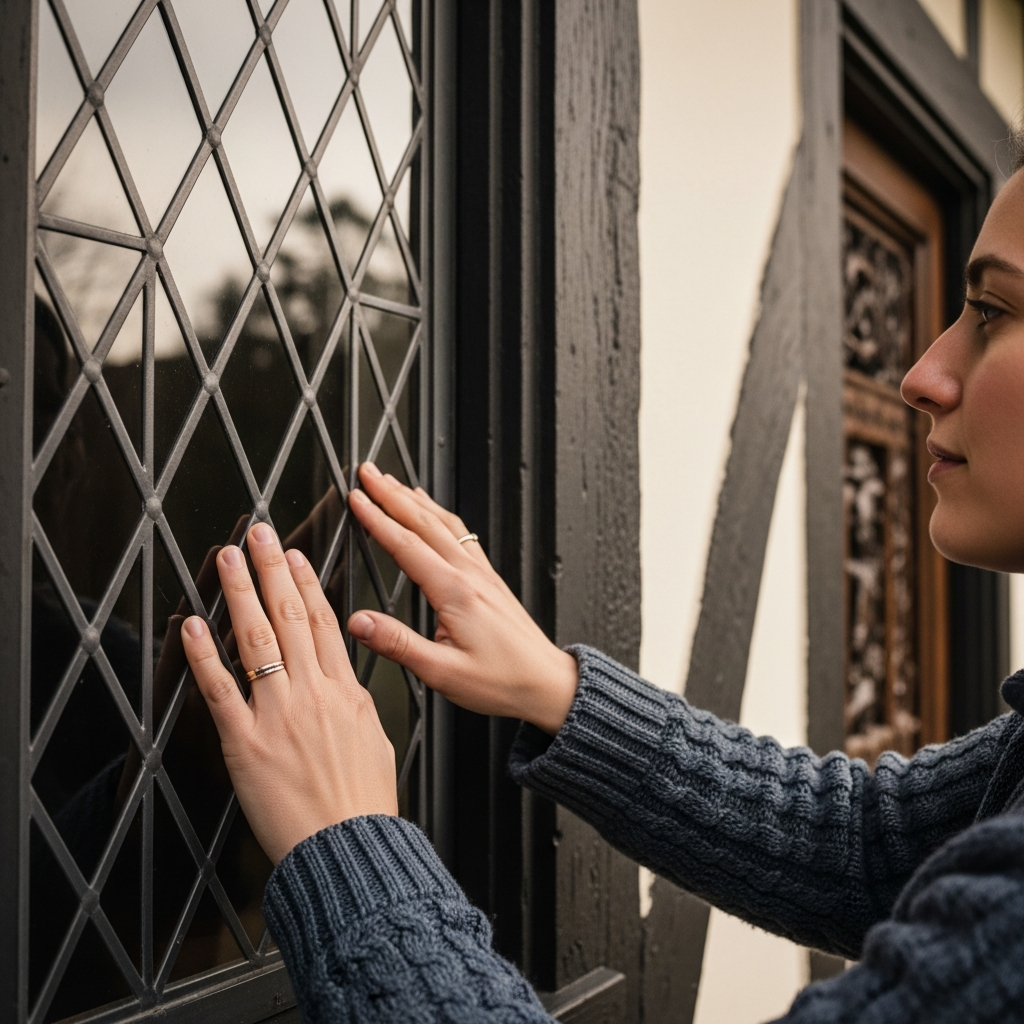
Windows on Tudor Revival homes come in a few specific flavors. Leaded glass — small diamond or rectangular panes joined by strips of lead called cames — is the most period-correct option and the most expensive to restore when it eventually fails. Steel casement windows arranged in long horizontal bands, sometimes with transoms above, are also common, especially on homes built through the 1920s and 1930s when steel windows were considered a premium upgrade.
Oriel windows — those enclosed, often polygonal projecting bays supported by corbels rather than a foundation — show up frequently and are one of the details that make the style read as unmistakably English. They break up flat facades and add shadow and depth you simply don’t get from flat window arrangements. I’ve seen oriel windows as small as a single-pane bay and as elaborate as three-story projecting towers with their own mini-roofs.
Other Markers Worth Noting
- Rounded or flattened arch entry doors — often set deeply into the facade
- Stone or brick lower floors with stucco upper floors (a common combination)
- Decorative vergeboard — also called bargeboard — along gable edges
- Massive front doors with strap-iron hardware, often arched
- Asymmetrical facades — Tudor Revivals rarely have a centered front door
- Low, horizontal massing overall despite the vertical roofline elements
Real Tudor vs Tudor Revival vs Tudor-Inspired — They Are Not the Same Thing
Probably should have opened with this section, honestly. Before you can identify a Tudor Revival home correctly, you need to understand what the word “Revival” is actually doing in that phrase. These are three distinct categories — conflating them leads to real confusion, especially when you’re reading a listing that uses “Tudor” as a marketing adjective for basically anything with dark beams and a vaguely pointy roof.
Original Tudor Architecture — 1485 to 1603
True Tudor architecture belongs to the reign of the Tudor monarchs in England — Henry VII through Elizabeth I. These are the actual half-timbered structures where the exposed wooden frame was genuinely structural. Green oak timber, wattle-and-daub infill — a mixture of woven sticks and clay — and buildings that evolved over generations rather than being designed in any modern sense. Proportions were dictated by available materials, not aesthetic theory.
You are not going to find one of these in an American suburb. Full stop. The closest you’ll get is a handful of reconstruction projects and museum buildings. Real Tudor buildings are in England, and even there many have been heavily restored over five centuries.
Tudor Revival — 1890s to 1940s
This is what most American homebuyers encounter when they search “Tudor style home.” The revival movement emerged from a broader 19th-century fascination with medieval English architecture, peaking in the United States between roughly 1900 and 1940. Architects like Charles Barton Keen in Philadelphia, and firms like Harrie T. Lindeberg’s office, were building serious, substantial Tudor Revival estates for wealthy clients. By the 1920s, pattern books had democratized the style — contractors across the country were building Tudor Revival bungalows and middle-class cottages alongside the grand estates.
What distinguishes a genuine Revival from later imitations? Materials. A 1925 Tudor Revival in Shaker Heights, Ohio will have solid masonry walls, real oak timbers, genuine leaded glass, hand-wrought iron hardware. These homes were built to last a century or more and generally have. The half-timbering may be decorative rather than structural, but the materials underneath — brick, stone, quality-grade dimensional lumber — are substantive.
Tudor-Inspired — 1970s to Present
Starting in the 1970s and continuing heavily through the 1990s, production builders discovered that Tudor aesthetic elements could be applied to tract housing at minimal cost. Thin wood strips glued to Masonite or OSB sheathing create the visual impression of half-timbering. Fiberglass-reinforced plastic oriel windows substitute for the real thing. The result looks Tudor from thirty feet and falls apart under scrutiny — or weather.
Don’t make my mistake. I got genuinely excited about a 1987 “Tudor” in suburban Maryland that looked fantastic in listing photos. Up close, the timbers were quarter-inch strips of pine already lifting at the corners, and the leaded glass was a factory-applied grid on a standard double-hung window. Not the same thing. Not even close.
This isn’t automatically a deal-breaker depending on your budget and goals. But you should know which category you’re buying before you’re standing at a closing table.
Regional Variations Across the US — Materials and Details Shift by Geography
Tudor Revival isn’t a monolithic look. The style adapted to local materials, climate, and building traditions in ways that can make a Philadelphia Tudor and a Portland Tudor look like distant cousins at best. Knowing regional patterns helps you assess whether a home is using period-appropriate materials or substitutions.
Northeast — Brick and Stone, Dark and Substantial
The Northeast — particularly Philadelphia’s Main Line suburbs, New York’s Westchester County, Connecticut’s shoreline towns — produced some of the most architecturally serious Tudor Revivals in the country. These homes lean heavily on Pennsylvania fieldstone and dark brick, often stone on the ground floor and brick or stucco above. The color palette runs to grays, dark reds, deep browns. The effect is heavy, formal, and unmistakably prosperous.
Frustrated by the limitations of imported stone, Charles Barton Keen started designing dozens of estates using local Wissahickon schist — a distinctive blue-gray stone quarried from the Philadelphia region — creating homes that felt genuinely rooted in their landscape in a way imported materials never could. That new idea took off several years later and eventually evolved into the regionally-grounded Northeast Revival aesthetic enthusiasts know and admire today.
Windows in Northeast Revivals often feature steel Crittall-style casements — look for Fenestra or Hope’s brand windows in original installations, though both companies have had complicated corporate histories since the 1950s.
Midwest — Stucco and Clinker Brick
Midwestern Tudor Revivals, concentrated in Cleveland, Chicago, Milwaukee, and Minneapolis, show a distinct preference for stucco half-timbering over stone. The regional palette shifts toward warm tans and cream stucco with dark brown or black timbers. You’ll also encounter clinker brick — those irregular, sometimes glazed or twisted bricks originally considered kiln waste — used to add texture to foundations and lower walls. Clinker brick has a rough, almost organic quality that suits the authentically imperfect medieval aesthetic beautifully.
The Midwest also produced a significant number of smaller Tudor Revival cottages — 1,400 to 2,000 square feet — built for middle-class buyers in streetcar suburbs during the 1920s. Charming, more modest in their detailing, but genuinely well-built homes.
Pacific Northwest — Wood Takes Center Stage
In Seattle, Portland, and surrounding suburbs, Tudor Revival met a region with abundant old-growth Douglas fir and a climate that pushed architects toward different solutions. Stone is less common; wood siding beneath the timbering is more typical. The half-timbering in Pacific Northwest Revivals tends toward more elaborate patterning — herringbone, chevron, decorative diagonal arrangements show up more frequently here than in the Northeast or Midwest.
The wet climate also pushed some Pacific Northwest builders toward deeper overhangs and covered entry porches you don’t always see on their drier-climate counterparts. Practical adaptations — not departures from the style — and period-correct for the region.
Maintaining a Tudor Revival Home — What No One Tells You Before You Buy
I genuinely love Tudor Revival homes. I also want to be direct about the maintenance reality, because the most responsible thing I can do for someone considering this purchase is describe the work honestly.
Half-Timber Repair — Complex and Expensive
The half-timbering is beautiful. It’s also the source of the most recurring maintenance headaches on these homes. Where timber meets stucco infill, you have a joint between two materials expanding and contracting at different rates. Over decades, that movement creates gaps. Water gets in. Water always gets in.
Proper repair requires removing failed caulk — look for products like Sika Sikaflex-15LM or similar high-movement sealants rated for wood-to-masonry joints — repointing the junction, then repainting both the timber and adjacent stucco. DIY-able if you’re comfortable on a ladder and willing to do it right. A contractor doing it properly on a medium-sized Tudor Revival — say 2,800 square feet with substantial half-timbering — will typically charge between $4,000 and $12,000 depending on your region and extent of deterioration.
Replacement of actual deteriorated timbers is a bigger project. Original timbers were often 4×6 or 6×8 solid oak or Douglas fir — matching that with modern dimensional lumber requires custom milling. Individual timber replacement can run $800 to $2,500 per section including labor. Budget accordingly.
Stucco Maintenance — Catch Problems Early
Traditional three-coat portland cement stucco — which is what most genuine Tudor Revivals have — is durable but not bulletproof. Hairline cracks are normal. Wide cracks, cracks suggesting structural movement, or stucco that sounds hollow when tapped are warning signs. The tap test is free and takes thirty seconds; try it on every exterior surface when you’re touring a home.
Do not let anyone talk you into applying EIFS — synthetic stucco — over failed traditional stucco as a repair strategy. It traps moisture, changes the visual character of the home, and creates long-term problems that cost more to fix than the original repair would have. I’ve seen this done to otherwise beautiful homes. It’s heartbreaking every time.
Window Restoration — Worth the Investment
Original leaded glass windows and steel casements are restorable and worth restoring. Leaded glass, when the lead cames start to fail, can be re-leaded by a skilled glazier — expect $150 to $350 per panel depending on complexity and location. Steel casement windows, particularly original Hope’s or Crittall units, can be restored with new weatherstripping and a rust treatment and refinishing process. Crittall North America — the brand still exists, apparently — sells replacement weatherstripping kits compatible with many original profiles.
[X] might be the best option here, as Tudor Revival restoration requires matching original materials. That is because modern vinyl replacements save money short-term and cost you authenticity, character, and often resale value long-term. Buyers who specifically seek out Tudor Revival homes want original windows. They’re part of what those buyers are paying for.
A Few Other Maintenance Notes
- Those tall, ornate chimneys need annual inspection — the decorative brickwork and corbeling are vulnerable to freeze-thaw damage in cold climates
- Steep roofs shed water fast, which is good, but the valleys between multiple intersecting roof planes accumulate debris and need regular clearing
- Original copper gutters on nicer Revivals should be preserved — they outlast aluminum and suit the aesthetic; replacement runs about $25 to $40 per linear foot installed
- Casement window hardware — cranks, latches, stays — for original steel windows is available from specialty suppliers like Andco Industries or period hardware retailers; don’t assume you need full replacement just because a crank mechanism fails
While you won’t need a restoration contractor on speed dial for every little thing, you will need a handful of reliable specialists — a glazier familiar with leaded glass, a mason comfortable with period brickwork, a stucco contractor who understands traditional three-coat systems. First, you should build those relationships before something fails — at least if you want to avoid the scramble of finding someone qualified mid-crisis. Tudor Revival homes reward owners who pay attention. They’re not passive investments you can ignore for five years. But a well-maintained Tudor Revival — stucco clean and tight, timbers solid, leaded glass throwing patterns across an entry hall floor — is one of the most visually distinctive and architecturally satisfying homes you can own. The style has survived a hundred years of changing taste for a reason.




Stay in the loop
Get the latest classic architecture today updates delivered to your inbox.