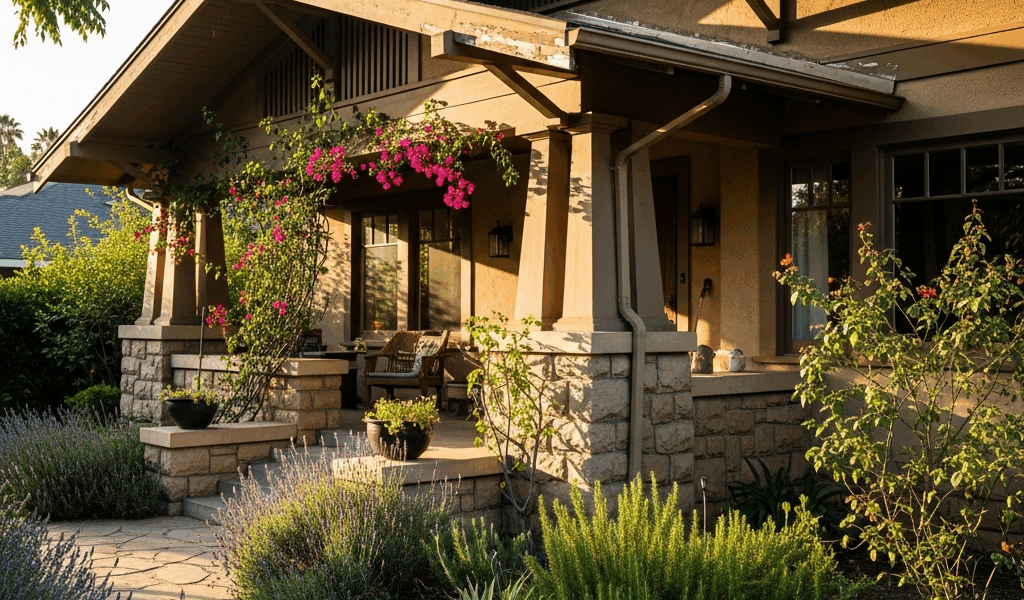
Last October, I spent three days walking the tree-lined blocks of Pasadena’s Oak Knoll and Bungalow Heaven neighborhoods with a notebook and a borrowed copy of Robert Winter’s Craftsman Houses. My goal was simple: see five Greene and Greene-era homes up close and figure out what actually separates a $2.4 million Craftsman from the mass-produced “Craftsman-style” boxes going up in every new subdivision in the San Gabriel Valley.
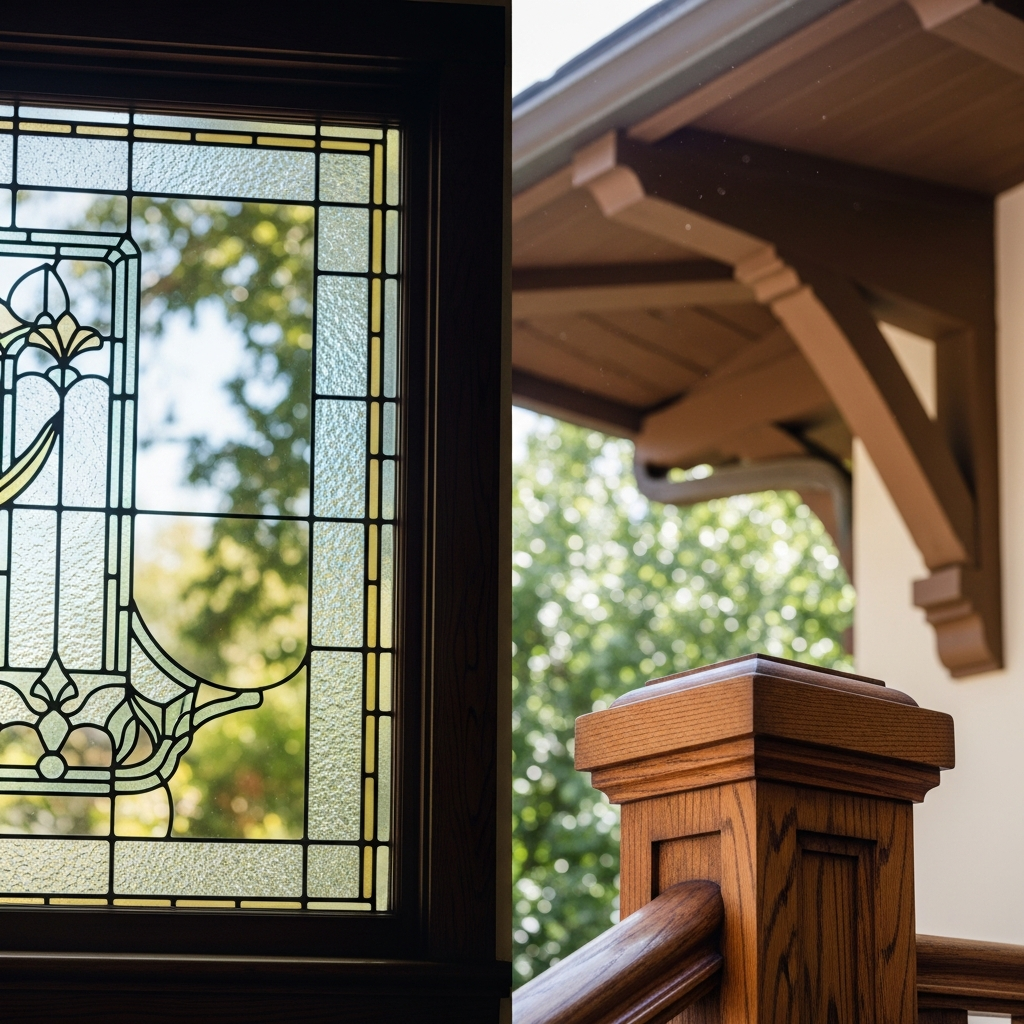
Here is what I found — and what most architecture guides leave out.
1. The Gamble House (4 Westmoreland Place) — The Timber Joints Tell the Story
Everyone photographs the Gamble House from the front lawn. The dark-stained Port Orford cedar timbers, the low-slung roofline, the sleeping porches — it is all iconic. But the detail that stopped me cold was inside, at the staircase landing.
Charles Greene designed a teak staircase where every joint is a visible, hand-fitted wedged tenon. No nails. No screws concealed under putty. The joinery is the decoration. I asked docent Margaret Liu about the wood sourcing: the teak was shipped from Burma through San Francisco in 1908, and the cedar came by rail from Oregon’s Rogue River region. Greene rejected three shipments before accepting timber with the grain pattern he wanted.
The takeaway: authentic Craftsman built-ins treat the joint itself as ornament. If you see a modern “Craftsman” kitchen where the cabinet joints are hidden behind filler strips, that is the giveaway it is reproduction.
2. The Blacker House (1177 Hillcrest Avenue) — Metalwork You Cannot Reproduce
The Blacker House is privately owned and not open for tours, but you can see the exterior metalwork from the sidewalk on Hillcrest. The copper downspouts are not standard half-round gutters — they are custom-hammered panels with a vine-and-cloud motif that Greene designed specifically for this house in 1907.
I spoke with John Reeves, a copper restoration specialist in Monrovia who has worked on two Greene and Greene properties. He told me that reproducing a single Blacker-style downspout section today costs between $8,000 and $14,000 in materials and labor, because each panel requires hand-raising over a wooden form. “You are paying for 40 hours of hammer work per linear foot,” he said. “Most contractors have never even seen the technique.”
Several of the original Blacker House light fixtures were removed and sold at auction in the 1980s — some went to the Huntington Library, others to private collectors. The house’s current owners have been slowly commissioning reproductions from a metalworker in Glendale.
3. 440 Arroyo Terrace — The Modest One Nobody Talks About
This small 1903 bungalow sits on a quiet stretch of Arroyo Terrace, overshadowed by the grander homes nearby. It was one of the Greene brothers’ earliest residential commissions, and it shows a transitional style: the roofline already has the characteristic low pitch and wide eaves, but the porch columns are simpler — river rock bases with plain timber posts instead of the elaborate brackets that came later.
What struck me is the clinker brick foundation. These are the misshapen, over-fired bricks that most builders discarded. Greene and Greene deliberately selected them for texture. I counted at least four distinct colors in a single course — deep purple, charcoal, burnt orange, and the classic dark red. A mason working on a renovation two doors down told me clinker bricks now sell for $3 to $5 each at architectural salvage yards, up from about 50 cents a decade ago.
If you are restoring a Craftsman foundation in Southern California, the best source I found is Olde Good Things in Los Angeles, though their clinker brick inventory turns over fast.
4. The Duncan-Irwin House (240 North Grand Avenue) — How Landscape Makes the House
This 1906 house demonstrates something I had read about but never understood until seeing it in person: Greene and Greene designed the landscaping as part of the architecture. The low stone retaining walls along Grand Avenue use the same arroyo stone as the house foundation, creating a visual line that pulls the building into the ground.
The current owner (who asked not to be named) has maintained the original planting plan using records from the Pasadena Museum of History. The front garden uses California native plants — manzanita, ceanothus, and coast live oak — that were unusual choices in 1906, when most Pasadena gardens were English cottage style. The result is a house that looks like it grew from the hillside rather than being placed on it.
This is the principle that modern Craftsman-style developments miss entirely. The houses in a new “Craftsman” subdivision in Arcadia I drove through afterward had identical landscapes: ornamental pear trees and boxwood hedges. The architecture references the style, but the site design ignores it completely.
5. A Private Restoration on Marengo Avenue — The Cost Reality
Through a contact at Heritage Square Museum, I was invited to see a Craftsman bungalow on South Marengo Avenue that is mid-restoration. The owners bought it in 2022 for $1.1 million and have spent approximately $340,000 so far — and they are roughly 60 percent done.
The biggest expense has been the windows. The originals were single-pane, true divided-light casements with art glass transoms. Four of the 14 windows were beyond repair (dry rot in the muntins). The owners hired a window shop in Duarte that specializes in historic replication: each replacement window cost between $4,200 and $6,800 depending on size and whether it included art glass.
The original Douglas fir floors required sanding down 3/16 of an inch to get below the damage layer. Their floor specialist, based in Alhambra, charged $7.50 per square foot for the sand-and-refinish, versus about $3.50 for a standard hardwood refinish. The difference is the care required to preserve the quarter-inch tongue-and-groove boards without sanding through them.
I asked the owners if they considered modern materials for any of the restoration. “We looked at composite trim for the exterior,” one of them told me. “It was about 40 percent cheaper. But when you put it next to the original redwood, the grain pattern is wrong, and it does not age the same way. In five years you would see the difference.”
What Actually Separates Authentic Craftsman From Imitation
After three days of looking at these houses, I came away with a checklist that has nothing to do with paint colors or porch brackets:
- Visible joinery: Real Craftsman woodwork shows its construction. Mortise-and-tenon, wedged joints, exposed rafter tails. If the joints are hidden, it is not Craftsman — it is Craftsman-shaped.
- Material sourcing: Original builders selected specific wood species for specific locations. Port Orford cedar for exterior trim (rot resistant), teak or mahogany for interior built-ins (stability), Douglas fir for framing and floors (strength). Modern reproductions often use a single species throughout.
- Site integration: The house relates to its landscape through matching materials, low horizontal lines, and native plantings. This is the hardest element to reproduce and the most commonly ignored.
- Hardware and metalwork: Original hardware was designed for the house, not selected from a catalog. Reproduction Craftsman hardware exists (Rejuvenation and House of Antique Hardware are the best sources), but it is generic by definition.
- Imperfection as intent: Clinker bricks, hand-split shakes, irregular stone — Greene and Greene chose materials that mass production would reject. If everything looks too perfect, it probably is.
If you are in the Pasadena area and want to see these houses yourself, the Gamble House offers tours Thursday through Sunday. For the others, drive the Arroyo Terrace loop and walk the blocks between Colorado Boulevard and California Boulevard in the Bungalow Heaven neighborhood. The Pasadena Heritage organization runs guided walking tours twice a month from September through June.

Stay in the loop
Get the latest classic architecture today updates delivered to your inbox.