How to Spot Authentic Art Deco Geometry
Art Deco architecture has gotten complicated with all the modern revivals and knockoffs flying around. Walk through a 1920s–1930s lobby and something catches your eye—a pattern that feels almost mathematical, shapes that seem to vibrate. You’re probably looking at genuine Art Deco. This is the most reliable visual marker I’ve learned to recognize, honestly.
The chevron pattern is everywhere in authentic Art Deco design. Think of repeated V-shapes stacked vertically or arranged in dramatic angles — you’ll see them in floor tiles, wall panels, door surrounds, and exterior brickwork. The Chrysler Building in New York uses chevrons relentlessly on its crown and facade. What makes them distinctly Art Deco rather than just geometric? The rhythmic repetition and the slightly aggressive forward momentum. They feel like they’re moving or ascending.
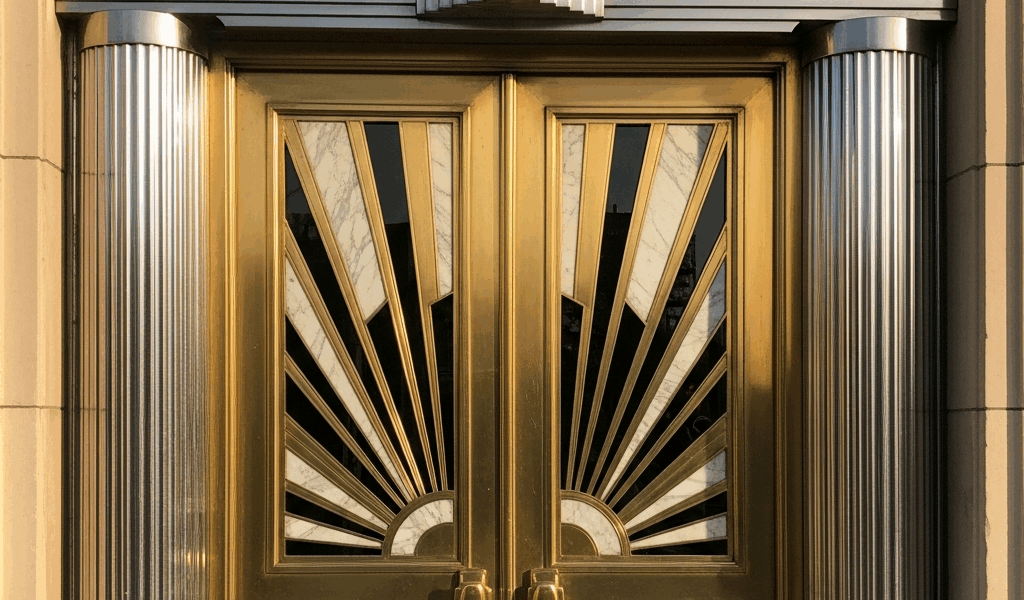
Sunburst motifs function as the style’s secondary signature. Radiating lines fan outward from a central point, resembling either a rising sun or a starburst. I first noticed this detail on the bronze door handles of a 1928 apartment building in Chicago — the rays extended in perfect symmetry, and the metalwork caught light in a way that felt intentional and luxurious. You’ll find sunbursts on elevator doors, floor medallions, exterior spandrels, and decorative wall panels. Unlike the more organic sun imagery in Art Nouveau, Art Deco sunbursts are precise, often geometric, almost architectural in their regularity.
Stepped or zigzag forms create vertical emphasis. Picture a shape that looks like a staircase or a lightning bolt integrated into the building’s profile — these appear on cornices, window surrounds, and roof edges. The setback skyscrapers of Manhattan exemplify this feature at monumental scale, but you’ll find miniature versions on residential buildings too. The stepped form signals modernity and upward reach, core themes of 1920s–30s optimism.
Symmetrical geometric compositions tie everything together. Art Deco abhors asymmetry. Every motif mirrors perfectly across a central axis. If you see geometric ornament that feels balanced and formal, with elements that could fold in half exactly, you’re likely looking at Art Deco. This differs sharply from Art Nouveau’s flowing, often asymmetrical curves.
Art Deco Materials and Surface Treatments
Identifying Art Deco also means understanding the materials craftspeople selected. They weren’t random choices — these materials communicated wealth, modernity, and permanence.
Terrazzo became the Art Deco flooring of choice. This composite of marble chips, granite fragments, or glass set in concrete or epoxy creates a speckled, lustrous surface. Original 1920s–1930s terrazzo floors develop a subtle patina over decades. Modern reproductions often look too uniform, too perfectly polished. That’s actually a red flag. Authentic terrazzo shows natural variation in chip distribution and slight surface irregularities from hand-finishing. If you’re examining a floor and every speck is exactly the same size and spacing, it’s been completely replaced.
Polished chrome and brass hardware define Art Deco interior spaces. Door handles, elevator trim, light fixtures, radiator covers — these were finished in these metals because they reflected light and suggested industrial precision. Real period chrome develops a subtle warmth and specific patina pattern. Reproduction chrome plating from the last 20 years looks uniformly bright and sterile. Run your finger across brass door hardware and feel slight variation in the surface depth — tiny scratches and wear patterns distributed across decades — you’re touching original material.
Black marble and contrasting stone combinations create visual drama. Highly polished black marble, often paired with white or pink marble, forms baseboards, wall panels, and floor borders. The high-gloss finish is characteristic; matte black stone finishes are later interventions. Sourcing replacement black marble to match 1920s–1930s pieces is nearly impossible, which is why original stone is worth protecting.
Glass blocks appear in walls, particularly in bathrooms, stairwells, and commercial storefronts. Early Art Deco glass blocks — 1920s–early 1930s — are thicker and more irregular than post-1950s versions. They contain slight air bubbles or waves in the glass. Modern replacement blocks are too uniform and perfectly clear. See distinct manufacturing imperfections? You likely have original material.
Glazed ceramic tile and faience work create colorful, durable surfaces. The tiles are typically small, 2–4 inches square, and arranged in geometric patterns. Authentic Art Deco tiles exhibit slight color variation from piece to piece, a result of hand-glazing processes. They might feature stylized flora, geometric patterns, or abstract designs. The glaze has a particular depth; modern reproductions often feel thin and plastic-like by comparison.
Interior vs. Exterior Art Deco Elements
Probably should have opened with this section, honestly. The location of ornamental details tells you exactly what to expect.
Inside buildings, focus on lobbies and circulation spaces first. Elevator doors display concentrated ornament — brass surrounds, geometric panels, sometimes elaborate sculptural relief. Lobby floors combine terrazzo, marble borders, and sometimes inlaid metal patterns. Wall paneling uses contrasting materials: wood veneers, polished stone, chrome trim. Brass mailboxes and door hardware receive meticulous detailing. Staircases feature polished railings, often chrome-plated steel with minimal ornamentation. Art Deco prefers clean lines over fussy detail.
I counted seven distinct materials on the stairs of a 1928 Manhattan office building — a single flight up. Chromium plating on the railing, walnut veneer on the wall panel, terrazzo treads with brass nosing, limestone risers, polished plaster walls, chrome light fixtures, and black marble baseboards. The effect wasn’t chaotic — it was orchestrated, each material in conversation with its neighbors.
Exterior Art Deco focuses on visual impact from street level. Spandrels — the wall sections between window rows — carry geometric ornament, often executed in tile, stone, or metal. Cornices and rooflines employ the stepped forms and chevron patterns mentioned earlier. Window surrounds feature bold trim in contrasting materials. Storefronts use chrome trim, glass blocks, and polished stone extensively. The building’s crown or roofline receives special attention, with setbacks, decorative towers, or ornamental copings creating silhouette interest.
The distinction matters practically. If you’re renovating interiors, expect to find quality materials preserved behind modern finishes. They were built to last and designed for the spaces you’re inhabiting. Exterior details face weather, so original material survival depends heavily on maintenance history. Chrome and polished stone weather poorly without protection; brick and tile weather better.
Art Deco vs. Art Nouveau and Streamline Moderne
Confusion between these three styles is universal. They’re consecutive historical movements with overlapping dates, and untrained eyes see “old geometric design” without distinguishing periods.
Art Nouveau precedes Art Deco, 1890–1910 versus 1920–1940. The key visual difference: Art Nouveau curves organically, like plants and natural forms. Whiplash curves, asymmetrical compositions, nature-inspired ornament characterize the style. See swirling tendrils, stylized flowers, or flowing lines that suggest growth? It’s Nouveau. Art Deco geometry is rigid, mathematical, symmetrical. A Nouveau iris is organic and delicate; a Deco sunburst is constructed and precise.
Streamline Moderne emerges from Art Deco in the 1930s–1940s and represents its evolution. The style emphasizes speed and aerodynamic forms — horizontal bands, curved corners never sharp angles, and a streamlined profile mimicking ships, trains, or cars. If Art Deco is static and symmetrical, Streamline Moderne is kinetic and directional. A Deco building sits squarely on its site; a Streamline Moderne building appears to be moving. The Hoover Building outside London exemplifies Streamline Moderne perfectly; the horizontal bands and curved forms suggest forward motion.
Here’s the practical distinction for identifying buildings. Art Deco uses sharp angles, stepped forms, chevrons, and symmetry. Streamline Moderne softens those angles into curves and adds motion through horizontal lines. Examining exterior cornices and they’re stepped, not curved? You’re looking at Deco. Corner details gently rounded and the overall form suggests movement? That’s Streamline Moderne.
Material choice differs too. Art Deco favors contrasting materials — black and white, polished and matte, reflective and textured. Streamline Moderne prefers continuous surfaces, often chrome or glass, that wrap around curves without visual breaks.
Preserving Art Deco Features in Your Home
Original Art Deco finishes respond well to gentle care. Chrome trim should be polished with non-abrasive wax — never steel wool or harsh commercial cleaners that remove patina and damage the plating. A soft microfiber cloth and paste wax designed for chrome restores shine without harm. Test on an inconspicuous area first. Don’t make my mistake. I learned this the hard way by using Brillo pads on 1928 door hardware, removing years of protective patina in minutes.
Terrazzo floors require periodic resealing with penetrating sealer, not acrylic finishes that yellow and peel. Small sections chipped? Specialist restorers can patch terrazzo to match, though costs run $800–$2,500 per repair depending on size and access.
Tile work needs regrouting every 50–70 years. Use grout matched to original color, often darker than modern standards. Avoid waterproofing sealers on glazed tile — they create visual haze. Polished marble and stone benefit from annual professional cleaning and occasional resealing with products designed for natural stone.
Door hardware and fixtures are sourced from restoration suppliers like Rejuvenation, Schoolhouse Electric, or specialty hardware companies. Reproduction brass handles designed to fit 1920s–1930s locks cost $35–$150 per handle. Expect to invest in authentic reproductions rather than cheap modern substitutes that feel thin and hollow.
One final note: document original finishes with photographs before any work begins. Color matching becomes nearly impossible without reference images, and your future self will thank you for the documentation. Art Deco buildings are investments in craft and materials. They’re worth preserving authentically.



Stay in the loop
Get the latest classic architecture today updates delivered to your inbox.