Prairie Style Architecture — Frank Lloyd Wright’s Vision Explained
Prairie style architecture has gotten complicated with all the misconceptions flying around. People throw the term at anything low-slung with a wide roof, missing the point entirely. As someone who has spent the better part of eight years measuring eave overhangs, photographing corner details, and actually sitting inside these homes to watch light move through them, I learned everything there is to know about what Frank Lloyd Wright was actually trying to accomplish — and why it still matters.
I own a 1:48 scale model of the Robie House on my desk — cost me $89 from a specialty architecture retailer in Madison — and I still catch details I missed the first hundred times I looked at it. That’s not an exaggeration. These buildings reveal themselves slowly. The first time I walked into a genuine prairie style home, something shifted. Conventional houses suddenly looked apologetic by comparison.
Frank Lloyd Wright’s Rejection of the Victorian Box
But what is prairie style, exactly? In essence, it’s architecture designed to echo the vast horizontal terrain of the American Midwest, with every element working alongside the flat land instead of against it. But it’s much more than that.
By the 1890s, the architectural establishment had trapped America inside boxes. Victorians climbed upward, decorated everything, and compartmentalized rooms — generally treating the landscape as something to conquer. Wright looked at the same Midwest everyone else saw and found something they’d completely missed: beauty in simplicity, strength in horizontality, freedom in open space.
Probably should have opened with this section, honestly. The philosophical shift Wright accomplished was genuinely radical. He wasn’t tweaking decorative details. He was redefining what architecture was supposed to do at a foundational level.
The prairie itself became his muse. Those endless flat horizons of Illinois, Wisconsin, and Michigan didn’t apologize for their emptiness — they celebrated it. A Victorian mansion announced itself loudly, dominating everything around it. A Wright prairie house whispered. It invited you to look longer, to notice relationships between materials, to feel the boundary between inside and outside dissolve.
This rejection wasn’t gentle. Wright was famously combative, dismissing Victorian architecture as derivative and dishonest at every opportunity. He believed horizontal lines — not vertical ones — expressed American freedom and democratic ideals. The prairie stretched without hierarchies or hard edges. Architecture, he argued, should do the same.
Between 1900 and 1920, Wright designed roughly 50 prairie style homes, each one testing his theories. Some succeeded brilliantly. Others taught him things through partial failure — which he’d never openly admit, but the evolution is visible if you study the sequence carefully. The Darwin D. Martin House in Buffalo, finished in 1905, reportedly cost the Martin family around $40,000 — an enormous sum then — and proved prairie style could transcend modest suburban lots and enter genuinely ambitious territory.
Key Features to Identify
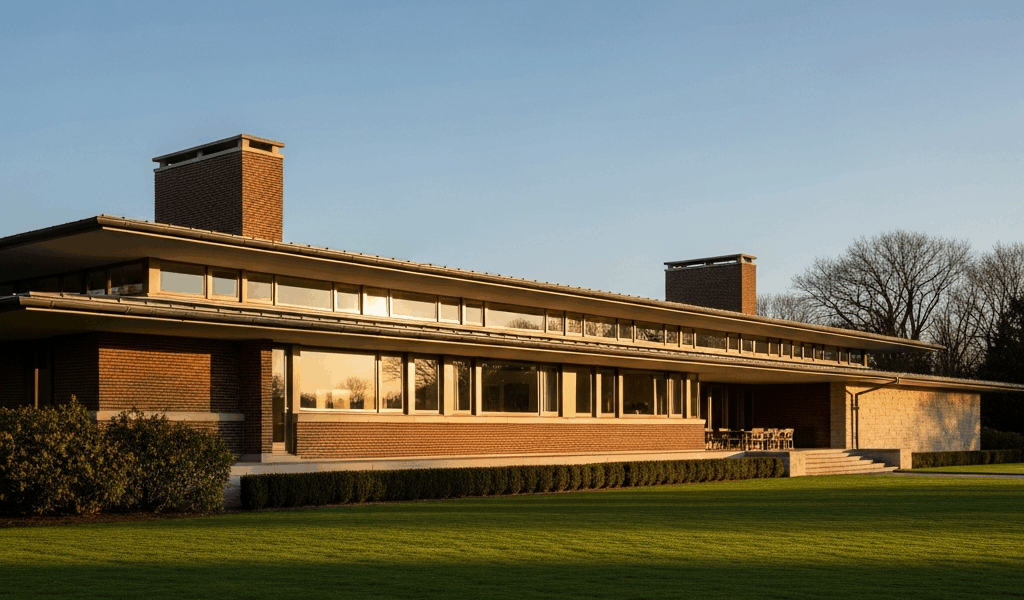
When you know what to look for, prairie style homes announce themselves immediately. They sit low. A typical Victorian mansion might stretch 35 feet toward the sky; a Wright prairie home might reach only 20 feet to the roofline, its mass spread across the lot rather than stacked. The rooflines matter tremendously — low-pitched slopes, often just 4 or 5 degrees, with dramatically overhanging eaves extending 2, 3, sometimes 4 feet beyond the wall beneath them. Those overhangs create deep shadows that reinforce the horizontal emphasis. The whole composition hugs the ground like it grew there.
The windows tell the story too. Forget the tall, narrow double-hungs that dominated Victorian homes. Wright preferred horizontal bands of casement windows arranged in geometric grids — not afterthoughts punched into walls, but integral elements designed to echo the proportions and rhythms of the prairie itself. The Susan Lawrence Dana House in Springfield, Illinois — completed in 1903 — features more than 250 art glass windows and doors. Each one designed specifically for its location. Many containing geometric patterns drawn from native prairie plants. That’s not decorative excess; that’s obsessive coherence.
Open floor plans replaced the Victorian maze of specialized rooms. A traditional house kept the kitchen hidden, the parlor formal, the servants’ domain entirely segregated. Wright dismantled all of that. Spaces flowed into one another without hard boundaries. Walls were reduced or eliminated entirely in favor of structural columns that could support the roof without fragmenting the interior. That’s what makes these homes so endearing to us architecture obsessives — you feel the space differently. It breathes.
The central chimney became an organizing principle. Wright often placed a massive chimney at the heart of the home — sometimes constructed from locally quarried stone — literally connecting the house to its landscape. This chimney did more than support the hearth; it anchored the entire composition. Rooms spiraled around it in flowing sequences rather than rigid hierarchies.
Materials mattered as much as forms. Wright favored brick, stone, and wood — things that age naturally and connect to the regional landscape. He rejected applied ornament in favor of letting materials express themselves honestly. A brick wall looked like brick. Wood trim showed its grain. This wasn’t budget-driven simplicity. It was a deliberate philosophical position about what honest architecture actually meant.
At the Frederick C. Robie House in Chicago — completed in 1910 at a cost of roughly $60,000 — nearly every interior element reflects this thinking. Light fixtures, furniture, tile patterns, even the metalwork on doors — all of it echoes the same linear geometric themes governing the exterior. Some critics called this obsessive. Wright called it integrity. Don’t make my mistake of dismissing it as mere stylistic repetition before you’ve actually sat inside one of these rooms and watched afternoon light move across those surfaces.
The proportions operated according to mathematical systems too. Wright didn’t choose random dimensions. He worked with modular grids — often derived from the brick dimensions themselves — creating relationships that felt inherently harmonious even when viewers couldn’t explain why. The Avery Coonley House in Riverside, Illinois, built between 1907 and 1908, stretches nearly 200 feet in length but feels entirely composed. Every dimension relates to every other dimension through Wright’s proportional logic. That’s the part most people miss entirely.
Where to Find Prairie Style Homes Today
Oak Park, Illinois — a suburb just west of Chicago — became the epicenter. Wright lived there, built his studio there, and designed more than 25 homes in that single community between 1894 and 1909. Walking those streets today feels like wandering through an open-air museum, except real people live in most of it. The Frank Lloyd Wright Home and Studio operates as a proper museum with tours that reveal his design process in surprising detail. I visited on a cold early October morning, when the mature trees created that dappled light that makes the homes look almost luminous against the sky. Worth timing your trip for autumn if you can manage it.
The neighborhood tells the full preservation story — some homes look exactly as Wright intended, some have been carefully restored, and a few bear the marks of well-meaning updates that slightly missed the original vision. Apparently even sympathetic renovations can quietly undermine proportional relationships Wright spent months calculating. The difference is visible once you know what you’re looking for.
Beyond Oak Park, prairie style concentrated in other Midwest cities. Milwaukee has significant examples. Madison preserved the Lamp House. Buffalo’s Martin House Complex — one of Wright’s genuine masterpieces — requires intentional travel but rewards it completely. These aren’t casual drive-by destinations. Budget a full day minimum.
While you won’t need an architecture degree to appreciate these homes, you will need a handful of good resources before you go. The Frank Lloyd Wright Building Conservancy maintains databases of his properties and visiting information. Several architectural tourism companies offer specialized tours. Many privately-owned homes open occasionally for heritage events — worth watching their calendars. First, you should contact the Conservancy directly — at least if you want the most current access information, since visiting conditions change seasonally.
The investment community has noticed too. A well-restored Wright prairie home in decent condition might sell anywhere from $1.2 million to $3 million depending on size and location — a significant premium over comparable homes, but probably justified given both architectural importance and the quality of construction these buildings typically demonstrate. They were built to last. And apparently, most of them have.
Prairie style might be the best architectural lens for understanding American design history, as the movement requires grasping both philosophical ambition and technical innovation simultaneously. That is because Wright wasn’t just designing buildings — he was arguing, loudly and persistently, for a completely different relationship between human habitation and the natural world. That argument still holds up. The buildings still prove it, if you take the time to actually look.




Stay in the loop
Get the latest classic architecture today updates delivered to your inbox.