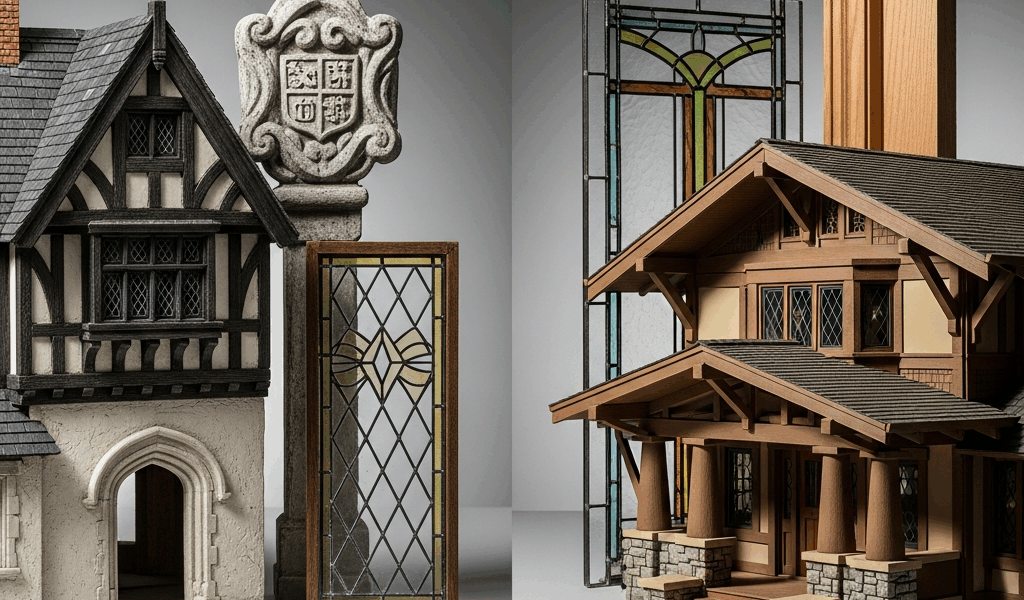
Tudor Revival vs Craftsman Style — How to Tell Them Apart
Tudor Revival vs Craftsman style has gotten complicated with all the armchair architecture noise flying around. As someone who has spent fifteen years walking historic neighborhoods in the Midwest and Pacific Northwest — clipboard in hand, trying to document residential buildings before they get flipped into something unrecognizable — I learned everything there is to know about misidentifying these two styles the hard way. A 1928 Tudor Revival on a street in Oak Park, Illinois. I wrote it up as a Craftsman bungalow in my survey notes. My supervising historian circled the error in red pen and handed it back without a single word. That moment changed how I look at houses.
The confusion is understandable, honestly. These two styles share a philosophical ancestor, but they ended up looking nothing alike on an actual street. Once you know the four visual markers I use in the field, you won’t mix them up again.
The Shared Arts and Crafts DNA
But what is the Arts and Crafts movement, exactly? In essence, it’s a late 19th-century revolt against Victorian excess — against machine-made ornamentation and the cluttered, overwrought aesthetic of high Victorian homes. But it’s much more than that. It was a whole philosophical argument: buildings should be honest about their materials. Stop hiding the structure. Stop slapping decorative gewgaws onto every surface. William Morris and John Ruskin made that argument in England first, and by the 1890s it had crossed the Atlantic.
That shared philosophy is exactly why people confuse Tudor Revival and Craftsman. Both feel grounded, earthy, handmade. Neither one looks like a Victorian wedding cake. Both use natural materials — wood, stone, brick — with visible texture and real weight. You stand in front of either one and feel the same general solidity that you simply don’t get from a Queen Anne cottage.
The divergence happened at the point of cultural reference. American Craftsman architects — Gustav Stickley’s influence looms large, alongside the Greene brothers out in Pasadena — looked to vernacular American building traditions, Japanese joinery, Swiss chalet forms. They were building something distinctly of this continent. Tudor Revival architects, working roughly the same period from about 1890 to 1940, looked backward across the Atlantic to late medieval English manor houses. Same philosophy. Radically different historical vocabulary.
That’s what makes this distinction endearing to us architecture nerds — the tension is philosophical before it’s visual. Ask yourself when you walk up to an unfamiliar house: does this feel like a California hillside or an English countryside? The answer is usually already written in the roofline before you’ve reached the front walk.
Roof Pitch Tells You Immediately
Probably should have opened with this section, honestly.
Stand across the street. Look at the roofline. That’s most of your answer right there.
Craftsman homes have low-pitched roofs — typically a 4-in-12 to 6-in-12 pitch, meaning the roof rises four to six inches for every twelve inches of horizontal run. The roof feels like it’s hugging the house. Wide, overhanging eaves extend two to three feet out from the wall plane, sometimes considerably more on Greene and Greene commissions where you see eaves pushing past thirty-six inches. The whole effect is horizontal. The house looks like it belongs to the ground.
Tudor Revival roofs do the opposite. Steep — dramatically, aggressively steep. Pitches of 10-in-12, 12-in-12, even sharper on the secondary gables. They shoot upward and create a vertical, reaching quality. Multiple gables intersect at odd angles. Dormers punch through at sharp pitches. Where a Craftsman roof says “settle in,” a Tudor Revival roof says “look up.”
Gable count matters too. Craftsman bungalows often carry a simple cross-gable or a single dominant front-facing gable. Tudor Revival homes are characterized by multiple gables of different sizes competing for your attention — a large central gable, smaller flanking gables, steep dormers, sometimes a projecting gabled bay. The roofline is active and complex where the Craftsman roofline stays calm and horizontal.
I once clocked a Tudor Revival during a survey in Shaker Heights, Ohio where I counted seven distinct gables on the front facade alone. Seven — on a house maybe 2,400 square feet total. That kind of gable density is a pure Tudor Revival signature. You will not find it on any Craftsman house anywhere.
The Eave Detail
Look at what’s happening at the eave edge. Craftsman homes show their structure — exposed rafter tails cut to a decorative profile, often two-by-six stock, sometimes notched or shaped, projecting past the fascia board. The eave is thick and substantial, and you can see exactly what’s holding it up. Tudor Revival eaves are often much tighter, sometimes nearly flush with the wall, because the visual drama lives in the gables and the half-timbering rather than in any eave projection.
Half-Timbering — The Tudor Giveaway
I walked up to a house in Ann Arbor once with a colleague who kept insisting it was a “rustic Craftsman.” It had decorative dark wood members applied to the upper gable — vertical, horizontal, and diagonal elements set against cream-colored stucco. Don’t make my mistake of second-guessing what you’re seeing. That is Tudor Revival half-timbering, and it is the single most reliable visual signature of the style.
Here’s what most people don’t realize about Tudor Revival half-timbering: it’s largely decorative. On genuine medieval English timber-frame construction, the heavy oak members on the exterior were the actual structural skeleton of the building — load-bearing, with the spaces between them filled with wattle and daub, brick, or plaster. By the time American architects were building Tudor Revival houses in the 1910s through the 1930s, the structural system was conventional wood framing or masonry. The dark wood members applied to the stucco upper stories are applied ornament. They reference the historical form without doing what the historical form actually did.
This reveals something philosophically interesting — and a little contradictory. Tudor Revival architects were operating within the Arts and Crafts vocabulary of honest materials while simultaneously applying purely cosmetic historical references. Craftsman architects solved that tension differently.
Craftsman homes expose their structural elements too. But those elements are actually structural — or at least genuinely part of the assembly. The knee braces under the porch beams transfer real loads, or they read visually as though they do. The rafter tails are the actual rafter ends. The through-tenon joinery visible on Greene and Greene furniture translated into their architecture as real joinery. Nothing is applied for effect alone.
So the distinction is this: dark timber members creating a pattern against light stucco on the upper walls and gables means Tudor half-timbering. Exposed wood elements at the eaves, porch, and brackets that appear to be genuine components of the building’s assembly means Craftsman detailing. The materials overlap — both use dark-stained wood prominently — but the relationship of that wood to the building is completely different.
Tudor Revival facades also commonly feature:
- Brick or stone on the lower story with half-timbered stucco above
- Decorative patterns within the half-timbering — herringbone, chevron, or sunburst infill between the stucco panels
- Casement windows with small divided lights, often with leaded glass
- Tall, grouped chimney stacks — another English medieval reference
Craftsman exteriors, by contrast, show:
- Horizontal wood clapboard, shingles, or board-and-batten — full-coverage siding without any applied timber grid
- Knee braces and decorative brackets at the eave line and porch structure
- Double-hung or casement windows with a simple upper sash divided into small panes over a single lower pane — the classic Craftsman window pattern
- Stone or clinker brick porch piers that feel massive relative to the house scale
Porch and Entry Differences
Walk up to the front door. This is where the two styles diverge most dramatically in how they handle human arrival.
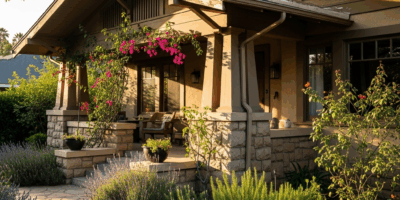
The Craftsman front porch might be the best option for identifying the style at close range, as Craftsman architecture requires a strong social centerpiece. That is because Gustav Stickley and his contemporaries built a whole philosophy around the porch as a space for family life conducted in partial view of the neighborhood — neither fully public nor fully private. Wide, often the full width of the facade. Deep enough for actual furniture. My field rule of thumb: if a porch can hold a porch swing and two rocking chairs with comfortable circulation, it reads as Craftsman scale. The porch roof sits on tapered square columns — wider at the base than the top — resting on substantial piers of river rock, clinker brick, or rough-cut stone. You move through a sheltered intermediate zone before you ever reach the door.
Tudor Revival homes handle entry completely differently. The dominant entry form is a recessed doorway set directly into the facade rather than preceded by any projecting porch. The door itself is often arched — a rounded or slightly pointed arch borrowed from Gothic and late medieval English forms. Sometimes you get a small stoop or a tight covered entry, but nothing approaching the broad welcoming porch of a Craftsman. The entry draws you in and upward toward the verticality of the facade rather than settling you into a comfortable horizontal shelter.
Door hardware tells you a lot too — apparently more than most people notice. Tudor Revival entries frequently feature heavy strap hinges, iron ring pulls, and nail-head studding on solid wood doors, all referencing medieval ironwork. Craftsman doors tend toward simpler, cleaner hardware with more Arts and Crafts formalism — square escutcheons, simple lever or knob hardware, sometimes art glass sidelights flanking the door.
Windows near the entry reinforce the distinction. Tudor Revival favors narrow, tall casements with diamond-pattern leaded glazing. Craftsman favors the divided-over-single double-hung window with clear glass — sometimes art glass in the upper transom, but never the full leaded diamond pattern.
First, you should run through this checklist in order when you’re standing on a sidewalk trying to read an unfamiliar house — at least if you want a reliable answer before you reach the front walk. Roofline pitch and gable count first, then eave detail, then wall surface for half-timbering, then the entry sequence. It took me a misidentified survey form and fifteen years of neighborhood walks to get there. The logic is clean once you see it.


Stay in the loop
Get the latest classic architecture today updates delivered to your inbox.