
Understanding Prairie Style Architecture
Prairie style architecture represents one of America’s most distinctive contributions to global design history. Born in the early 20th century Chicago suburbs, this movement emphasized horizontal lines, natural materials, and harmony with the Midwestern landscape. Today, Prairie homes remain highly sought after by collectors and preservation enthusiasts who appreciate their revolutionary approach to domestic space.
Origins and Historical Context
The Prairie School emerged around 1900 as a direct response to Victorian excess. While Queen Anne and Second Empire homes featured vertical emphasis, elaborate ornamentation, and dark interiors, Prairie architects pursued the opposite aesthetic—low-pitched roofs, bands of windows, and open floor plans that celebrated the flat Midwestern horizon.
Frank Lloyd Wright typically receives credit as the style’s originator, though he worked alongside talented contemporaries including Marion Mahony Griffin, Walter Burley Griffin, William Gray Purcell, and George Elmslie. These architects shared offices, exchanged ideas, and competed for commissions throughout the Chicago metropolitan area.
The movement’s philosophical underpinnings drew from the Arts and Crafts tradition, particularly its emphasis on honest materials and rejection of mass-produced decoration. However, Prairie architects pushed further, arguing that buildings should reflect their specific geographic and cultural context—a concept Wright termed “organic architecture.”
Defining Architectural Features
Horizontal Emphasis
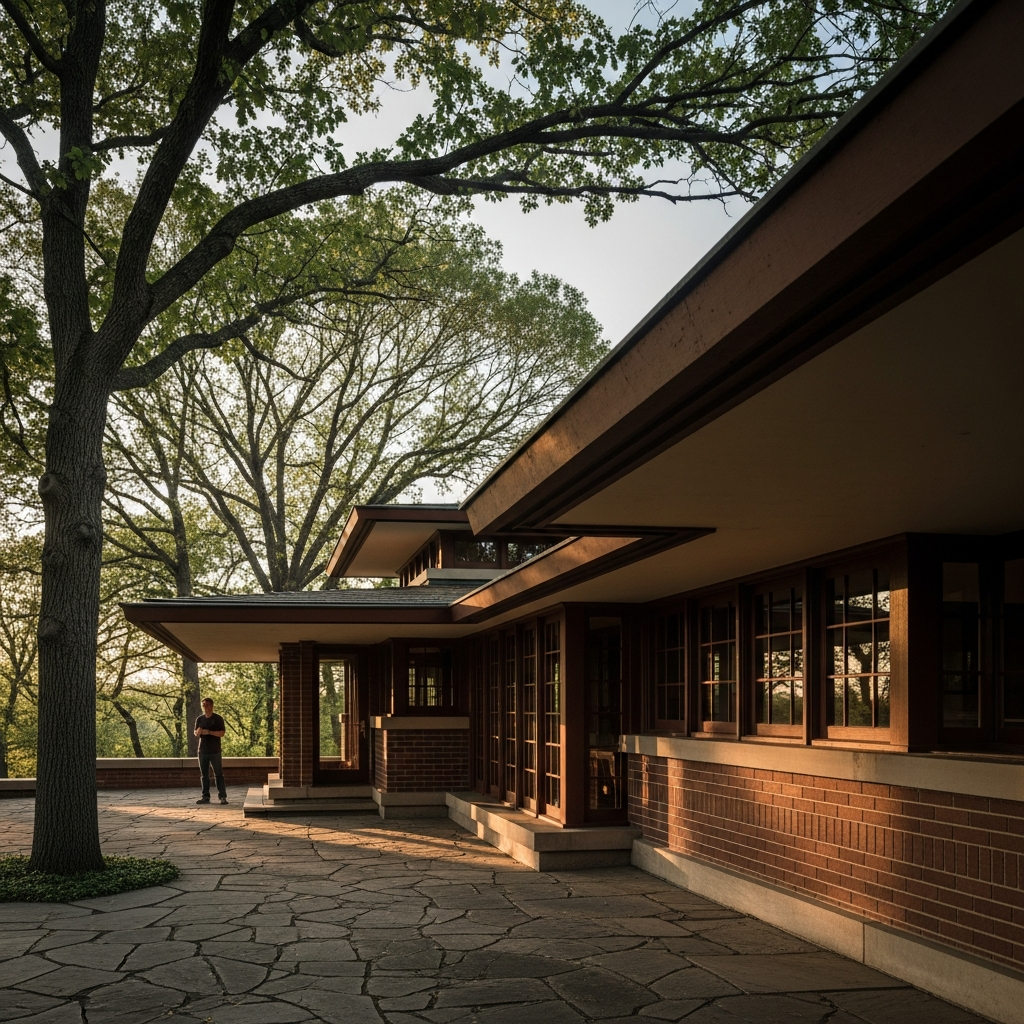
The most immediately recognizable Prairie characteristic is relentless horizontality. These homes stretch across their lots with low-slung profiles that seem to embrace the ground rather than rise above it. This effect results from several deliberate design choices working in concert.
Low-pitched hip or gable roofs, often with deep overhanging eaves, cap Prairie homes. The eaves sometimes extend four feet or more beyond exterior walls, creating dramatic shadow lines while sheltering ribbon windows below. Broad chimneys anchor the composition vertically without disrupting the overall horizontal flow.
Continuous window bands reinforce the horizontal theme. Rather than placing individual double-hung windows in separate openings, Prairie architects grouped casement windows together into extended ribbons, often wrapping around corners. These bands blur the boundary between interior and exterior while flooding rooms with natural light.
Materials and Craftsmanship
Prairie architects favored natural materials expressing their inherent character. Roman brick—longer and thinner than standard bricks—emphasized horizontal coursing. Architects often specified recessed mortar joints that cast shadows, further accentuating the banding effect. Some homes featured art glass windows with geometric patterns that filtered light into colored patterns throughout the day.
Interior woodwork typically featured oak with simple, rectilinear profiles. Built-in furniture integrated seamlessly with architectural trim, creating unified spaces where architecture and furnishings shared common design DNA. Wood finishes ranged from natural stain to rich umber, always emphasizing grain patterns over applied decoration.
Exterior stucco provided smooth wall surfaces that contrasted with textured brick bands. Some Prairie homes combined multiple materials strategically—perhaps stucco on upper floors with brick below—creating horizontal zoning that reinforced the low profile.
Floor Plans and Spatial Flow
Prairie floor plans broke radically from Victorian compartmentalization. Rather than isolated rooms connected by narrow hallways, Prairie interiors featured flowing spaces defined by partial walls, built-in cabinetry, and ceiling height changes. The central fireplace—often a massive affair of Roman brick or cut stone—anchored the plan without fully enclosing adjacent areas.
This open planning anticipated mid-century modern layouts by fifty years. Living and dining areas typically merged, separated perhaps by a colonnade or change in floor level rather than solid walls. Kitchens remained more enclosed, reflecting early 20th-century domestic arrangements, though they connected more directly to service areas than Victorian predecessors.
Second floors often stepped back from ground level, reducing the apparent height while creating protected terraces or sleeping porches. Basements typically housed mechanical equipment and storage, with finished recreation spaces rare in original Prairie designs.
Regional Variations and Spread
While Prairie style originated in Chicago, the aesthetic spread rapidly across the Midwest during its 1900-1920 heyday. Minneapolis, Milwaukee, Des Moines, and smaller communities throughout Illinois, Wisconsin, Iowa, and Minnesota feature significant Prairie collections.
California architects adapted Prairie principles to their climate, creating hybrid styles that influenced later developments. Irving Gill’s concrete structures and Greene and Greene’s ultimate bungalows share Prairie DNA while responding to Southern California’s particular conditions.
Pattern books and national publications spread Prairie ideas to builders without direct architect involvement. These “builder’s Prairies” simplified the style—eliminating custom art glass and built-in furniture—while maintaining recognizable horizontal proportions. Such examples populate suburban streets throughout the Midwest, representing the style’s mass-market penetration.
Decline and Revival
Prairie style’s dominance faded after World War I. Returning veterans favored Colonial Revival and Tudor Revival homes that evoked European tradition and stability after wartime upheaval. Prairie’s association with progressive politics and unconventional lifestyles became liabilities as conservative tastes prevailed.
Frank Lloyd Wright continued developing organic principles through his Usonian period, but the broader Prairie movement essentially ended by 1920. Many original Prairie homes suffered unsympathetic modifications during mid-century—vinyl siding covering original stucco, picture windows replacing art glass, rooflines altered to add second-story space.
Preservation efforts accelerated starting in the 1970s as architectural historians recognized Prairie’s significance. Organizations like the Frank Lloyd Wright Building Conservancy and local preservation groups documented surviving examples and advocated for protection. Today, well-preserved Prairie homes command premium prices, often selling quickly to buyers who appreciate their historical importance.
Identifying Authentic Prairie Examples
Distinguishing genuine Prairie architecture from lookalikes requires careful observation. True Prairie homes display consistent horizontal emphasis throughout their design—not just in rooflines but in window placement, trim details, and overall massing.
Look for these specific features when evaluating potential Prairie properties:
- Low-pitched roofs (typically under 30 degrees) with wide overhanging eaves
- Continuous horizontal window bands, often with geometric art glass
- Roman brick or narrow horizontal siding emphasizing lateral lines
- Broad central chimneys anchoring the composition
- Open floor plans with flowing interior spaces
- Built-in furniture and woodwork integrated with architectural trim
- Natural materials expressing their inherent character without applied decoration
Builder interpretations may exhibit some features while lacking others. The most architecturally significant Prairie homes display comprehensive integration of these elements throughout the design.
Preservation Considerations
Prairie homes present particular restoration challenges. Original stucco systems often failed, requiring careful remediation that maintains historic appearance while addressing moisture problems. Art glass windows, if surviving, demand specialized conservation rarely available locally.
Heating and cooling systems pose difficulties in open floor plans. Original Prairie homes relied on radiant heat from central fireplaces supplemented by perimeter radiators. Modern HVAC retrofits must navigate limited chase space while maintaining uninterrupted ceiling planes.
Energy efficiency improvements require sensitivity. While storm windows can protect original art glass, they must not obscure decorative patterns. Insulation upgrades may conflict with original wall assemblies. Experienced preservation architects understand these tradeoffs and can guide owners toward appropriate solutions.
Living in a Prairie Home Today
Modern Prairie residents appreciate their homes’ timeless qualities. Natural light fills interior spaces throughout the day, reducing artificial lighting needs. Open plans accommodate contemporary lifestyles better than compartmentalized Victorian alternatives. Built-in storage eliminates clutter while maintaining clean visual lines.
Challenges include limited privacy (those flowing spaces work both ways), difficult furniture placement (built-ins leave few open wall expanses), and maintenance demands (those dramatic overhangs require periodic attention). But for owners who appreciate Prairie principles, these tradeoffs pale beside the satisfaction of inhabiting architectural history.
The Prairie School’s influence extends far beyond its specific surviving examples. Mid-century modernism, Eichler’s California developments, and contemporary sustainable design all trace conceptual roots to those early 20th-century Chicago innovators who reimagined what American homes could be.
Notable Prairie Houses to Visit
Several significant Prairie homes welcome public visitors:
Robie House (Chicago) – Perhaps the style’s ultimate expression, this 1910 Wright masterpiece features dramatic cantilevered roofs and extraordinary art glass. Now owned by the University of Chicago, it offers regular tours.
Dana-Thomas House (Springfield, Illinois) – An early Wright commission preserved with exceptional integrity, including original furnishings and extensive art glass.
Meyer May House (Grand Rapids, Michigan) – Meticulously restored by Steelcase Corporation, this 1909 Wright residence demonstrates Prairie principles in their fully realized form.
Purcell-Cutts House (Minneapolis) – This 1913 Purcell and Elmslie design showcases the broader Prairie movement beyond Wright’s shadow.
Visiting these properties provides invaluable context for understanding Prairie achievement. Photographs cannot capture the spatial experience—the way light moves through art glass, the subtle connections between interior and exterior, the encompassing sense of shelter that these revolutionary homes provide.
Prairie style represents American architecture at its most inventive and place-specific. These homes emerged from their particular landscape and cultural moment, yet their principles—honest materials, integrated design, harmony with nature—remain relevant for contemporary builders seeking alternatives to generic developer products. Understanding Prairie helps us imagine what thoughtful regional architecture might yet become.
Detailed Component Analysis
Shifters and Brake Levers
The brake/shift lever combination represents your primary contact point with the groupset. Ergonomics matter tremendously here because you hold these levers for hours during long rides. Shape, reach adjustment, and lever throw all affect comfort and control.
Shimano’s STI levers swing inward for shifting, with a smaller paddle behind for opposite direction shifts. SRAM uses a single lever with different push depths. Campagnolo adds a thumb button for upshifts. Each system has devoted fans, and personal preference should guide your choice.
Electronic systems offer customizable shift behavior through smartphone apps. You can adjust shift speed, multi-shift behavior, and button mapping. Some systems allow sequential shifting using a single button. These customization options add value beyond the basic shifting function.
Front Derailleurs
Front derailleurs move the chain between chainrings. Electronic versions auto-trim to prevent chain rub as you shift across the cassette. Mechanical versions require manual trim adjustment or acceptance of occasional rub in cross-chained positions.
Modern front derailleurs mount in various ways. Braze-on mounts attach directly to frame bosses. Clamp-on versions fit frames without bosses using band clamps. Verify your frame’s mounting standard before purchasing.
Setup precision matters significantly for front derailleurs. Poor adjustment causes chain drops, grinding, or shifting refusal. Electronic versions are more forgiving of installation imperfection because motors provide consistent force regardless of cable condition.
Rear Derailleurs
The rear derailleur moves the chain across cassette cogs. Cage length determines cassette capacity—the difference between largest and smallest cogs the derailleur can handle. Short cages work for racing cassettes with limited range. Long cages accommodate wide-range climbing cassettes.
Clutch mechanisms in rear derailleurs add chain tension to prevent chain slap on rough roads. Originally a mountain bike feature, clutches now appear on many road groupsets. The added drag is minimal but chain security improves notably.
Shadow-type designs tuck the derailleur close to the frame, reducing crash damage risk. This design also improves aerodynamics marginally, though the effect is minimal compared to other factors.
Cranksets
Cranksets transfer your power to the chain. Crank arm length affects pedaling dynamics and fit. Standard lengths are 170mm, 172.5mm, and 175mm. Some manufacturers offer additional sizes. Proper length depends on leg length and flexibility.
Chainring sizes determine gear ratios. Compact cranks use 50/34 combinations for easier climbing. Standard cranks use 52/36 for faster flats. Semi-compact 52/34 or 50/36 options split the difference. Your terrain and fitness level should guide this choice.
Bottom bracket standards vary by frame. Threaded, press-fit, and various proprietary standards exist. Cranksets designed for one standard may not fit others without adapters. Verify compatibility before purchasing.
Cassettes
Cassettes provide the rear gear range. Modern 12-speed cassettes offer ranges from 10-33 up to 10-36 teeth. Wider ranges help on climbs but create larger jumps between gears. Racing cassettes use tighter ranges for precise cadence control.
Material affects weight and durability. Steel cogs last longer and cost less. Titanium cogs save weight but wear faster and cost more. Aluminum large cogs save weight but wear quickly under power. Most cassettes combine materials across different cogs.
Cassette lockrings require specific tools and torque specifications. Improper installation causes cassette movement and potential damage. Many cyclists prefer professional installation for this component.
Chains
Chains wear faster than other drivetrain components. Regular replacement protects expensive cassettes and chainrings. Chain checkers measure wear; replace before reaching 0.75% elongation to prevent accelerated cassette wear.
Quick links simplify chain removal for cleaning. Most modern chains include reusable quick links. Master links from previous generations required special tools and weren’t designed for repeated opening.
Chain width must match drivetrain speed. 12-speed chains are narrower than 11-speed chains. Using incorrect chain width causes poor shifting and accelerated wear. Always match chain to your specific groupset generation.
Maintenance Requirements
All groupsets require maintenance regardless of price tier. Higher-tier components may need less frequent attention but aren’t maintenance-free. Understanding maintenance needs helps plan time and budget.
Regular Cleaning
Clean your drivetrain after every wet ride and at least weekly during dry conditions. Accumulated grime accelerates wear and degrades shifting. Degreaser removes old lubricant and dirt; fresh lubricant protects against wear and corrosion.
Avoid high-pressure water on bearings and electronics. Gentle spray and brushing clean effectively without forcing water into sensitive areas. Dry components thoroughly before applying fresh lubricant.
Cable and Housing
Mechanical groupsets require cable replacement as cables stretch and fray. Housing deteriorates over time, introducing friction that degrades shifting. Annual replacement keeps shifting crisp; more frequently for high-mileage riders.
Electronic systems eliminate cable maintenance but require firmware updates occasionally. Batteries need charging monthly for typical usage. Wireless systems require battery management for multiple components.
Brake Maintenance
Disc brake pads wear with use and require replacement. Contaminated pads squeal and lose stopping power. Rotor surfaces should be cleaned with isopropyl alcohol after touching with bare hands.
Hydraulic fluid requires occasional bleeding to remove air bubbles. Spongy lever feel indicates air in the system. Mineral oil and DOT fluid types aren’t interchangeable; use only the specified type for your brakes.
Common Upgrade Scenarios
Many cyclists upgrade groupsets over time. Understanding common scenarios helps plan purchases and timing.
Wheels Before Groupset
If your current groupset shifts adequately, wheel upgrades often provide more noticeable improvement. Lighter, stiffer wheels accelerate faster and hold speed better. Aerodynamic wheels reduce drag at speed.
Electronic Conversion
Converting from mechanical to electronic requires new shifters, derailleurs, battery, and wiring. Brakes and crankset may remain if compatible with the new system. Professional installation ensures proper setup.
Power Meter Addition
Adding a power meter to an existing crankset is often possible. Crank-based, pedal-based, and hub-based options exist. Research compatibility with your specific crankset and frame before purchasing.
Final Thoughts on Groupset Selection
Groupset choice represents a significant investment in your cycling experience. Take time to test different options, research compatibility with your frame, and consider your long-term upgrade path. The right groupset enhances every ride, while the wrong choice creates frustration.
Remember that the rider matters more than the equipment. A fit cyclist on an entry-level groupset outperforms an unfit cyclist on flagship components. Invest in fitness, skills, and bike fit alongside component choices.
Whatever you choose, maintain it properly and ride it often. Miles on the bike matter more than grams saved or features added. The best groupset is the one that gets you out riding regularly, shifting smoothly, and stopping safely when needed.
The cycling industry continues evolving, with new groupset generations appearing every few years. Today’s flagship technology becomes tomorrow’s mid-tier option. Patience can yield excellent value as previous-generation components remain fully functional while prices drop.
Whether you’re building a new bike, upgrading an existing one, or simply researching options, understanding groupset technology helps you make informed decisions. The knowledge in this guide applies across brands and tiers, giving you the foundation to evaluate any groupset you encounter.
Maintenance Guide for Prairie Home Owners
Owning a Prairie home requires commitment to ongoing maintenance that preserves both aesthetic integrity and structural soundness. Unlike conventional homes where repairs can proceed without historical consideration, Prairie properties demand restoration approaches sensitive to original materials and design intent.
Roof Systems
Those signature low-pitched roofs with wide overhangs require special attention. Original roofing often consisted of built-up layers of felt and asphalt, sometimes with clay tile or slate on higher-end examples. Modern replacement materials must maintain appropriate visual character—avoid high-profile dimensional shingles that disrupt the horizontal emphasis.
Overhang soffits typically feature plaster or stucco finishes that weather poorly without adequate drainage. Inspect annually for staining or soft spots indicating moisture infiltration. Gutter systems must handle significant water volumes shed by those wide eaves—undersized gutters or clogged downspouts quickly cause fascia damage.
Masonry and Stucco
Roman brick presents unique restoration challenges. These elongated bricks (typically 1½” tall by 12″ long) were manufactured in limited quantities and are difficult to match for repairs. Fortunately, the original specifications emphasized subtle color variation, making carefully sourced replacement brick less conspicuous than with uniform modern alternatives.
Repointing must use lime-based mortars matching original composition. Portland cement mortars—standard in modern construction—are too hard for Prairie-era brick, causing spalling and accelerated deterioration. Experienced restoration masons understand these requirements, though they may be harder to find outside major metropolitan areas.
Stucco systems require periodic assessment. Original scratch-coat and brown-coat assemblies differ fundamentally from modern synthetic stucco (EIFS). Water infiltration behind original stucco may persist undetected for years before damage becomes apparent. Infrared thermography can reveal hidden moisture problems without destructive investigation.
Windows and Art Glass
Prairie art glass represents both the style’s glory and its most challenging preservation element. Original windows featured hand-made glass in distinctive colorations—autumnal ambers, sage greens, iridescent clears—held by zinc or copper cames rather than lead. These panels filter light into ever-changing patterns as the sun moves across the sky.
Conservation options range from protective storm windows (reversible, minimal intervention) to full restoration (addressing failed came joints and cracked glass panels). Qualified conservators are few—expect long wait times for major projects. Never allow unqualified glaziers to attempt art glass repairs; improper handling can destroy irreplaceable panels.
Original casement hardware often corroded or wore beyond repair. Fortunately, several specialty manufacturers now reproduce Prairie-era window hardware in period-appropriate bronze or brass finishes. Replacement hardware should match original profiles exactly—modern substitutes invariably appear out of place.
Interior Woodwork
Prairie interiors featured extensive custom millwork—trim profiles, built-in cabinets, and integrated furniture elements—all designed as unified ensembles. Maintaining this woodwork requires commitment to compatible finishes and repair techniques.
Original finishes typically consisted of oil-based stains topped with shellac or early lacquers. These finishes mellow beautifully over time, developing patina that synthetic alternatives cannot match. Before stripping any original finish, consult a preservation specialist—what appears damaged may actually be appropriate patina.
Missing elements present difficult decisions. Skilled furniture conservators can reproduce original pieces from surviving examples or archival photographs. However, such reproduction demands both craft expertise and design sensitivity. Poorly executed additions detract from overall integrity regardless of technical competence.
The Investment Case for Prairie Preservation
Prairie homes typically appreciate faster than comparable properties in their markets. This premium reflects several factors:
Scarcity drives demand. The Prairie era lasted roughly twenty years, limiting total production. Many original examples were demolished, modified beyond recognition, or neglected into unsalvageable condition. Those surviving in good condition represent an inherently limited supply facing steady collector demand.
Authenticity matters increasingly to buyers. As reproduction architecture saturates suburban landscapes, homes with genuine historical pedigree stand apart. Prairie properties offer something irreproducible—actual connection to a specific moment in American design history.
Tax incentives can reduce restoration costs significantly. Federal rehabilitation tax credits return 20% of qualifying expenses on income-producing historic properties. State credits add additional benefits in many jurisdictions. Residence-only properties may qualify for property tax freezes or local incentive programs.
Energy performance often surprises critics. Those massive masonry chimneys store significant thermal mass, moderating temperature swings. Deep overhangs shade summer sun while admitting low winter angles. Original window bands—properly restored with interior storms—perform adequately with far less embodied energy than replacement alternatives.
Resources for Prairie Enthusiasts
Several organizations support Prairie preservation:
Frank Lloyd Wright Building Conservancy maintains the most comprehensive database of surviving Wright works and advocates for their protection. Membership provides access to exclusive tours and educational programming.
Prairie School Architecture Society focuses on the broader movement beyond Wright, documenting significant works by his contemporaries and publishing scholarly research.
National Trust for Historic Preservation offers technical guidance applicable to Prairie and other historic properties through their Preservation Green Lab and various publications.
Local historical societies often maintain files on specific Prairie properties, including original plans, historic photographs, and chain-of-title documentation. Such information proves invaluable during restoration planning.
Understanding and preserving Prairie architecture connects us to one of America’s most original design movements. These homes transcended their immediate context to influence architects worldwide, demonstrating that American designers could create something genuinely new rather than imitating European precedent. That achievement deserves our ongoing stewardship.




Stay in the loop
Get the latest classic architecture today updates delivered to your inbox.