What Mediterranean Revival Actually Means
Mediterranean Revival has gotten complicated with all the mislabeling flying around. I spent a Saturday afternoon last spring walking through a 1927 neighborhood in Coral Gables, Florida — trying to name every house I passed. Half looked vaguely Spanish to me. Some seemed Italian. A few looked like they belonged on a movie set in the hills above Los Angeles. That confusion is exactly why I’m writing this.
As someone who has walked hundreds of historic neighborhoods across Florida and California, I learned everything there is to know about identifying Mediterranean Revival homes. Today, I will share it all with you.
But what is Mediterranean Revival? In essence, it’s a distinct American architectural movement that ran roughly from 1915 to 1940, pulling inspiration from southern Spain, Italy, and North Africa. But it’s much more than that. Designers like Addison Mizner filtered those Old World influences through their own vision of what luxury looked like during the American boom years — and the result was something genuinely original. It’s not a catch-all umbrella for anything stucco-covered or tile-roofed. Once you know what to look for, you’ll see it everywhere in certain zip codes — and nowhere in others.
The Roof Is Always the First Giveaway
Stop looking at the front door. Look up.
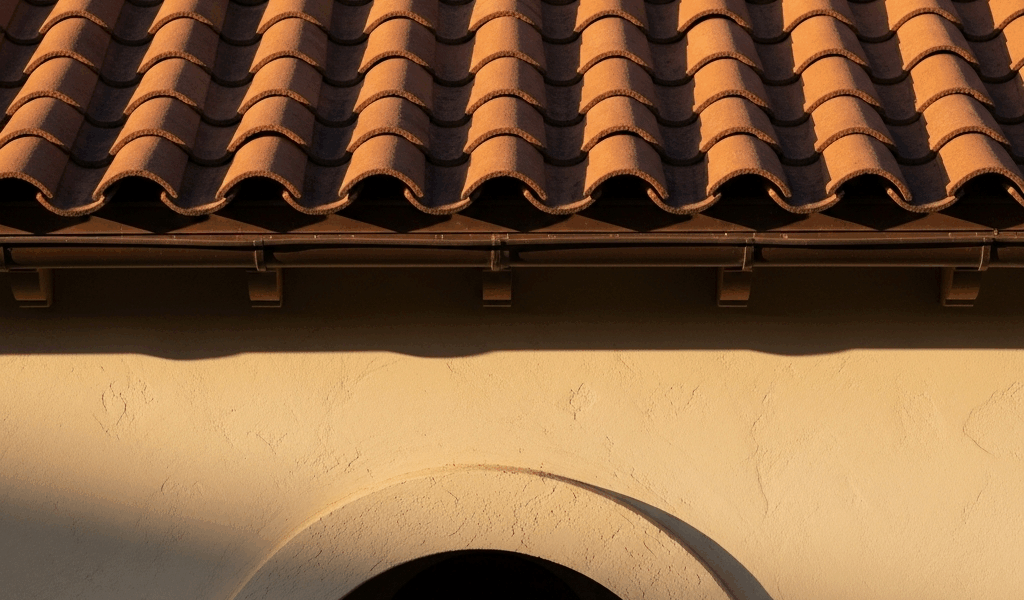
The single fastest way to identify a Mediterranean Revival home is the roof. Nearly every example features low-pitched or completely flat rooflines covered in barrel clay tiles — almost always terra cotta in color. Not wood shingles. Not asphalt or slate. Chunky, curved, clay barrel tiles, typically hand-finished looking, arranged in an overlapping pattern that creates deep shadow lines and real texture.
This detail matters more than you’d think. A Craftsman house might have decorative brackets and natural materials, but it sits under a steeply pitched roof covered in wood shingles. Colonial Revival homes — particularly Georgian examples — have steep gabled roofs with slate, asphalt, or wood shakes. Mediterranean Revival refuses the pitch. The tiles stay low and proud, visible from the street, clearly the main event.
Pay attention to the eaves too. Mediterranean Revival homes often feature overhanging eaves with exposed rafter tails or decorative brackets underneath — wood or plaster elements sitting between the wall and the tile overhang. These aren’t hidden away. They’re meant to be seen. On larger estates, decorative corbels support these overhangs, sometimes with tilework or painted details alongside them.
Arches, Towers, and Exterior Details to Look For
Once the roof has confirmed your suspicion, move to the facade itself. Mediterranean Revival homes feature round or slightly pointed arches over primary openings — windows, doors, entry loggias, covered porches. Not sharp Gothic points. Gentle curves, often carrying a slight Moorish influence that’s subtle enough to miss if you’re not looking for it.
Look for wrought iron grilles and balcony railings. Almost always present — either as functional security features on ground-floor windows and doors, or as decorative elements on upper-level balconies. The ironwork is typically ornamental without being fussy. Scrollwork, geometric patterns, simple vertical bars with decorative finials. Nothing excessive.
The wall surface matters too. Mediterranean Revival homes are stuccoed. Smooth or lightly textured, sometimes with a color wash applied over the base coat. You won’t see clapboard. You won’t see exposed brick. The entire exterior reads as a unified stucco surface — often cream, soft yellow, or pale pink, occasionally with darker trim around openings.
Larger Mediterranean Revival estates often include corner towers or belvederes — small enclosed or semi-enclosed upper-level spaces projecting from corners or prominent walls. They’re not watchtowers. Think of them as architectural punctuation marks, typically capped with their own tiled roofline, positioned to create visual interest and break up the massing. More common on mansion-scale examples, but worth noting regardless.
One more thing that separates Mediterranean Revival from Colonial or Georgian Revival: asymmetry. Mediterranean Revival facades are deliberately irregular. Windows don’t line up in strict grids. Door placement doesn’t follow rigid rules. Towers, arches, and covered porches are positioned according to interior function and visual drama — not facade geometry. Stand in front of a Colonial Revival home and then a Mediterranean Revival example and this contrast becomes immediately obvious. One is rigidly symmetrical. The other is deliberately unbalanced. That’s what makes Mediterranean Revival endearing to us architecture enthusiasts.
How to Tell It Apart from Spanish Colonial Revival
Probably should have opened with this section, honestly. This is where most people stumble.
Spanish Colonial Revival and Mediterranean Revival are genuinely easy to confuse. Both emerged in roughly the same era. Both used stucco, arches, clay tiles. But they’re distinct enough that a homebuyer or history enthusiast should know the difference — and getting it wrong in a listing description is the kind of mistake that follows you around.
Spanish Colonial Revival tends to be simpler, more restrained. Often single-story or one-and-a-half stories, with minimal decorative flourishes. The focus is clean lines and unadorned surfaces. Ornament, when present, is usually limited to the entry surround or a simple carved beam or corbel. That’s about it.
Mediterranean Revival pulls from Italian and North African sources in addition to Spanish precedent. That combination gives it license for significantly more ornamentation — tiled fountains in courtyards, decorative tilework around window frames and doorways, carved or painted entry surrounds, multiple towers or covered arcades. The overall effect is richer and more intentionally picturesque. More layered, really.
So, without further ado, let’s dive in on two tests you can apply while standing directly in front of a house:
- Count the visual incidents. Spanish Colonial Revival homes tend toward simplicity — one or two focal points maximum. Mediterranean Revival homes pack more detail into the facade: an arched entry, a tower, a tiled band, a decorative balcony railing, multiple arched openings at different levels. More is more, intentionally.
- Look at the roofline complexity. Spanish Colonial Revival often has a simple, straightforward roofline. Mediterranean Revival rooflines are usually more varied — tiles stepping up and down, multiple roof planes, towers punctuating the profile in ways that feel almost theatrical.
Where You’ll Find Mediterranean Revival Homes Today
Geography isn’t everything, but it tells you something fast. Mediterranean Revival boomed in specific markets during the 1920s and 1930s. Palm Beach, Florida. Coral Gables. Pasadena and Santa Barbara in California. Parts of Arizona and the Southern California coastline. These were wealth-driven markets where imported European luxury architecture made sense to developers and buyers willing to spend real money.
If you’re in Minneapolis or Pittsburgh or rural Pennsylvania, you’re not going to stumble across authentic Mediterranean Revival on every block. The style required warm-climate symbolism and wealthy markets to justify the cost and the craftsmanship involved. Conversely, if you’re in Coral Gables looking at a 1925 address, odds are high you’re standing in front of either Mediterranean Revival or Spanish Colonial Revival — and now you know how to tell the difference.
The style experienced a second wave in the 1980s and 1990s across Sun Belt suburbs. I’m apparently someone who notices construction quality immediately, and that wave of new builds works for me as a study in contrasts while authentic 1920s originals never fail to impress. Don’t make my mistake of assuming a newer Mediterranean Revival-style home is using the same materials. Many rely on simulated tile — plastic, essentially — thin stucco finishes, and proportions that feel stretched or compressed compared to authentic examples. Original Mediterranean Revival homes feature hand-finished or authentically aged tiles, substantial stucco depth (usually 2 to 3 inches applied over lime mortar and lath), and proportions that mirror the 1920s–1930s originals.
When evaluating any example, look at material quality and proportion first. Authentic Mediterranean Revival feels substantial. The tiles, ironwork, stucco — everything has weight and presence. The arches feel right. The scale feels balanced. Newer interpretations sometimes look thin or overwrought by comparison, like a photocopy of a photocopy. Once you’ve seen enough of the real thing, the difference is immediate.



Stay in the loop
Get the latest classic architecture today updates delivered to your inbox.