
Flying buttresses rank among the most innovative and visually striking structural elements in architectural history. These elegant stone arches, projecting outward from cathedral walls, solved engineering challenges that had limited building heights for centuries. Understanding how flying buttresses work reveals the genius behind Gothic architecture’s soaring interiors and luminous stained glass windows.
What Is a Flying Buttress?
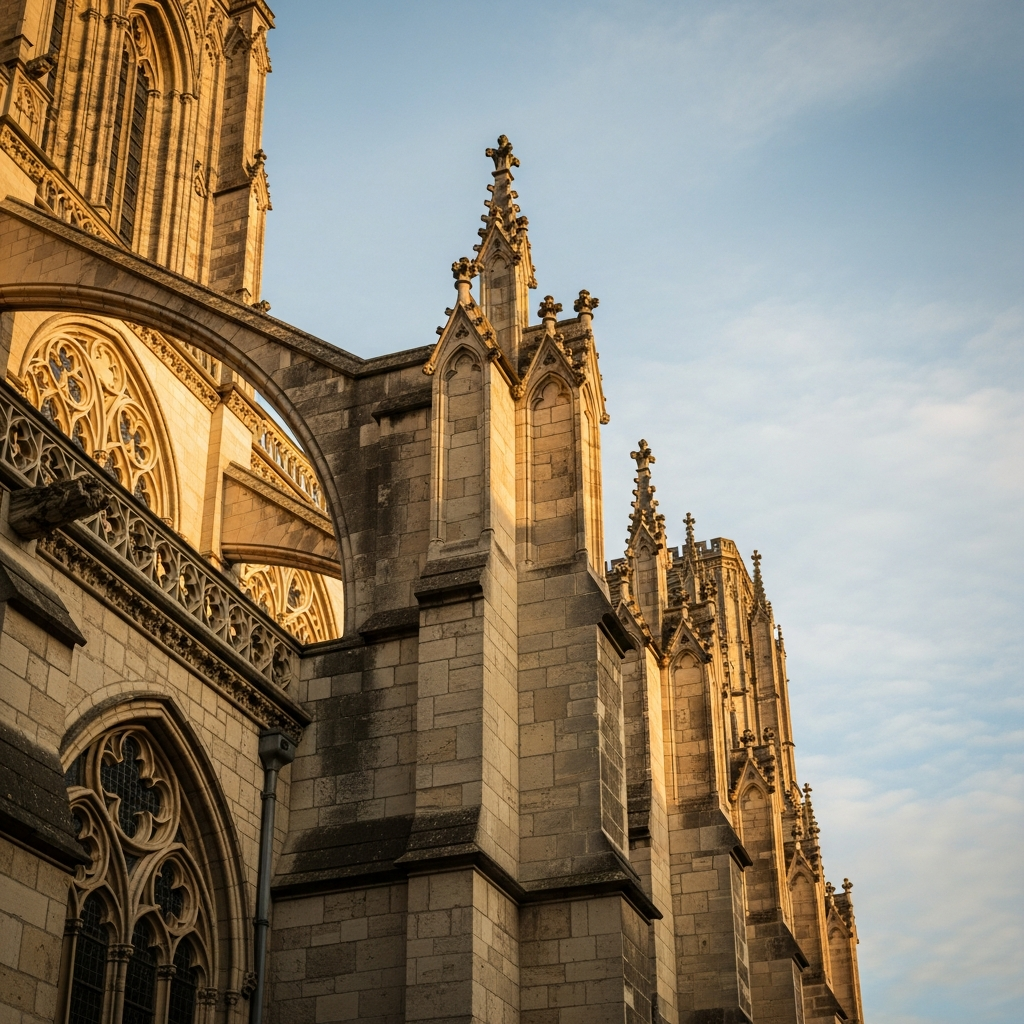
A flying buttress consists of an inclined bar or arch that carries the thrust of a roof or vault from an upper wall to an outer support called a pier buttress. Unlike traditional buttresses built directly against walls, flying buttresses span open space—hence the term “flying.” This design transfers the outward force created by heavy stone vaults away from the walls themselves.
The typical flying buttress system includes three main components: the flyer (the arched segment that spans from wall to pier), the pier buttress (the vertical masonry support that receives the thrust), and the pinnacle (a weighted decorative element that increases downward force on the pier). Each component plays a critical role in maintaining structural equilibrium.
The Engineering Problem They Solve
Stone vaults create tremendous outward thrust. Imagine a heavy arch pushing sideways against walls—without adequate support, those walls would eventually buckle and collapse. Romanesque architects solved this by building extremely thick walls, which limited window size and kept interiors relatively dark.
Gothic master builders wanted taller buildings with larger windows to illuminate interiors with colored light. Flying buttresses provided the answer. By transferring lateral forces to external supports, architects could construct thinner walls pierced by expansive windows while maintaining structural integrity.
How Flying Buttresses Actually Work
The physics involves redirecting forces rather than simply resisting them. When a vault pushes outward against the upper wall, the flying buttress catches that horizontal thrust and channels it diagonally downward to the pier. The pier then transmits the force vertically into the ground.
Pinnacles atop pier buttresses serve a structural purpose beyond decoration. Their added weight increases the downward component of the force, helping to keep the pier in compression rather than allowing it to tip. Medieval builders understood instinctively what modern engineers calculate: stone structures perform best under compressive loads.
Notable Examples
Notre-Dame de Paris features perhaps the most famous flying buttresses in the world. Its double-tier system supports the high vault while creating the cathedral’s distinctive silhouette. The buttresses span approximately 15 meters from the clerestory wall to their supporting piers.
Chartres Cathedral showcases flying buttresses integrated with an elaborate water drainage system. Rainwater collected on the roof channels through the buttresses themselves, emerging through gargoyle spouts positioned at the outer piers.
The Cathedral of Beauvais pushed Gothic engineering to its limits. Its choir vault rises 48 meters—the highest Gothic vault ever constructed. The ambitious flying buttress system required multiple modifications after partial collapses, demonstrating that medieval builders sometimes exceeded the technology’s safe limits.
Evolution of the Form
Early flying buttresses from the late 12th century appear as relatively simple quarter arches. As builders gained confidence, the structures became more elaborate. High Gothic examples often feature double flyers stacked vertically to address thrust at multiple heights along the vault.
Late Gothic and Flamboyant period buttresses incorporated increasingly decorative tracery, transforming structural necessities into ornamental features. Some designs included small passages allowing access for maintenance.
Modern Applications and Influence
Contemporary architects occasionally employ flying buttress principles in innovative ways. While modern materials like steel and reinforced concrete handle lateral forces differently, the concept of external bracing remains relevant. Some neo-Gothic revival buildings of the 19th and 20th centuries faithfully replicated medieval buttress systems.
Understanding flying buttresses provides insight into how structural challenges shape architectural aesthetics. What began as an engineering solution became a defining characteristic of Gothic style—proof that necessity and beauty can emerge from the same source.




Stay in the loop
Get the latest classic architecture today updates delivered to your inbox.