What Makes a Craftsman Bungalow Different
Identifying Craftsman bungalows has gotten complicated with all the copycat architecture flying around. As someone who spent three years flipping early homes in Portland, Oregon — ground zero for authentic Craftsman work — I learned everything there is to know about spotting the real thing versus a bungalow-shaped impostor. Today, I will share it all with you.
The confusion is genuine. Later builders grabbed the silhouette — low roof, wide porch, that familiar footprint — without committing to the material honesty underneath. Prairie homes, Foursquares, ranch-style houses from the 1950s onward — they all borrowed pieces of the aesthetic. But the bones are different. Craftsman bungalows built between 1905 and 1930 have specific DNA, and once you know what to look for, you can spot it from twenty feet away.
Probably should have opened with this section, honestly: the style wasn’t accidental. It emerged as a direct rebellion against mass production and factory-made ornament. That philosophy shapes every detail — the way a rafter tail is cut, how a built-in bookshelf is jointed, which materials get used and why. Understanding the thinking makes the visual clues stick.
Start With the Roofline and Porch
Look up first. That’s checkpoint one.
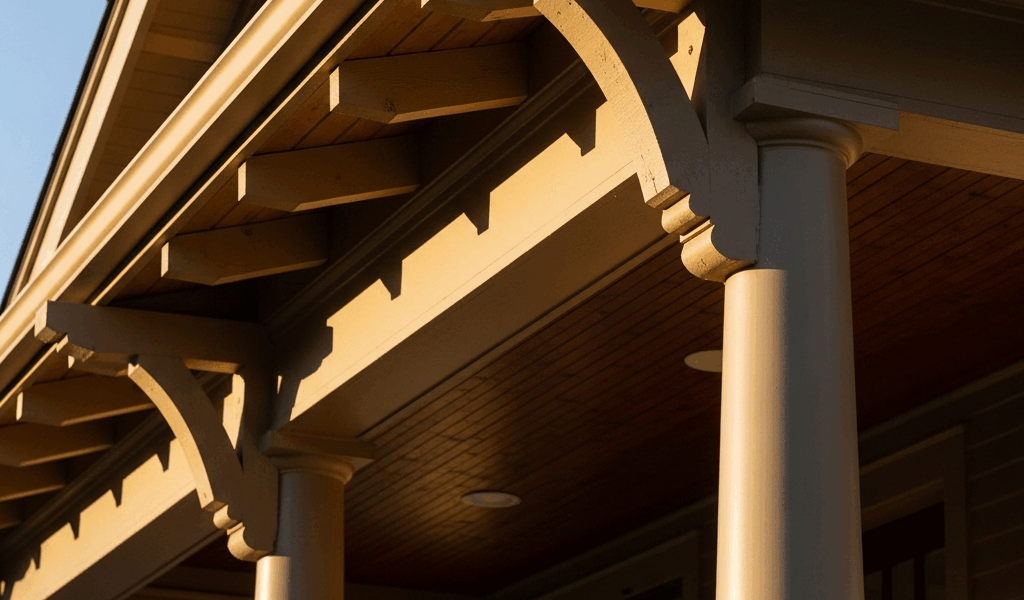
A genuine Craftsman bungalow carries a low-pitched gabled roof — typically a 6 to 8 pitch — with eaves overhanging the walls by 18 to 36 inches. Those eaves aren’t purely functional. They’re theatrical. Supposed to be visible, supposed to announce themselves. You want exposed rafter tails sticking past the fascia, decorative knee braces in the corners where rafter meets wall, and sometimes a shallow frieze board running between the wall top and the eave. That’s the real thing.
Prairie homes and later ranch imitations will sometimes have similar roofline features. The difference shows in the craftsmanship. A tapered column supporting a knee brace should taper evenly — clean shoulders where it meets the horizontal member. Rough or uneven joinery? You’re probably looking at a 1950s or 1970s reinterpretation. Don’t make my mistake of assuming the silhouette is enough.
Now look at the porch. It isn’t just attached to the front of an authentic Craftsman — it’s foundational to the whole composition. The columns supporting the roof sit on brick or stone piers rising 2 to 3 feet from the ground. The columns themselves are either tapered (thicker at the bottom, narrowing toward the top) or square-profiled — cleaner than anything you’d see on a Colonial Revival home.
Picture a 4×4 or 6×6 post tapering down to a 3×3 or 4×4 at the cap. That’s the signature. The column base sits directly on the pier with minimal decorative capital work. Fake Craftsmans from the 1980s onward tend to use thinner cylindrical columns or add spindle work — neither of which appears in authentic early homes.
Roof Overhangs — The Decisive Test
Measure the overhang. Under 12 inches? You’re not looking at Craftsman. Period. Colonial Revivals run tight eaves. Prairie homes sometimes have overhangs but keep the detail restrained. Craftsman homes embrace the overhang — lean into it, even. That 18-to-36-inch range isn’t negotiable.
Exterior Details That Confirm the Style
Once the roofline and porch check out, move to the wall surface. Authentic Craftsman bungalows use natural materials expressed honestly. Horizontal wood siding with 5 to 6 inch exposure is standard. Some homes have shingle-sided upper stories or gable ends. Clinker brick — irregular, discolored from the kiln, intentionally imperfect — shows up often on foundations and chimney work. River rock and cast-stone details appear regularly too.
Vinyl siding on a house with otherwise Craftsman proportions is a dead giveaway. Either you’re looking at a later reinterpretation or a significant renovation stripped of its original skin. True Craftsman homes from 1905 through 1930 were built to age in place. The wood was expected to weather and patina over decades. That was the point.
Windows matter more than people realize. Look for multi-pane windows divided into smaller, even rectangles. A 1-over-1 sash is less common than grouped casements or double-hung windows divided into four or six panes per sash. Triple or quad window groupings with narrow muntins show up frequently — especially in dining rooms and living room walls. Modern picture windows are a retrofit, full stop.
The foundation deserves a look too. Craftsman bungalows sit low — sometimes only 18 to 24 inches of visible foundation from grade. The house should appear to belong to its site, not perch above it. A tall crawlspace visible from the street, or basement windows running along the base? That’s an earlier or later style. Not Craftsman.
Interior Clues Worth Checking
Owners will let you inside if you ask respectfully. I’ve knocked on probably thirty doors over the years — explained my interest in the architecture — and got turned away twice. When you get in, go straight to the fireplace.
A Craftsman fireplace is massive. The opening is generously proportioned, the chimney breast dominates the room, and the material is honest — brick, river rock, or tile arranged without apology. The mantel runs wide and flat, typically 12 to 16 inches deep, finished in natural wood with square-edged profiles. No curves. No applied ornament beyond the wood grain itself. That restraint is the tell.
Check the trim package next. Baseboard, door casings, crown molding — all thick wood. Often 1×10 or 1×12 boards for baseboard, 1×6 or 1×8 for door surrounds. The profiles are recessed and reveal the joinery intentionally. That’s where the Craftsman philosophy becomes visible in a literal sense: the construction method is the decoration. There’s nothing hiding behind paint and filler.
Built-in bookshelves, window seats, and buffets in the dining room are interior signatures. Glazed cabinetry with leaded or textured glass, open shelving with square edges and exposed joinery below — that combination confirms Craftsman. I’m apparently more excited about built-in buffets than most people, and original Arts and Crafts hardware works for me in a way that reproduction Victorian hardware never does.
The floor plan should flow openly between living and dining rooms with minimal wall separation. Pocket doors sometimes divided these spaces when privacy was needed. Bedrooms stay small and simple by modern standards — often 10×12 or 11×13 feet. That’s not a flaw. It’s original intent.
How to Tell It Apart From Similar Styles
But what is a Prairie home, really? In essence, it’s a horizontal, ground-hugging design that shares Craftsman’s emphasis on natural materials. But it’s much more than that — and the differences matter when you’re trying to sort one from the other.
Prairie homes reject the porch entirely or shrink it to near-nothing. They spread across the lot rather than stack vertically. Craftsman bungalows are compact by comparison. One quick test: if there’s no porch, or almost none, you’re probably looking at Prairie. That’s what makes the porch so endearing to us Craftsman enthusiasts — it’s both functional and diagnostic.
Tudor Revival homes — common from the 1920s onward — use half-timbering, steeply pitched roofs running 10 to 12 pitch or steeper, and deliberately asymmetrical facades. Stand back and compare the roof angle to your eye level. If the peak rises dramatically higher than the wall is wide, it’s not Craftsman. The Craftsman roofline is low and calm. The Tudor roofline is theatrical in a completely different direction — vertical drama instead of horizontal shelter.
Colonial Revival homes built between 1880 and 1920 emphasize strict symmetry, formal centered entries, and paired columns without piers. The clapboard siding runs tighter and more uniform than Craftsman wood siding, which shows intentional variation in grain and color. Columns without stone or brick bases are a fast tell — Colonial Revival columns sit differently, speak a different architectural language entirely.
Frustrated by a deadline during one particularly compressed buying stretch, I used a single field test across three competing properties — walk to the front door and read the porch entry. Colonial Revival homes pull you inward with a formal, centered statement. Craftsman homes fold you into the everyday shelter of the house before you’ve even knocked. That feeling isn’t theory. It’s material and proportion in agreement, and once you’ve felt it a few times, it stops being something you analyze and starts being something you just know.


Stay in the loop
Get the latest classic architecture today updates delivered to your inbox.