What Colonial Revival Actually Looks Like From the Street
Colonial Revival architecture has gotten complicated with all the misidentification noise flying around. As someone who spent five years dragging friends and family up and down suburban streets pointing at facades, I learned everything there is to know about spotting this style from the curb. Today, I will share it all with you.
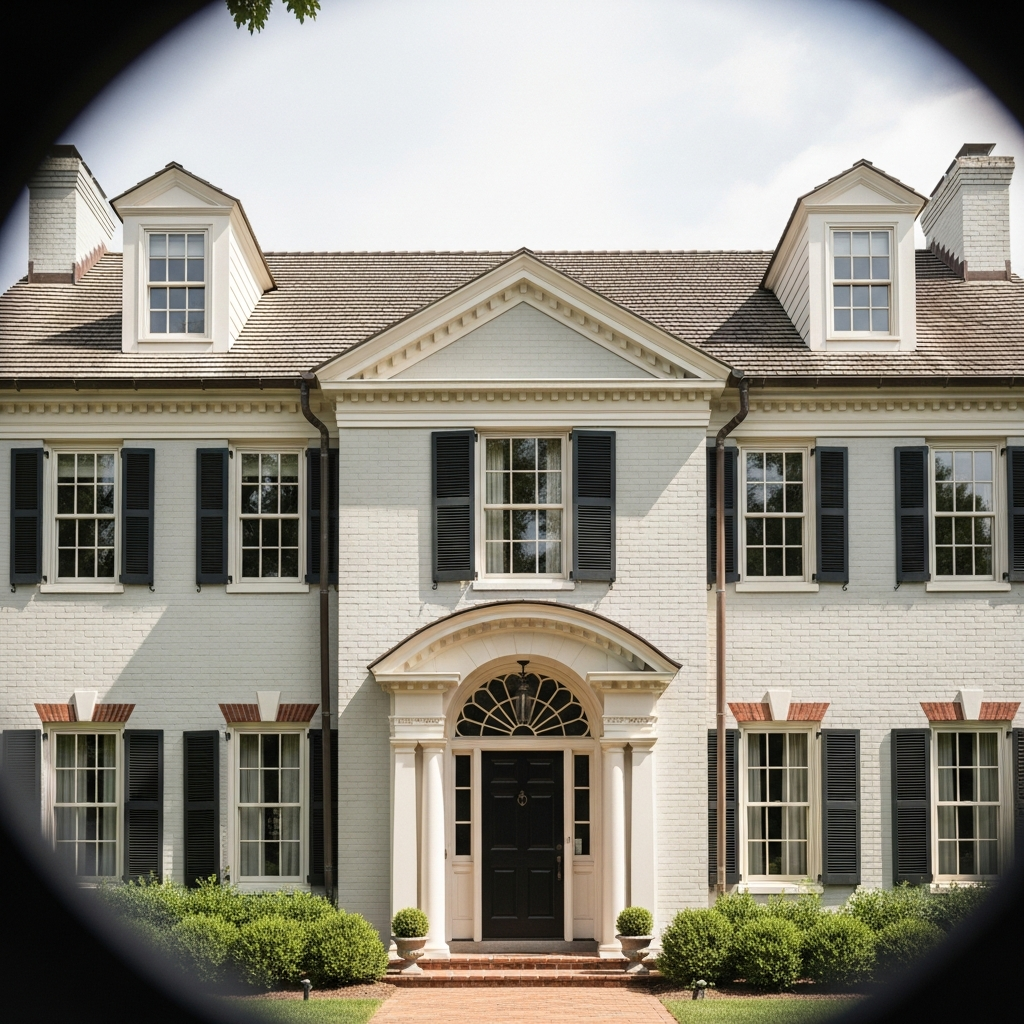
Start with symmetry. Walk up to one of these houses and your eye lands on a centered front door — every single time. Windows flank it on both sides, same count, same size, same spacing. Left mirrors right. That’s not coincidence or laziness. Colonial Revival architects working between the 1880s and 1950s were genuinely obsessed with order, pulling directly from actual Colonial homes built a century or two before them. Symmetry is checkpoint one. Everything else builds from there.
Two stories is the standard. A pitched roof with moderate slope sits on top. The overall impression is formal — almost severe, honestly — in a way that feels composed rather than cold.
Materials matter too. Deep red or muted brown brick dominates in most regions. White or cream clapboard runs a close second. You won’t find the mixed-material chaos of a Victorian here, or the half-timbering of a Tudor. Clean surfaces. Honest materials. That’s the Colonial Revival philosophy made visible, right there on the exterior.
The Front Door and Entryway Are Your Biggest Clue
Probably should have opened with this section, honestly. The entry is so diagnostic that once you train your eye to read it, identification takes maybe ten seconds flat.
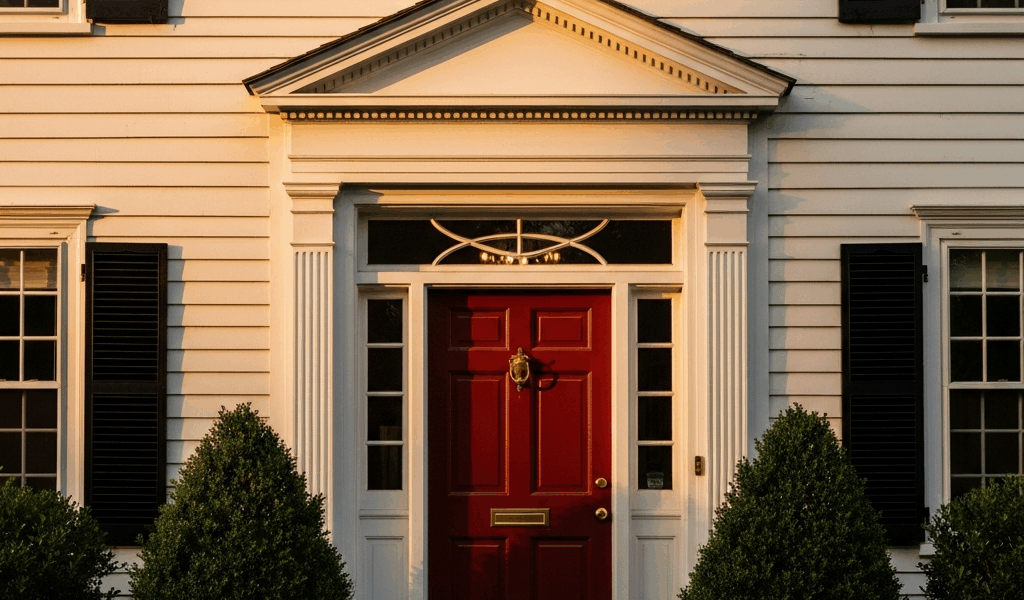
Look directly at the front door. Dead center on the facade — always. Above it sits a pediment, either triangular or fan-shaped, borrowed straight from Greek and Roman temple architecture. You’ll see it on Colonial Revivals constantly. Not on Craftsman bungalows. Not on Farmhouses. Not on Tudors. The pediment is yours to keep as a reliable signal.
Flanking the door, look for pilasters — flat columns with decorative capitals — or actual round columns framing the entry like sentinels. Sometimes the entry recedes slightly into a small portico. Other times it’s flush with the facade. Either way, the architect made the door the absolute focal point by stacking classical element on top of classical element until there was no question where your eye should go.
The door itself is paneled. Six or eight raised panels arranged in a grid, typically. Sidelights — tall vertical windows — sit on either side. A transom window caps the whole assembly above. This three-part entry arrangement is pure Colonial Revival. Compare it mentally against a Craftsman door, which runs wider, darker, more substantial. Or a Tudor door, which is arched or heavily carved. The Colonial Revival door whispers restraint. That’s what makes it endearing to us architecture enthusiasts.
I once toured a 1920s Colonial Revival in suburban Connecticut — Fairfield County, if you’re curious — with the original hardware still intact. Brass kick plates. Crystal doorknobs. The kind of hardware that probably costs more per square inch than most modern fixtures. The owners had spent $8,000 on restoration alone. But I recognized the entry the moment I stepped onto the front walk. Unmistakable.
Windows That Give the Style Away
Double-hung sash windows are the backbone of Colonial Revival identification. They slide vertically — upper sash down, lower sash up — a mechanism that dates back centuries and one Colonial Revival builders stuck with religiously.
Count the panes in each sash. Six-over-six is most common: six small panes in the upper, six in the lower. Nine-over-nine shows up frequently too. Eight-over-eight, occasionally six-over-nine. Each pane is separated by a muntin, that thin wood or metal bar creating a grid across the glass. That grid is essential. Don’t skip it when evaluating a house.
Modern replacement windows destroy this signature instantly. A homeowner who swaps out six-over-six sash windows for a single-pane casement has fundamentally altered the style — whether they meant to or not. I’m apparently the kind of person who checks window authenticity before anything else during a home tour, and that habit works for me while ignoring it never has. Don’t make my mistake. If the sash count is gone or irregular, someone compromised the original design, and that affects both historical integrity and resale value in certain markets.
Shutters flank the windows. But here’s the critical detail: Colonial Revival shutters are sized to actually cover the window opening if closed. Not the tiny decorative imposters bolted to siding next to modern windows. Real shutters. Usually painted dark green or black. Louvered or solid panel. If the shutters don’t align dimensionally with the windows beside them, they’re likely a later addition — or an incorrect restoration.
The spacing throughout is almost relentless. Three windows across the second story. Three across the first floor, plus the centered door on the main facade. All aligned vertically. All the same size. To modern eyes it reads almost rigid, but that geometric regularity is the signature language of the style. Once you see it, you can’t unsee it.
Roof Shape and Roofline Details to Look For
The roof is where most people stop looking. Mistake. The roofline carries real diagnostic weight.
Most Colonial Revival homes carry either a side-gable roof — two slopes meeting at a ridge running perpendicular to the street — or a hip roof with slopes on all four sides. Pitch runs moderate. Not as steep as Victorian, not as flat as mid-century modern. Roughly 6-in-12 to 8-in-12, meaning the roof rises six to eight inches for every twelve inches of horizontal run. You don’t need a protractor. It just looks… balanced.
Dormers are common on larger examples — small windows protruding from the roof slope, gabled or shed-roofed, maintaining the same window style as the facade below. Symmetrical placement. Paired dormers on each slope. Another nod to order and proportion, right up to the very peak of the house.
The roofline itself stays clean. No decorative bargeboard like you’d find on a Gothic Revival. No exposed rafter tails like a Craftsman. At the eave edge, look for a cornice — a horizontal molded projection. And within that cornice, dentil molding: small rectangular blocks arranged like teeth along the underside. These are secondary confirmation signals rather than primary ones, but they show up on quality Colonial Revival builds with reassuring consistency.
Colonial Revival vs True Colonial — How to Tell Them Apart
But what is the actual difference between these two? In essence, it’s about when and why a house was built. But it’s much more than that.
True Colonial homes went up between roughly 1600 and 1800, primarily along the East Coast. They sit on irregular lot sizes, squeezed into old neighborhood patterns that predate surveying grids. The materials show age. Windows are often wavy or uneven because they were hand-poured. Construction techniques are visible in the bones of the building.
Colonial Revival homes came later — 1880s through the 1950s, peaking hard in the 1920s and 1930s. They occupy suburban lots with regular dimensions. Materials are uniform and mass-produced. Windows match perfectly because they were ordered from the same manufacturer — Andersen or Pella, perhaps a regional supplier — rather than fabricated on-site by a local glazier.
Lot size is your fastest clue. A house sitting on a quarter-acre suburban lot with a driveway and a proper setback from the street? Colonial Revival. A house wedged into a narrow village lot with no driveway and a stone wall running along a road that predates automobiles? That’s likely a True Colonial. A neighborhood built in developer phases with consistent setbacks and similar house sizes? Colonial Revival was almost certainly the model. A neighborhood with wildly different house eras and styles sharing a single street? Probably original colonial settlement with later infill.
Construction materials offer one more signal — especially useful during renovation or inspection. Colonial Revival homes typically used balloon framing, with continuous studs running from foundation to roofline. True Colonial construction used post-and-beam or timber-frame methods, with visible hewn beams you can actually reach out and touch. That’s not something any developer was replicating in 1928.
So, without further ado, let’s put it simply: five visual checkpoints — symmetrical facade, classical entry, six-over-six windows, moderate-pitch roof, geometric regularity throughout. Train your eye on the street first. Verify indoors second. You’ll be fluent in the language faster than you’d expect, and you’ll start seeing Colonial Revivals absolutely everywhere. They’re hiding in plain sight on streets you’ve driven down a hundred times.



Stay in the loop
Get the latest classic architecture today updates delivered to your inbox.