The Original Purpose Behind Victorian Wraparound Porches
I’ve spent the last five years tracking down the architectural decisions that shaped American homes, and honestly, if there’s one feature that confuses buyers more than any other, it’s the wraparound porch on Victorian houses. People ask me constantly: “Is this original?” “Why did they build it this way?” The answer isn’t glamorous — Victorian architects didn’t design wraparound porches because they looked nice, though they certainly do. They built them because families needed somewhere to actually live that wasn’t stifling hot.
Before air conditioning arrived in the 1930s, Victorian homes were ovens. High ceilings, heavy drapery, dark wallpaper — it all trapped heat like a furnace. Sleeping indoors meant waking up drenched. The wraparound porch solved this with brutal practicality. It created a shaded buffer zone around the entire structure, reducing interior temperatures by 10–15 degrees Fahrenheit on a typical summer day. More importantly, it caught breezes from multiple directions.
But here’s what most architectural histories gloss over: porches became social currency in Victorian culture. Women especially had limited public space. A wraparound porch let them sit outside without leaving “home” — they could greet neighbors, display themselves appropriately clothed, and maintain social standing without stepping onto the street. That wasn’t decoration. That was freedom.
Entertaining worked differently then too. You didn’t invite someone inside immediately. The porch was your first move — a semi-public space that signaled hospitality without admitting them fully into private quarters. The wraparound design meant you could entertain multiple groups simultaneously without them crossing paths. One conversation happened on the north side, another on the south. The porch became a stage.
How Victorian Families Actually Used These Spaces
Stripped of modern assumptions, Victorian porches functioned as outdoor rooms with strict schedules.
Morning arrivals started early. Wealthy households sent servants outside at dawn to sweep and ready furniture. By 7 a.m., the mistress of the house would take breakfast coffee on the east-facing section — catching the rising sun without the afternoon heat. Children played on the protected sections while staying visible to watchful eyes inside.
Midday meant strategy. By 10 a.m., the summer sun made most porches unusable unless heavily shaded by vines. Wisteria, clematis, and grapevines were planted deliberately for this purpose. Afternoon tea happened around 3 or 4 p.m. on the north or west side — whichever direction offered the coolest airflow. This wasn’t casual sitting. Seating was formal, coordinated, intentional.
Evenings transformed the porch entirely. Once temperatures dropped after sunset, the entire family migrated outside. Rocking chairs came out. Some families would spend more time on the porch between June and September than they spent inside their homes. The porch became the primary living space for three months straight.
Servant movement shaped the porch layout too, though few homeowners realize this now. A wraparound design let servants move goods, firewood, and waste around the house perimeter without crossing the formal entertainment zones. The porch connected to rear kitchens and utility areas invisibly. You don’t see this in photographs, but you can feel it in how the floorboards wear differently in certain sections.
Spotting an Original Wraparound vs. a Later Addition
Probably should have opened with this section, honestly. Buyers care more about authenticity than history once they own the property.
The most reliable indicator is foundation continuity. Original wraparound porches sit on matching masonry — the same brick, stone, or concrete that anchors the main house structure. Later additions typically use different materials or sit on isolated piers that don’t integrate with the original foundation line. Get underneath the porch and look. You’ll see whether the joinery flows naturally or if someone bolted it on afterward.
Beam and joist patterns tell a story too. Original porches used local lumber in specific dimensions — 2x8s or 2x10s were standard in the 1880s–1910s. Modern additions use standardized lumber that looks visibly different in color and sizing. Check the underside of the porch where the main beams sit. Hand-hewn marks or period-appropriate joinery like mortise and tenon connections? You’re looking at original work. Beams bolted together with modern galvanized fasteners? It’s an addition.
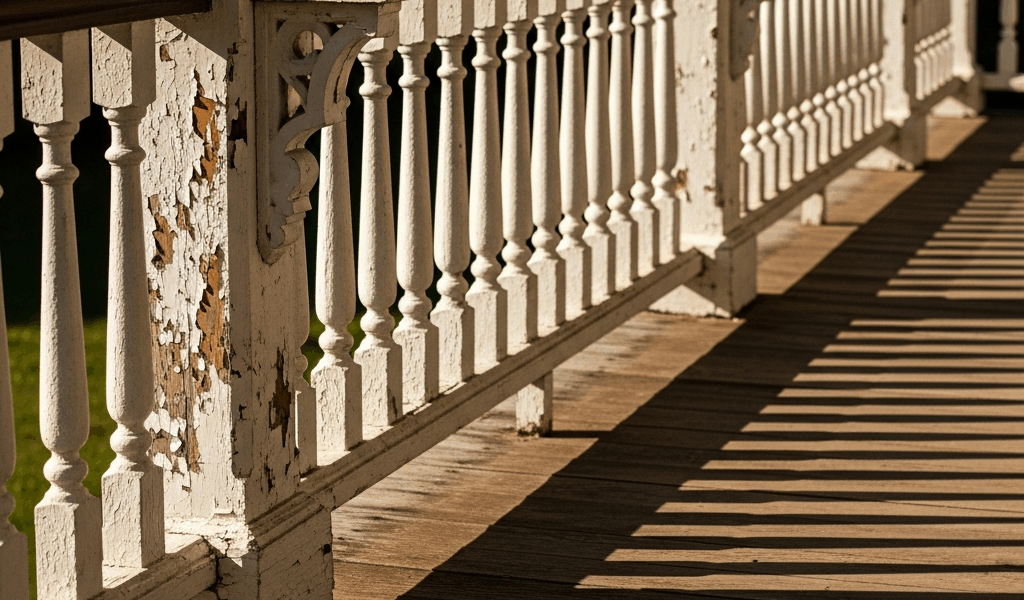
Railing style matters enormously. Authentic Victorian railings follow specific patterns tied to regional building codes and local preferences. Spindle spacing was typically 3–4 inches center-to-center. Handrails sat at 32–34 inches high. Modern replacements often deviate from these measurements to meet current safety codes. A porch with railings that feel slightly “off” dimensionally often indicates later renovation. Original railings also show consistent wear patterns — weathering and paint age should match across the entire structure if nothing’s been replaced.
Paint layering reveals timeline details. Using a small scraper on an inconspicuous spot — underside of a railing, perhaps — examine how many paint layers exist. Original porches built in 1895 might show 10–12 distinct layers. A section repainted twenty years ago might show only 3–4 layers. Mismatched paint history across different sections signals partial rebuilding.
Foundation settling creates natural cracks. Porches that settled with the original house show consistent cracking patterns across the full perimeter. Later additions might show cracking in only certain sections, or no settling damage at all, which seems good but actually suggests it’s been rebuilt. Real age looks messy. Uniformly perfect condition suggests renovation.
Why This Detail Still Matters for Your Home Today
I grew up in a house with a deteriorating Victorian porch. My parents ignored it for years, told themselves it was “just decorative.” By the time they addressed the damage, the repair bill exceeded $12,000 because water had rotted the interior support structure. That taught me something: porches aren’t optional details.
For resale value, original wraparound porches command a measurable premium. Comparable Victorian homes without them sell 6–8% lower on average, depending on the market. Buyers recognize them as authentic markers — proof the house hasn’t been aggressively modernized. Character matters. Authenticity sells.
More practically, original porches define how you can actually use your property. An authentic wraparound stays cooler naturally through cross-ventilation. Modern additions often ignore this entirely, creating hot, unusable spaces. If you’re considering extended outdoor living, understanding whether your porch is original changes whether it’ll function the way Victorian owners intended.
Restoration priorities shift too. An original porch worth $40,000 to save demands different decisions than an 1970s addition worth $8,000 to remove and rebuild. Authenticity determines whether you restore in period-appropriate style or modernize without guilt.
Common Mistakes Restorers Make With Victorian Porches
I’ve watched homeowners pour money into porches only to make them worse.
The biggest mistake: modern materials masquerading as period-appropriate work. New composite railings, vinyl flooring, pressure-treated lumber — it fundamentally changes how a porch functions and looks. Victorian porches used solid wood that weathered gracefully. Composite materials don’t age the same way. They stay plasticky, never acquiring the patina of authentic aging. If you’re keeping an original porch, keep original materials. Yes, you’ll repaint. Yes, you’ll replace rotted sections. Use matching period lumber and finishes.
Oversized repairs destroy character. I’ve seen entire porch floors replaced when only 20% was actually rotted. Partial replacement preserves the wear patterns and evidence of use that give a porch authenticity. Don’t rip everything out because one section failed.
Railing “upgrades” are nearly universal mistakes. Modern building codes demand 4-inch spheres can’t pass through railings — a safety standard. But authentic Victorian railings often use spindle spacing that’s tighter than this. Some restorers compromise by adding modern balusters while keeping original structure. This creates visual chaos — old posts with new spindles. If codes require changes, do it honestly. Replace the full railing in appropriate style rather than half-measure it.
Removing vines is another common error. Clematis, wisteria, climbing roses — they’re not destroying your porch. They’re doing their original job, providing shade and cooling. I’ve seen owners strip these away for a “cleaner” look, then spend thousands trying to keep the newly exposed porch from overheating and warping. The plants were part of the system.
Understanding why Victorian homes have wraparound porches changes how you see them. They’re not quaint affectations. They’re engineered solutions to real problems. When you’re evaluating a Victorian home or planning restoration work, that perspective matters. The porch isn’t decorative. It’s structural, historical, and still functional if you respect what it actually is.



Stay in the loop
Get the latest classic architecture today updates delivered to your inbox.