What Actually Makes a House a Craftsman Bungalow
Identifying Craftsman bungalows has gotten complicated with all the builder-grade imitation flying around. As someone who has spent years crawling through open houses, renovation projects, and century-old neighborhoods with a notepad, I learned everything there is to know about spotting the real thing versus a dressed-up knockoff. Today, I will share it all with you.
But what is a Craftsman bungalow? In essence, it’s a modest American home style built primarily between 1905 and 1930, rooted deepest in California, that pushed back hard against Victorian excess and the rise of factory-made ornament. But it’s much more than that. It’s a philosophy — honest materials, visible structure, nothing decorative that doesn’t also do a job. Every exposed rafter tail, every tapered column, every thick wood mantel is there because it means something.
By the time you finish reading, you’ll walk up to any house and know whether it’s genuinely Craftsman or just wearing the costume. You’ll spot the developer homes from 2003 that somebody dressed up with vinyl columns and called it done. So, without further ado, let’s dive in.
The Porch Is the First Thing That Gives It Away
The porch is the face of a Craftsman bungalow. It does not lie.
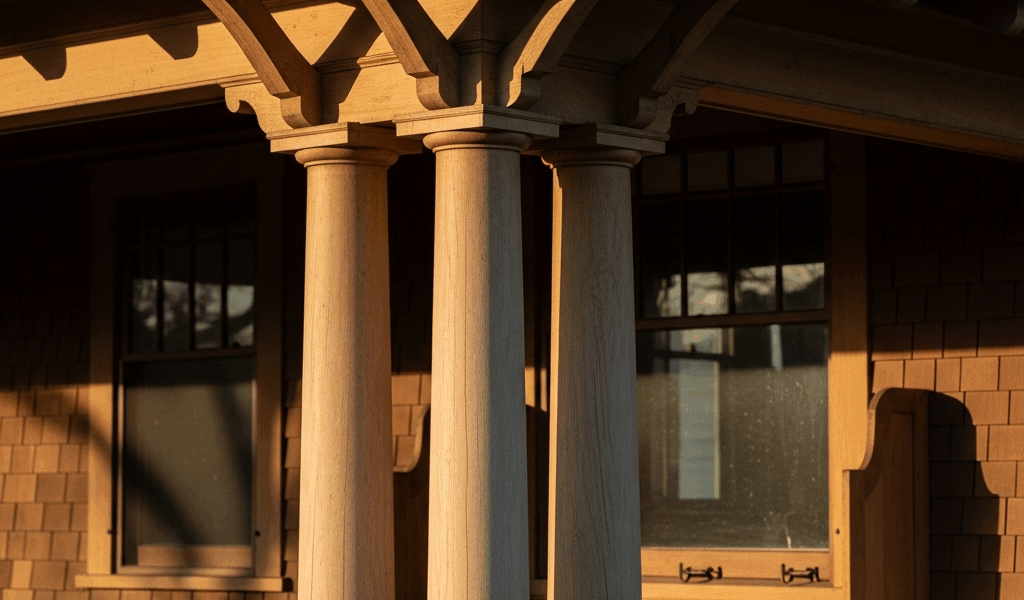
Look at the columns first. Real Craftsman porches use tapered or square columns — wider at the base, narrowing slightly toward the top. These columns don’t just sit on the deck boards. They sit on substantial piers: brick, stone, or poured concrete, typically 18 to 24 inches tall. The piers are load-bearing anchors. They’re built to outlast everyone currently living on the block. The columns themselves run 6 to 8 inches square at the base, sometimes more on larger homes.
The porch roof is low-pitched and extends well past the columns — 18 to 36 inches of overhang, sometimes deeper. That’s not decoration. That overhang is keeping afternoon rain off anyone sitting in a porch chair in 1914, same as it’s doing right now.
Look up at the underside of that overhang. Exposed rafter tails. The ends of the actual roof rafters, left visible on purpose — usually 6 to 10 inches deep, evenly spaced. Run your hand underneath. You should feel distinct wood members, not a flat painted surface. That detail shows up on authentic Craftsman homes from Pasadena to Portland to Chicago’s North Side.
The fake version — and I’ve seen this fail on enough recent construction to know it cold — uses thin round columns planted directly on the deck with no pier underneath. Hollow vinyl. Sometimes cheap pine stained to look heavier than it is. No base, no substance. The porch roof sits steeper, closer to the house wall, with minimal overhang. The soffits are smooth painted aluminum. No rafter tails anywhere. None of it reads as intentional. It reads as cost-cutting on a $287,000 spec home.
Stand back. Squint. Does that porch feel like it could hold a rocking chair and two people on a Thursday afternoon? Or does it feel like set dressing?
Rooflines and Overhangs You Will Not See on Other Styles
Probably should have opened with this section, honestly. That low roof profile is the first thing your eye catches when you’re rolling down a street lined with Craftsman bungalows. They sit lower, wider, more grounded than anything built around them.
The pitch is shallow — usually 5/12 to 7/12. For every 12 inches of horizontal run, the roof rises 5 to 7 inches. That creates a gabled or hipped profile that looks almost tucked in against the lot, like the house is settling its weight into the ground on purpose.
Gabled ends often carry triangular knee braces — heavy wooden brackets set into the gable angle. These aren’t nailed on for looks. They’re transferring roof load down into the walls. You’ll see them in pairs, sometimes four across a single gable end. Typically 2×6 or 2×8 dimensional lumber, chamfered on the edges. That chamfer is a small detail. It matters.
Wide overhanging eaves run the perimeter. Under those eaves: fascia boards, often 1×10 or 1×12, thick and flat. Gutters on original homes are copper gone green, or galvanized steel that’s been painted so many times the drip edge has lost its sharpness. Original copper gutters on a 1918 bungalow look dark brown or verdigris. That’s not neglect. That’s 106 years of honest weathering.
Dormers, when they exist, feel integrated. They mirror the main roof pitch. They use the same materials. They look like part of the design — because they were designed in, not added during a 1970s renovation when someone needed a second bathroom upstairs.
Prairie Style homes overlap with Craftsman bungalows geographically and chronologically. Both use shallow roofs and wide overhangs. But Prairie Style pulls everything horizontal — long lines, low walls, expansive. Craftsman bungalows are compact. That’s what makes them endearing to us enthusiasts. They feel rooted, specific, human-scaled.
Interior Details That Separate Authentic from Imitation
Walk through the front door. Look at the fireplace.
An authentic Craftsman fireplace is a built structure — not a prefab insert surrounded by a tile kit from a big-box store. The surround is brick, river stone, or handlaid tile. The mantel is thick solid wood, often 1×12 or heavier, sitting at roughly 48 to 52 inches from the floor — comfortable eye level when you’re standing in the room. Natural finish or warm stain. Simple edge profile: a chamfer, a subtle bevel. No heavy turnings, no appliqués, nothing that looks like it was ordered from a Victorian catalog.
Flanking the fireplace: built-in shelving. Square edges, often with a back panel, sometimes open. Built on-site, nailed into the walls. They feel permanent because they are permanent — they’ve been there since Woodrow Wilson was president. Brackets support the shelves: simple metal or wood, not invisible floating hardware.
Box-beam ceilings run through living rooms and sometimes bedrooms. These aren’t true structural beams — they’re furred-down ceiling sections with 4×4 or 6×6 members applied underneath, creating the impression of heavier construction. That’s an honest illusion. Craftsman philosophy at work: show the structure, even when it’s slightly theatrical about it.
Picture rails run at about 36 inches up the walls. Simple L-shaped profile, painted or stained to match trim. These existed so you could hang a framed print without driving a nail into the plaster. Practical. Intentional.
Trim throughout — door frames, baseboards, window casings — is thick and flat. No ornate ogee molding. No corner rosettes. Simple stops and bevels. Baseboards run 6 to 8 inches tall. The wood feels like it was built to outlast the people who installed it, which it has.
Here’s where renovations go wrong — and don’t make my mistake of overlooking this during a walkthrough. New owners gut the original built-ins and install floating shelves thinking that’s somehow more authentic. It isn’t. They skim-coat over beam details, paint everything white, sand original finishes down to bare wood. These aren’t upgrades. They’re erasures.
Original hardwood floors are quarter-sawn oak, maple, or Douglas fir — simple border inlays in contrasting wood. Not parquet. Not herringbone. Simple geometry that doesn’t compete with everything else happening in the room. If you see laminate or sheet vinyl, that’s a later installation. Someone covered the good stuff.
Hardware, Windows, and the Small Details That Matter
Walk close to a window. Real Craftsman windows are double-hung with a 6-over-1 or 8-over-1 pane configuration. The upper sash has six or eight small panes divided by muntins. The lower sash is one single pane of glass. Frustrated by expensive large-format glass manufacturing in 1910, builders used divided upper sashes to keep costs manageable while still giving occupants a clean sightline from seated height through that solid lower pane. Function drove the design. It always did.
Art glass transoms above doors and sidelights appear throughout authentic homes — geometric patterns in simple straight lines, occasionally with colored glass accents in amber, brown, or muted green. Earth tones. Nothing flashy.
Door hardware tells you a lot fast. Look at the locksets and hinges. Authentic pieces are hammered or oil-rubbed bronze — often stamped with a manufacturer’s mark on the backplate. Mission-style backplates are square or rectangular, no flourish. Bright polished brass or chrome finishes didn’t live on Craftsman homes. I’m apparently a hammered-bronze person, and Emtek’s Mission line works for me while modern lever hardware never quite reads right on a 1920s door.
This new approach to hardware — matching original profiles in modern reproductions — took off several years ago and eventually evolved into the cottage industry enthusiasts know and rely on today. You can find period-correct replacements for nearly everything now, which makes authentic restoration genuinely achievable on a budget.
While you won’t need to rebuild a bungalow from scratch, you will need a handful of reference points to assess what you’re looking at. First, you should learn the column-and-pier combination — at least if you want a reliable single test that works from the street. The window configuration might be the best secondary check, as Craftsman identification requires details that read from close range. That is because porch structure is visible at a distance, but glass patterns demand you get within arm’s reach.
Quick checklist — five things that confirm authenticity:
- Tapered columns on masonry piers with exposed rafter tails
- Shallow roof pitch with integrated dormers and knee braces
- Built-in shelving flanking a brick or stone fireplace
- 6-over-1 or 8-over-1 double-hung windows
- Simple, flat, thick trim throughout
Five things that suggest heavy remodeling or imitation:
- Round columns with no piers; smooth aluminum soffits
- Steep roof pitch; minimal eaves
- Floating shelves; white painted box beams
- Single-pane or modern vinyl windows
- Ornate molding; thin trim; modern finishes


Stay in the loop
Get the latest classic architecture today updates delivered to your inbox.