Prairie Style Architecture — What Makes Frank Lloyd Wright Homes Different
Prairie style architecture has gotten complicated with all the Craftsman comparisons flying around. And honestly, I get it — I was guilty of the same confusion for years. About eleven years ago, I found myself on a sidewalk in Oak Park, Illinois, visiting a friend on a slow afternoon, when someone suggested we wander the neighborhood where Wright built his early houses. I figured it’d be casual. A nice walk, some old houses, maybe grab coffee after. Instead I planted myself in front of the Thomas House on Forest Avenue for a full twenty minutes, genuinely stumped by why it looked so unlike every other house I’d ever found beautiful. I’ve been chasing that feeling ever since. What you’re about to read is what I wish someone had handed me on that sidewalk.
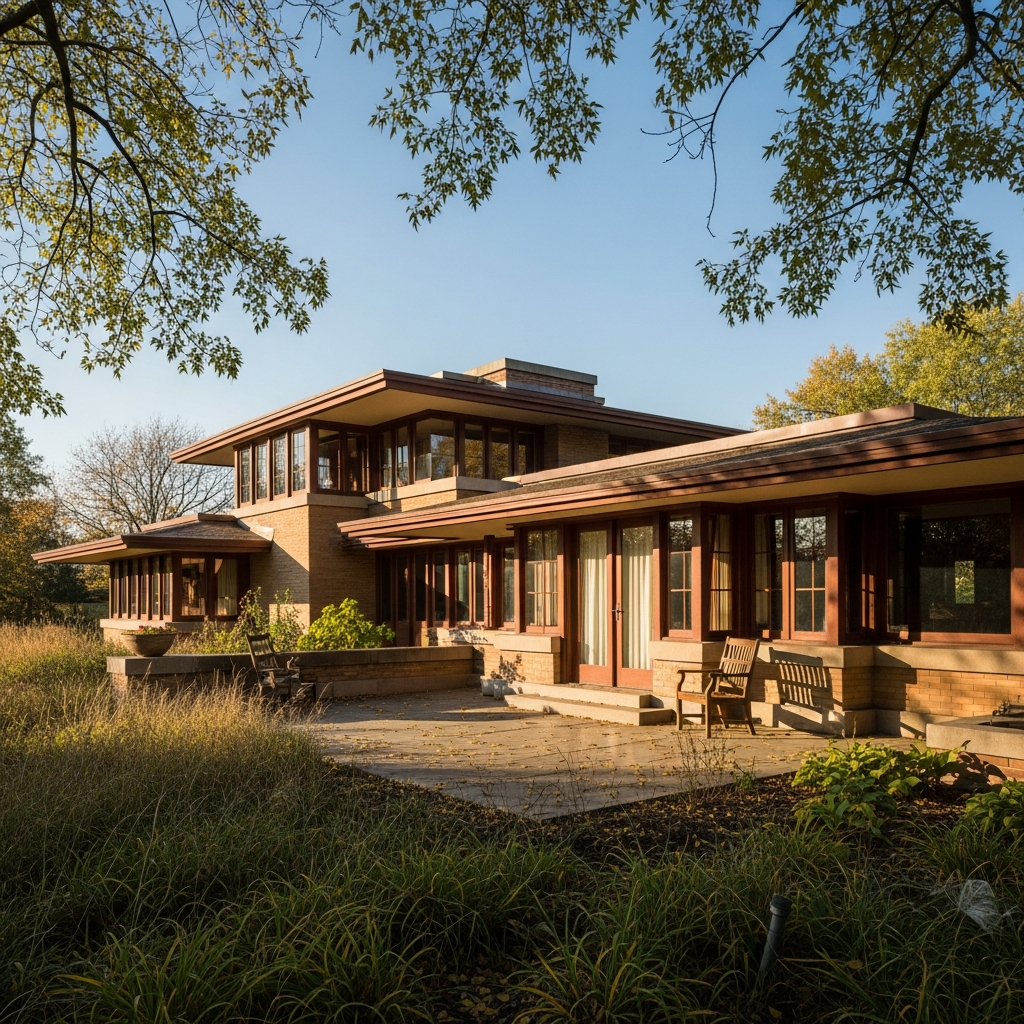
Prairie gets lumped in with Craftsman constantly. The confusion is understandable — both movements emerged around the same time, both were pushing back against fussy Victorian excess, and both cared about natural materials. But they are genuinely different things. Different philosophies, different geometries, different relationships to the land. If you’ve ever stood in front of a house and known it was something but couldn’t name it, this is your guide.
Prairie Style in 30 Seconds
But what is Prairie style? In essence, it’s an American design movement developed primarily between 1900 and 1920, centered in the Midwest, and most closely associated with Frank Lloyd Wright and a loose group of Chicago architects who became known as the Prairie School. But it’s much more than that. The name comes from Wright’s stated goal of creating homes that echoed the flat, expansive American prairie — buildings that belonged to their site rather than sitting on top of it like transplants from somewhere else.
The visual vocabulary is specific enough that once you know it, you see it everywhere.
The Horizontal Line — Almost a Religion
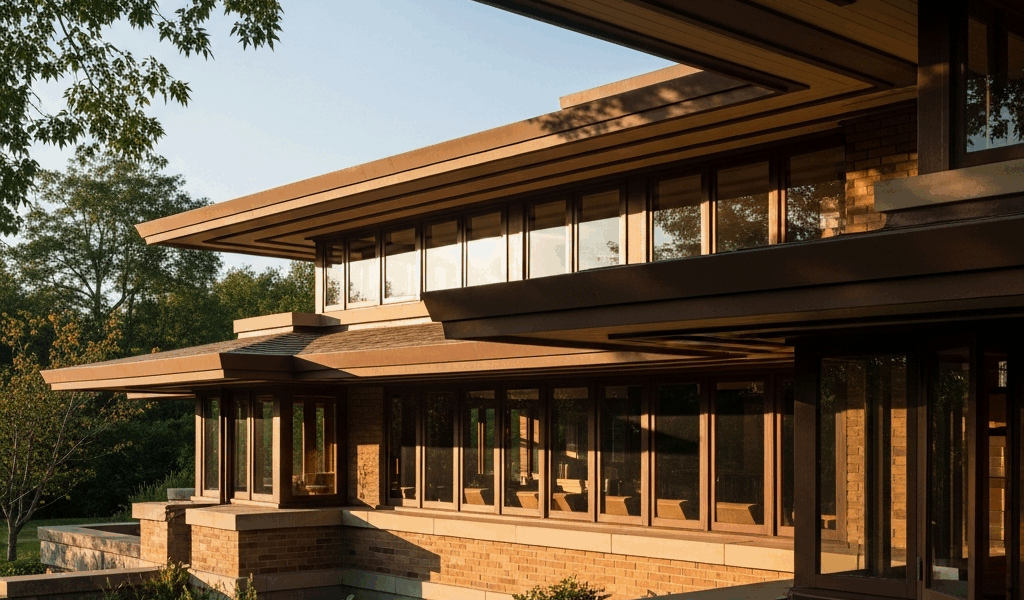
Wright was obsessed with the horizontal. He elongated everything he could — the roofline, the windows, the brickwork coursing, the built-in furniture, the overhanging eaves. At the Robie House in Chicago, the main roof overhangs extend roughly five feet beyond the walls. Five feet. That’s not a quirk. That’s a declaration. He wanted the house to hug the earth, to feel like it was growing out of the ground rather than stacked on top of it. He even had bricks manufactured to a custom proportion — the Roman brick, roughly 11.5 inches long by 1.5 inches tall, much wider and flatter than standard — specifically to reinforce those horizontal lines in the facade.
Roofs, Chimneys, and the Hearth as Anchor
Prairie roofs are typically low-pitched hipped roofs or flat roofs with deep overhanging eaves. No steep gables trying to puncture the sky. The silhouette stays close to the horizon. And at the center of most Prairie homes sits a massive masonry chimney — not decorative, not tucked away, but deliberately placed at the literal and symbolic heart of the house. Wright believed the hearth was the nucleus of domestic life, so he organized entire floor plans around it. Every room radiates outward from that central mass.
Ribbon Windows and the Connection to Outside
Prairie homes use windows differently than almost any residential architecture that came before them. Instead of individual punched windows sitting in solid walls, Wright used continuous bands — ribbon windows — that wrap corners, line entire walls, and dissolve the barrier between interior and exterior. Many of these windows are art glass: geometric leaded designs in amber and green that filter light the way a forest canopy does. Standing inside a Prairie home on a sunny afternoon feels genuinely different from standing inside a Victorian or Colonial. The light arrives transformed.
The Plan — Cruciform and Open
Most Prairie homes are organized on a cruciform plan — a cross shape when viewed from above. This breaks the house into four wings extending from the central chimney mass, creating dynamic spaces, exterior terraces at the corners, and a sense that the building is reaching outward in every direction. The interior is surprisingly open for its era — Wright tore out the walls separating parlor from dining room from living space, creating flowing continuous interiors decades before open floor plans became standard in American housing.
How Prairie Style Differs From Craftsman
Probably should have opened with this section, honestly. The Prairie-versus-Craftsman confusion is the single most common mistake I see in architecture discussions online, in real estate listings, and even on some historic preservation plaques. Getting it wrong matters — not just for pedantic reasons, but because the two styles come from completely different philosophical places, and that difference shows up plainly in the buildings.
Geography and Origin
Craftsman style came primarily from California. Gustav Stickley published The Craftsman magazine starting in 1901 from the East Coast, but the architectural expression most people picture — wide front porch, exposed rafter tails, tapered columns on stone piers — was perfected by Charles and Henry Greene working out of Pasadena. Prairie style came from the flat Midwest, specifically the Chicago area. The landscape shaped both movements in very real ways. Craftsman responds to California’s outdoor lifestyle and redwood forests. Prairie responds to open horizontal terrain and the desire to claim that flatness as beauty rather than something to overcome.
Philosophy — Craft vs. Organic
Craftsman drew from the British Arts and Crafts movement — handcraft, natural materials, visible construction as moral goods, a reaction against industrial mass production. The beauty of a Craftsman house is the beauty of the joint, the dovetail, the hand-hammered copper strap hinge on an oak door. Prairie style was pursuing something different. Wright called his philosophy “organic architecture” — the idea that a building should grow naturally from its site, its program, and its materials the way a tree grows from specific soil in a specific climate. Wright wasn’t nostalgic for pre-industrial craft. He wanted to use industrial methods to produce something authentically American and rooted in its specific place.
Form — Vertical vs. Horizontal
This is the visual tell. Stand in front of any house and ask yourself: does this building want to go up, or does it want to go out? Craftsman bungalows have gabled roofs with visible rafters, tapered porch columns that narrow as they rise — the dominant geometry is triangular, pointing upward. Prairie homes are aggressively horizontal. Every line pulls your eye sideways. The roof presses down. The eaves reach out. Even when a Prairie home has two stories, the proportions are arranged to minimize any sense of vertical height. This one distinction will get you to the right answer nine times out of ten.
Materials
Craftsman interiors feature dark-stained quartersawn oak, visible beam work, built-in bookcases with glass-paned doors, ceramic tile from companies like Grueby or Batchelder. Prairie interiors use Roman brick, horizontal board-and-batten, plaster walls with wood trim cut in geometric patterns — the emphasis is on geometry rather than revealed grain. Both use natural materials, but Craftsman celebrates the material’s inherent warmth and texture, while Prairie uses material in service of a spatial and geometric idea. That’s what makes Prairie endearing to us architecture obsessives — it’s ruthlessly coherent, even when it’s showing off.
Famous Prairie Style Homes You Can Visit
Reading about Prairie architecture is genuinely useful. Walking through a Prairie building changes your understanding in ways photographs simply cannot. These three are the most significant, and each one rewards a full day of your time — don’t rush them.
Robie House — Chicago, Illinois
Completed in 1910 for Frederick C. Robie — a bicycle and motorcycle manufacturer who apparently wanted something radical — the Robie House is the canonical example of Prairie style at its most mature. It sits at 5757 South Woodlawn Avenue in Hyde Park. Tours run through the Frank Lloyd Wright Trust and cost around $20 for adults as of the last time I checked. Worth every dollar. The building is extraordinary from the street, but the interior tour reveals the sequence of spaces Wright choreographed with almost theatrical precision. Living and dining areas share a continuous second-floor space — separated only by the chimney mass — with those famous five-foot roof overhangs creating covered terraces on both ends. The art glass windows are amber, gold, and green — the colors of the prairie itself across different seasons. If you visit one Prairie building in your life, make it this one.
Fallingwater — Mill Run, Pennsylvania
I know what you’re thinking. Fallingwater isn’t a Prairie house — it’s perched over a waterfall in the Pennsylvania woods, built of reinforced concrete and local sandstone, not Roman brick on a flat Midwestern lot. You’re right that it represents Wright’s mature Usonian period rather than the Prairie period proper. But Fallingwater carries every Prairie principle forward: the horizontal cantilevered planes, the integration with landscape, the cruciform organization, the central hearth as anchor. Understanding Prairie style makes Fallingwater legible in ways it isn’t otherwise. The house is operated by the Western Pennsylvania Conservancy — tours book weeks in advance, starting around $35 — and the guided experience is exceptional. Go in spring when the falls are running full.
Taliesin — Spring Green, Wisconsin
Taliesin is Wright’s personal home and studio, built starting in 1911 on land his family had farmed for generations in the Wisconsin River valley. The name means “shining brow” in Welsh — Wright built the complex on the brow of a hill, never on top of it. Taliesin is different from the Robie House in that it’s rambling, irregular, deeply personal rather than tightly composed. But it’s the building where you understand what Wright meant by organic architecture as a lived philosophy rather than a theoretical position. The complex sits on 600 acres, tours range from $30 to $70 depending on length, and the landscape alone justifies the drive. Seeing where Wright actually lived makes his work make more sense — all of it, not just the famous houses.
Prairie Style Elements in Modern Home Design
As someone who spent years obsessively tracking Prairie influences through contemporary residential architecture after that Oak Park afternoon, I learned everything there is to know about where this vocabulary shows up today. Prairie didn’t die in 1920. It went underground, resurfaced in mid-century modernism, and now influences serious contemporary residential design in ways worth understanding — especially if you’re building or renovating and want to borrow from this vocabulary intelligently.
The Open Floor Plan — A Prairie Invention
Every real estate listing celebrating an “open concept living area” owes a direct debt to Wright. The removal of walls between living room, dining room, and kitchen — which feels so natural now that buyers treat it as a baseline expectation — was genuinely radical in 1905. Wright proved it worked spatially and socially. Mid-century tract home designers borrowed it, the postwar Ranch house made it standard, and now we build essentially nothing else. The lineage is direct and largely uncredited.
Window Walls and the Indoor-Outdoor Connection
Contemporary architects working in the Prairie tradition push window walls to their logical conclusion — floor-to-ceiling glazing that eliminates the distinction between inside and outside. Firms like Lake Flato Architects in San Antonio and Bohlin Cywinski Jackson reference Prairie principles in projects that use modern materials to achieve the same spatial goals Wright was pursuing a century ago. The specific language changes — instead of leaded art glass ribbon windows, you get aluminum-framed curtain wall systems or Marvin Ultimate Casement windows in custom-width configurations. The intent is identical. Dissolve the boundary. Connect the interior to its landscape.
Low Rooflines and Horizontal Emphasis
The Ranch house — which dominated American residential construction from the late 1940s through the 1970s — is essentially Prairie style translated for mass production. Single-story, low-pitched roof, horizontal massing, integration with the landscape rather than elevation above it. Most Ranch houses are architecturally modest, but the best examples — especially custom Ranch homes by architects like Cliff May in California — demonstrate how powerful the Prairie vocabulary can be at modest scale and budget. Contemporary architects reviving the Ranch form are essentially returning to Wright’s foundational premises about domestic architecture in the American landscape. They don’t always say so, but they are.
The Central Hearth in Contemporary Terms
Wright’s organizing principle — all rooms radiating from a central hearth — shows up in contemporary design in ways that don’t always involve an actual fireplace. I’ve seen custom homes where the kitchen island plays the role of hearth, the structural and social anchor around which everything else organizes. Some architects use a staircase tower as the central mass. The specific element changes, but the principle persists: domestic space works better when it has a clear center of gravity that activities orbit, rather than a collection of equivalent rooms strung together by corridors.
A Note on Getting This Wrong
Don’t make my mistake. The error I made early on was trying to apply Prairie elements piecemeal — wide eaves here, some art glass there — without understanding the underlying logic. Prairie style isn’t a collection of features you can mix and match. It’s a coherent spatial philosophy that generates those features. The overhanging eaves exist because Wright wanted sheltered outdoor space that transitions between inside and outside. The ribbon windows exist because Wright wanted to dissolve the wall as a barrier. The horizontal brickwork exists to reinforce the connection to the earth. Pull any element out of context and it looks arbitrary. Understand the logic and every element becomes inevitable.
Go to Oak Park. Walk slowly. Stand in front of the buildings longer than feels comfortable. The education is right there on the street, and it’s free.


Stay in the loop
Get the latest classic architecture today updates delivered to your inbox.