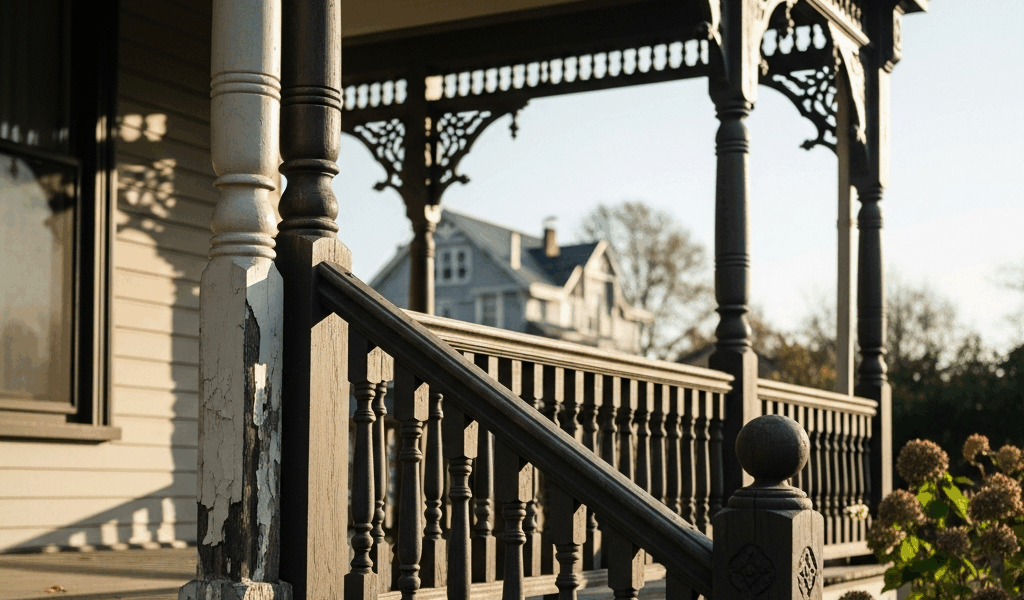
My neighbor’s Victorian porch railing cost $12,400. I know this because I watched the installation over three weekends in September, asked questions every time I walked by, and eventually got invited onto the porch to see the finished product up close. What I learned about the real cost of period-accurate exterior woodwork changed how I think about restoring any historic home.
Here is the full breakdown of what that railing actually involved — and what you can do instead if your budget is closer to $3,000 than $13,000.
Why the Original Railing Failed
The house is an 1892 Queen Anne Victorian in a historic district in Savannah, Georgia. The original porch railing had turned spongy over the past decade — water infiltration through cracked paint had reached the structural posts, and a contractor found active termite damage in two of the six balusters sections. The railing was not just cosmetically damaged; it was a safety hazard. The historic district commission required replacement in kind, meaning the new railing had to match the original design, materials, and dimensions.
“In kind” sounds straightforward until you start pricing it. The original railing used old-growth heart pine — a wood species that is essentially unavailable in new-milled form because the virgin longleaf pine forests it came from were logged out by the 1920s. The balusters were turned on a lathe in a pattern specific to this house: a vase-and-ring profile with a slight entasis (outward curve) in the main shaft.
The $12,400 Breakdown
My neighbor hired a millwork shop in Brunswick, Georgia, that specializes in historic reproduction. Here is what the project cost:
- Material (reclaimed heart pine): $3,200. The shop sourced timber from a demolished textile mill in Macon. Reclaimed heart pine runs $8 to $14 per board foot depending on grade and width. The railing required approximately 280 board feet after accounting for waste from turning and shaping.
- Milling and turning: $4,800. This covered 42 balusters, six newel posts, the top rail, and the bottom rail. Each baluster required individual lathe work to match the original profile. The shop made a custom turning template from one of the least-damaged original balusters.
- Installation: $2,600. Two carpenters worked three days. The porch deck had to be partially pulled up to set the newel posts into the floor joists (per the original construction method). The balusters are mortised into both rails — not face-nailed, which is the shortcut most modern builders take.
- Priming and painting: $1,800. This was not a DIY paint job. The historic commission required an oil-based primer (Zinsser Cover Stain) followed by two coats of Sherwin-Williams Duration exterior in a specific color match (SW 7012 Creamy, which matched the house’s documented 1904 color scheme). The paint was applied by brush, not sprayer, to match the original brush-mark texture visible in historic photographs.
Where the Money Actually Goes
I assumed the biggest cost would be the reclaimed wood. It was not. The labor for custom turning was the single most expensive line item at nearly 40 percent of the total.
I visited the Brunswick shop to understand why. The turner, a man named Curtis who has been doing this work for 22 years, showed me the process. Each baluster starts as a rough-sawn blank about 2.5 inches square and 32 inches long. He centers it on the lathe, rough-turns it to a cylinder, then uses a series of gouges and skew chisels to cut the vase-and-ring profile. The entasis curve is the tricky part — it requires freehand tool control with no template guide, just the original baluster mounted on a reference board behind the lathe.
“A production shop with a CNC lathe could do these faster,” Curtis told me. “But CNC leaves tool marks in a spiral pattern that you can see under paint. Hand-turned balusters have straight tool marks parallel to the axis. On a painted railing it probably does not matter to most people, but the commission’s inspector knows the difference.”
Each baluster takes Curtis about 25 minutes. At 42 balusters, that is roughly 17.5 hours of lathe time alone, not counting setup, sanding, or the newel posts (which are more complex and take about 90 minutes each).
The $3,000 Alternative That Actually Looks Good
Not everyone lives in a historic district with an architectural review commission. If you have a Victorian porch that needs a new railing and your budget is limited, here is what I would recommend based on what I learned:
Option 1: CNC-turned poplar ($2,800 to $4,200). Several suppliers sell CNC-turned balusters in standard Victorian profiles. Poplar is a hardwood that machines well, takes paint beautifully, and costs about $3 per board foot versus $10 or more for reclaimed heart pine. The main suppliers I found are Vintage Woodworks in Fredericksburg, Texas, and Cumberland Woodcraft in Carlisle, Pennsylvania. Both offer custom profile matching from a photograph or sample baluster.
The poplar will not last as long as heart pine in exposed conditions — expect 15 to 20 years with proper maintenance versus 40 or more for heart pine. But at one-third the price, you can afford to replace it once and still come out ahead.
Option 2: Composite with paint-grade finish ($1,800 to $3,000). Fypon and several competitors make polyurethane baluster systems in Victorian profiles. I was skeptical until I saw an installation on a house on East Gaston Street in Savannah that had been up for four years. At porch-viewing distance (8 to 10 feet), I could not tell it from wood. Up close, the surface texture is too uniform — it lacks the grain telegraphing you get with painted wood — but it is genuinely hard to spot.
The downsides: composite does not take paint the same way (it tends to peel if the surface is not properly prepared), it cannot be mortised (it attaches with screws and adhesive), and it expands and contracts differently than wood, so the joints can open up in extreme temperature swings.
Option 3: Mix materials ($2,200 to $3,800). This is what a contractor in the Savannah area recommended as the best value. Use real wood for the newel posts and top rail (the parts people touch and see up close) and CNC-turned poplar or composite for the balusters (which are seen from a distance and take less abuse). This gives you the look and feel of a wood railing where it matters, with cost savings where it does not.
Maintenance: The Cost Nobody Quotes
Whatever material you choose, the railing is only as durable as the paint system protecting it. My neighbor’s contractor gave him a maintenance schedule: inspect annually, spot-prime any cracks or chips within 30 days, and repaint completely every 5 to 7 years. The full repaint will cost $800 to $1,200 each time.
The most common failure mode for Victorian porch railings is not rot or termites — it is paint failure at the baluster-to-rail joint. Water sits in that joint and wicks into the end grain. Curtis, the turner, told me the single most important thing you can do is seal the end grain with a penetrating epoxy (he recommends Smith’s Clear Penetrating Epoxy Sealer) before priming. “That one step adds five years to the life of every baluster,” he said.
My neighbor’s $12,400 railing will probably outlast both of us if it is maintained. But for most homeowners, a $3,000 poplar railing with good paint and annual maintenance will look just as good from the sidewalk and last long enough to be someone else’s problem. The key is understanding what you are actually paying for — and deciding where the money matters to you.


Stay in the loop
Get the latest classic architecture today updates delivered to your inbox.