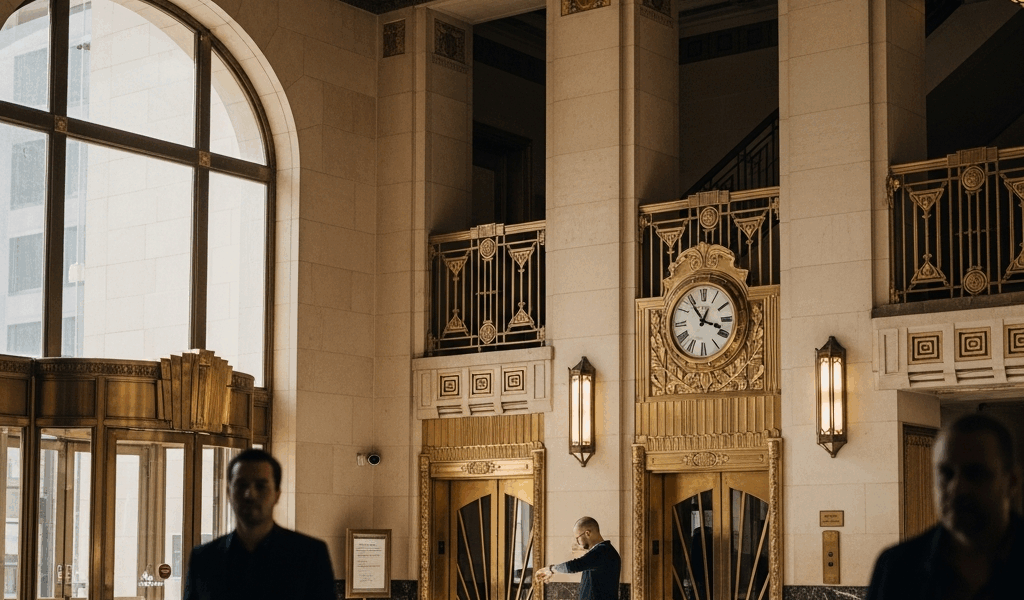
Most people visit Chicago for the skyscrapers. The Tribune Tower, the Wrigley Building, Willis Tower — they dominate every architecture tour. But if you take the Brown Line to the Loop and start looking at lobby level instead of up, you will find something the guided tours skip entirely: a concentration of Art Deco interior detailing that rivals anything in Miami or New York.
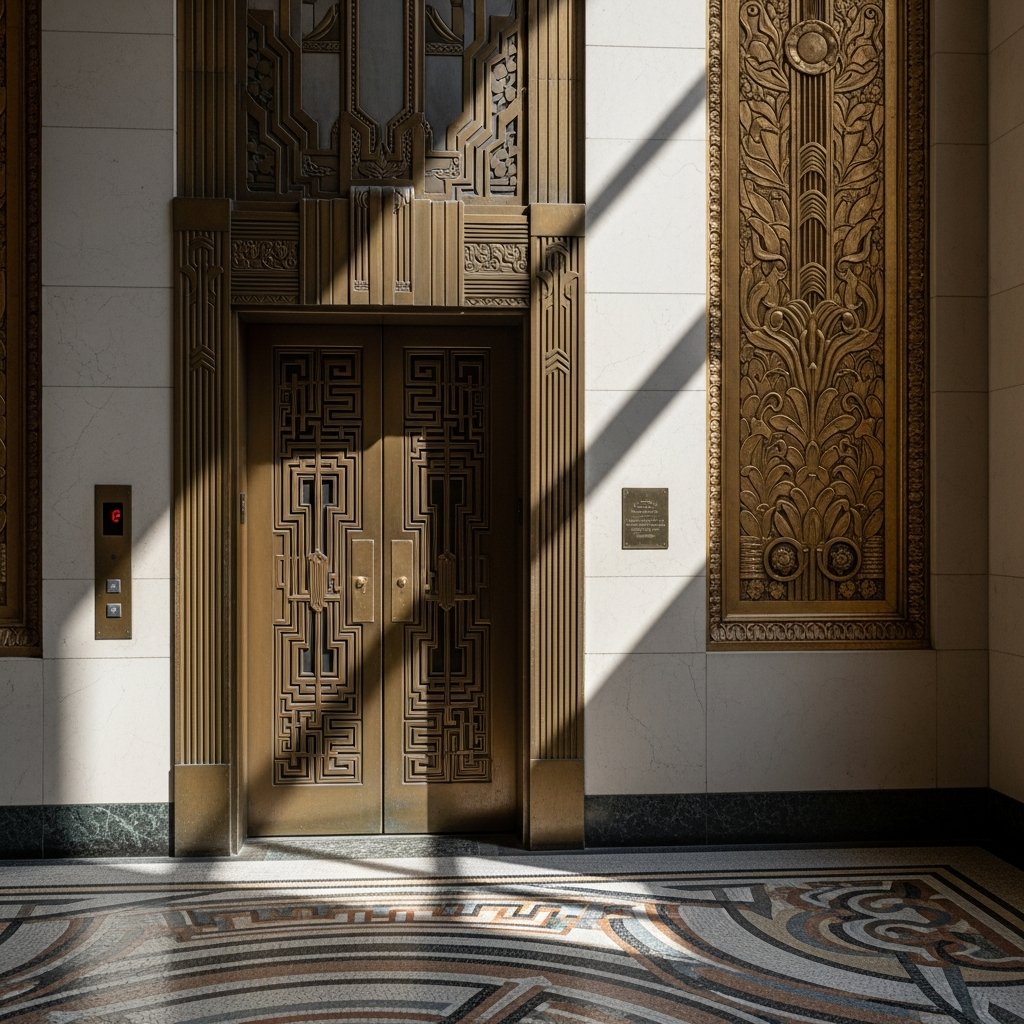
I spent a week in January walking the corridors and lobbies of buildings along LaSalle Street, Wacker Drive, and Michigan Avenue. I was looking specifically for the decorative metalwork, terrazzo floors, and elevator surrounds that define commercial Art Deco — the stuff that gets covered up by dropped ceilings and drywall during office renovations.
The Chicago Board of Trade Building (141 West Jackson Boulevard)
Start here. The CBOT lobby is the single best public Art Deco interior in the Midwest, and most Chicagoans have never been inside.
The building was designed by Holabird and Root and completed in 1930. The three-story lobby features cascading nickel-silver light fixtures, walls of Kasota stone (a warm cream-colored Minnesota limestone), and a series of allegorical panels in cast aluminum depicting the grain trade. The elevator doors are worth a special trip: each pair features geometric wheat sheaf patterns in brushed chrome that catch the light differently depending on where you stand.
When I visited, a building engineer named Carlos walked me through the mechanical room behind the lobby. The original mail chutes — polished brass tubes that ran from the 45th floor to the mailroom — are still in place, though no longer in use. The Art Deco detailing extends even here: the chute brackets are cast in a stepped zigzag pattern that matches the building’s crown.
The building is open during business hours. Walk in like you belong there, because you do — it is a public lobby. The security desk may ask where you are going; say you are visiting the observation area or the CBOT visitor gallery.
One North LaSalle (1 North LaSalle Street)
This 1930 building by Vitzthum and Burns has a lobby that most people walk through without looking up. That is a mistake. The ceiling is a barrel vault covered in gold-leaf mosaic tiles depicting stylized celestial motifs — suns, moons, and geometric star patterns. It was restored in 2014 by Conrad Schmitt Studios of New Berlin, Wisconsin, at a cost that building management described to me only as “significant — seven figures.”
The terrazzo floor is equally remarkable. It uses a color palette of deep green, cream, and burgundy in a pattern of interlocking chevrons and zigzags. I got on my hands and knees to look at the brass divider strips separating the colors — each one is hand-set, not machine-cut, which means slight variations in width that give the floor a warmth you cannot get from modern pour-in-place terrazzo.
The building manager, Patricia Reyes, told me that maintaining the terrazzo requires a specialized crew from a company in Cicero that does nothing but historic floor restoration. They grind and polish the lobby twice a year. “You cannot use standard floor machines,” she said. “The brass strips will pop out. Everything is done with hand grinders and then sealed by hand.”
The Carbide and Carbon Building (230 North Michigan Avenue)
Now the St. Jane Chicago hotel, this 1929 Burnham Brothers building is famous for its dark green terra cotta exterior with gold leaf trim — supposedly inspired by a champagne bottle. But the interior tells a different story.
The original lobby has been modified for hotel use, but the elevator bank retains its bronze doors with geometric fan patterns. I asked the front desk manager if I could see the original mail lobby on the second floor. It has been converted to a meeting space, but the original bronze mailbox bank is still mounted on the east wall — 200 individual boxes with Art Deco numbering plates that use a custom typeface designed specifically for this building.
A bellhop named Derek, who has worked at the building since before the hotel conversion, pointed out something I would have missed: the lobby floor is not marble, as it appears. It is a poured composite material called Zenitherm, developed in the 1920s as a marble substitute. “They do not make it anymore,” he said. “When a section cracks, the restoration people have to color-match a modern epoxy to fill it. They have been doing that since the 1990s.”
The Pittsfield Building (55 East Washington Street)
This is the sleeper on the list. The Pittsfield Building, designed by Graham, Anderson, Probst and White in 1927, has a two-story arcade that most people use as a shortcut between Washington and Randolph streets without noticing the details.
Look up in the arcade. The ceiling panels are cast plaster with geometric rosette patterns, painted in muted gold and sage green. The original color scheme was documented by a restoration architect from Wiss, Janney, Elstner Associates during a 2008 survey, and the current colors are based on that paint analysis. Below each ceiling panel, polished brass sconce fixtures with frosted glass shades provide warm, indirect lighting that makes the arcade feel like an Art Deco jewelry box.
The retail spaces along the arcade include several watch repair and jewelry shops that have been there for decades. One jeweler, who has operated from the same storefront since 1987, told me the building’s ownership has been good about maintaining the common areas. “They know the arcade is what makes this building special,” he said. “You take that away and it is just another office tower.”
What You Will Not Find on Google
The reason these details are worth seeing in person is that most of them are not documented online. The Chicago Architecture Center’s tours cover the exteriors; the interiors are treated as private office space even when they are technically public lobbies. There is no comprehensive guide to Chicago’s Art Deco interiors — the closest thing is David Garrard Lowe’s Lost Chicago, which focuses on what has been demolished rather than what survives.
A few practical notes for anyone planning a similar walk:
- Timing matters: Visit lobbies during business hours (8 AM to 5 PM weekdays). Many buildings lock their lobbies on weekends, and the lighting is better during the day anyway.
- Bring a flashlight: Some of the best metalwork detail is in elevator surrounds and mail lobbies that are dimly lit. A small LED flashlight reveals casting details you cannot see otherwise.
- Talk to building staff: Engineers, security guards, and longtime tenants often know more about the architectural details than the building ownership does. They see these details every day and most of them are happy to talk about what they have noticed over the years.
- The Chicago History Museum archive (1601 North Clark Street) has original architectural drawings for many of these buildings. Access is by appointment, but the research staff is helpful and the drawings show details that were never built or have since been removed.
Chicago’s Art Deco heritage is hiding in plain sight — you just have to look at the right altitude.


Stay in the loop
Get the latest classic architecture today updates delivered to your inbox.