Walk into almost any parking garage, pass under a highway overpass, or enter a monumental building, and chances are you’re trusting your safety to an engineering principle the Romans perfected two millennia ago. The arch, that elegant curve of wedge-shaped stones or bricks, remains one of humanity’s most successful structural innovations, as relevant today as when Augustus ruled the Mediterranean world.
The Genius of Compression
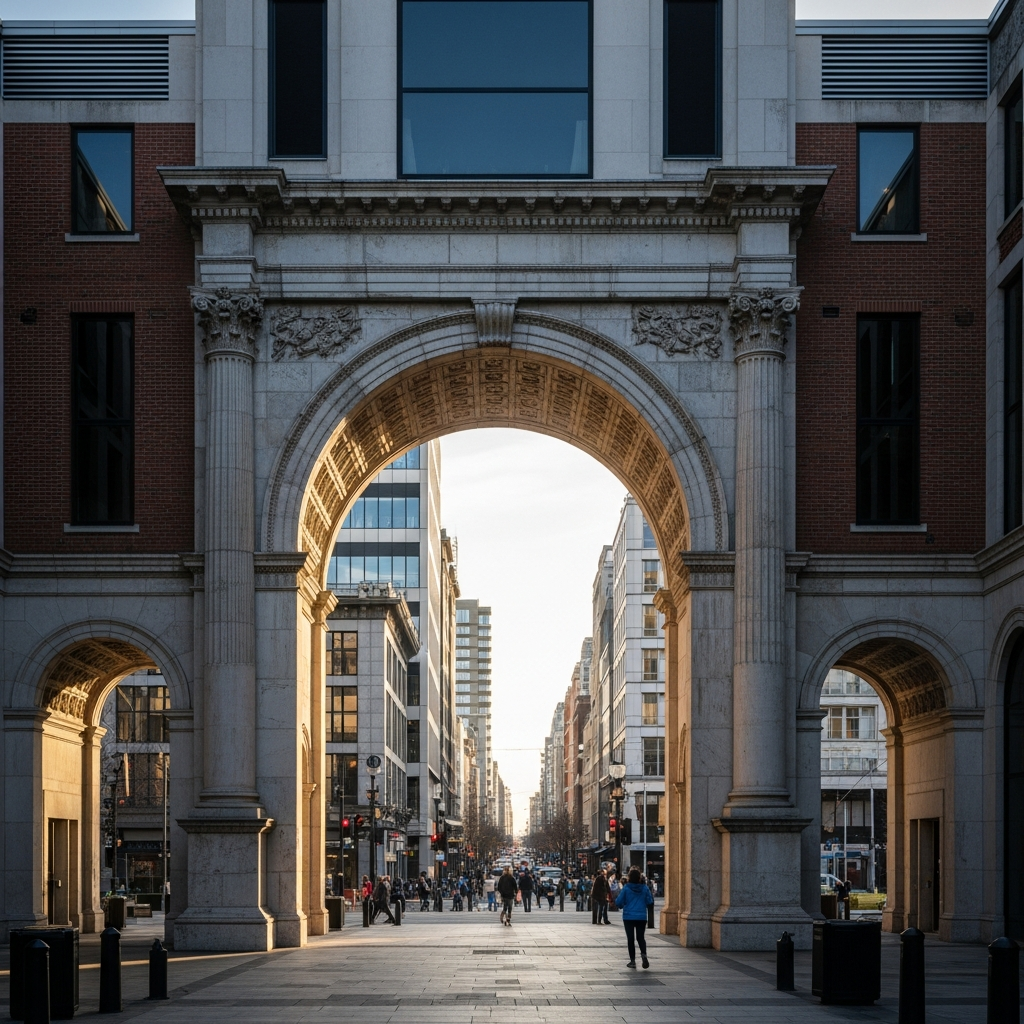
To understand why Roman arches endure, you must understand how they work. Unlike a horizontal beam, which experiences both compression (squeezing) on top and tension (stretching) on bottom, an arch transfers loads entirely through compression. Each wedge-shaped stone (or voussoir) pushes against its neighbors, and this continuous pushing translates vertical loads into outward thrust absorbed by the supporting walls or buttresses.
This matters because masonry excels at handling compression while failing quickly under tension. A stone beam can only span limited distances before its own weight creates tensile stresses that crack it apart. An arch, by contrast, can span vast openings while keeping the stone exclusively in compression, playing to the material’s strength.
The keystone, the wedge-shaped stone at the arch’s crown, doesn’t actually “lock” the arch as popular mythology suggests. Every voussoir matters equally; removing any one would collapse the structure. The keystone is simply the last placed, and its name reflects its ceremonial rather than mechanical significance.
Roman Innovation
The arch existed before Rome; the Etruscans and Mesopotamians used arched construction centuries earlier. But Roman engineers transformed the arch from a specialized technique into a universal system, combining arches with their revolutionary concrete to create buildings and infrastructure of unprecedented scale.
The Romans developed the barrel vault (an extended arch), the groin vault (two barrel vaults intersecting at right angles), and ultimately the dome (an arch rotated around its center). These innovations allowed them to roof enormous spaces without interior columns, creating the vast interiors that still astonish visitors to buildings like the Pantheon.
Roman aqueducts demonstrate the arch’s infrastructure potential. The Pont du Gard in southern France, still standing after nearly 2,000 years, carried water across a river valley on three tiers of arches stacked 160 feet high. Engineers calculated that gravity would move water across dozens of miles, and the arched bridges made it possible without requiring tunnels through every hill.
Why They Still Stand
Several factors explain the remarkable longevity of Roman arched structures. The arch form itself is inherently stable; properly designed, it only strengthens as loads increase, the compression locking the voussoirs more tightly together. Unlike tensioned structures that fatigue over time, arches in compression can theoretically last forever.
Roman construction quality also matters. Their concrete, made with volcanic ash, actually strengthens with age as the calcium-aluminum-silicate-hydrate crystite continues developing. Their stone-cutting precision created joints so tight that many arches survive without mortar.
The simplicity of the arch concept permits easy maintenance and repair. When individual stones weather, they can be replaced without dismantling the structure. The Colosseum has lost its marble cladding, been shaken by earthquakes, and had its bronze clamps stolen, yet its arched skeleton stands recognizable after nearly two thousand years.
Modern Applications
Contemporary engineers continue employing arched principles, though often in forms the Romans wouldn’t recognize. Steel arches span stadiums and convention halls. Concrete arch bridges carry highways across valleys. Even the catenary curves of suspension bridge cables relate mathematically to arch behavior, with the cables in tension rather than the masonry in compression.
Parking structures typically use reinforced concrete arches or arch-like frames to span between columns. Highway overpasses frequently employ arched or arch-derived forms to handle traffic loads. The principle remains constant: transfer loads through curved paths into supports, keeping materials in compression where they perform best.
Lessons in Durability
The survival of Roman arches offers lessons for contemporary builders concerned with sustainability and longevity. Structures designed to work with materials’ natural properties, rather than against them, last longer and require less maintenance. Simple, robust forms survive earthquakes and weathering that destroy more complex systems.
The next time you walk beneath an arch, ancient or modern, take a moment to appreciate the engineering elegance above you. That curve, refined through centuries of human experience, represents one of our species’ great intellectual achievements: understanding how to make stones float on air.


Stay in the loop
Get the latest classic architecture today updates delivered to your inbox.